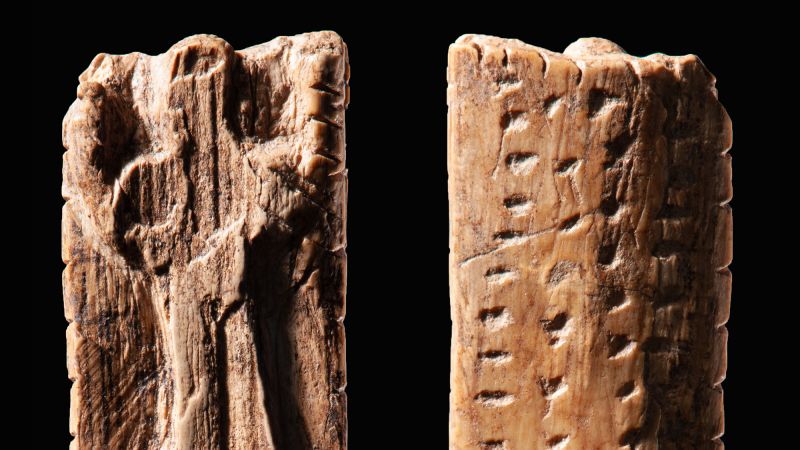
The discovery of symbols and markings on artifacts attributed to Stone Age humans, dated over 40,000 years ago, suggests a possible precursor to written language. This analysis emerged from the examination of 260 artifacts in Germany, indicating a complexity and density of information that parallels proto-cuneiform script, which originated in Mesopotamia approximately 5,300 years ago, reports BritPanorama.
The carvings, located on tools and figurines, demonstrate a level of sophistication unique to early human communication. Researchers utilized computer-assisted techniques to assess around 3,000 geometric signs, including dots, lines, and crosses, often depicting local fauna such as woolly mammoths and horses. Notably, some figurines represented human-animal hybrids, which may reflect a cultural reverence for apex predators of the time, according to the authors of the study published in the journal PNAS.
Christian Bentz, a coauthor and associate professor at Saarland University, remarked on the unexpected similarity of these markings to early proto-cuneiform: “This was really surprising to us, because we would have expected these sign sequences to not be close to either proto-writing or modern-day writing.” Similarly, Ewa Dutkiewicz, another coauthor and curator at the Museum of Prehistory and Early History in Berlin, pointed out that the era coincides with the arrival of anatomically modern humans in Europe, marking a significant cultural transition.
While the research provides intriguing insights into potential early forms of communication, the exact meanings of these symbols remain elusive. The patterns observed—such as repeated geometric shapes—distinguish them from spoken language, leading to various interpretations over the years, including their use as hunting tallies or decorative elements. Bentz expressed his surprise at the analytical results, indicating direct correlations between these ancient markings and established writing systems.
Despite these findings, attributing precise meanings to the symbols is difficult. “These are very basic geometric figures, so even if I might be pretty sure about the meaning on a specific object, it might be completely different for another one,” said Dutkiewicz, reflecting the complexities inherent in interpreting archaeological evidence.
The significance of this discovery may prompt a reevaluation of how writing and communication have evolved. “We see there is much more going on beyond written language,” Dutkiewicz noted. The study suggests that the capability to convey information through symbols existed far earlier than previously acknowledged, indicating a mental capacity for abstract thought possibly extending back tens of thousands of years.
Robert Kentridge, a psychologist at Durham University, emphasized that the sequences undoubtedly convey information, although their specific content remains unidentified. His previous research on similar artifacts connected symbols to behaviors significant for survival, such as animal reproduction cycles. This underscores the functional purpose behind what might initially appear as mere decoration.
Ultimately, the cautious approach adopted by Bentz and Dutkiewicz—eschewing definitive meanings—is preferable amid such ambiguous interpretations. The evidence from this study paints a more nuanced portrait of our ancient ancestors, countering the notion that they led primitive lives devoid of complex social or cultural constructs.
“There is sophistication in the art and the sculpture that they produced,” Kentridge remarked, highlighting how contemporary perceptions may misrepresent these early humans. As research continues to unfold, it reinforces the notion that humanity’s evolutionary journey is not only about survival but also about the development of intricate cultural expressions.