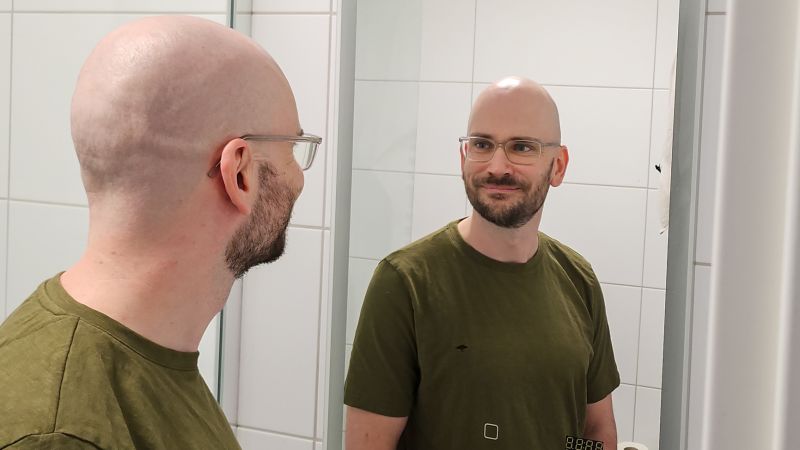
Daniel Halas recently shocked himself upon seeing his reflection after shaving his head. Walking to the bathroom in his home in Bavaria, Germany, he encountered an unfamiliar image: a smooth scalp devoid of any thinning areas or styling concerns. For a fleeting moment, he struggled to recognize himself, which gave way to a rare sense of relief, reports BritPanorama.
Watching it happen
In his late 20s, Halas observed his hair gradually thinning, a reality he was familiar with due to witnessing similar experiences among family and friends. Despite knowing the possibility existed, the onset of hair loss felt particularly frustrating, especially during a period marked by regular exercise and a focus on personal appearance.
“If you have normal hair growth, you have a lot of choice which hairstyle you wear,” he noted. “With thinning hair, there are hardly any options and very few that look good.” This narrowing of choices became a daily reminder of the uncontrollable changes taking place in his life.
Meanwhile, 21-year-old Alejandro Morales Gonzalez from Porto, Portugal, faced a different hair-related anxiety. As a devoted guitarist with hair that cascaded past his shoulders, he integrated his long locks into his identity as a future rock star. Thus, the onset of thinning hair was particularly distressing.
“Having long hair is almost a requirement,” he explained, emphasizing the effort he devoted to its care, envisioning it as a lifelong component of his look. However, as he began noticing thinning at the crown and sides, he experienced panic. “Living without hair was simply not an option,” he remarked, beginning a vigilant battle against each strand that felt out of place.
Across the Atlantic in Virginia Beach, Virginia, Kendrick Lee’s journey diverged once more. Initially mistaking severe dandruff for scalp psoriasis — a chronic autoimmune condition — his experience revolved around a persistent and visible issue that, while not painful, made him feel self-conscious. This led to consistent head covering with hats and do-rags.
As Gonzalez’s hair loss accelerated, he also resorted to hats, motivated by the appearance-focused nature of his photography career.
Despite the differing causes of their hair loss, all three men reflected a common sentiment: a profound loss of control over their appearance.
Why you’re losing your hair
Statistics reveal that by age 65, approximately 53% of men will experience some degree of baldness, with the likelihood of developing chronic conditions increasing as one ages. Hair follicles begin to slow down over time, leading to potential cessation of hair production. Other factors contributing to hair loss can include genetics, stress, and certain medications.
By age 35, two-thirds of American men will experience noticeable hair loss, rising to around 85% by age 50. Dr. Carolyn Goh, a clinical professor of dermatology at UCLA Health, identifies the most common types of hair loss as pattern hair loss and telogen effluvium. The former, influenced by family history and hormones, is known as androgenetic alopecia, while the latter is typically triggered by stressors like illness or surgery.
“The most common types of hair loss I see are pattern hair loss and telogen effluvium,” Goh noted. Additionally, conditions such as alopecia areata, where the hair may regrow as the follicles are not permanently damaged, and scarring alopecia, where the follicles are irreparably harmed, are also prevalent.
Determining the cause of hair loss often requires a thorough examination and possibly laboratory tests or a biopsy, Goh remarked. However, the psychological effects can be profound. Dr. Roberto Olivardia, a clinical psychologist, emphasizes that feelings associated with hair loss can vary; men may experience anger, frustration, sadness, or anxiety as their appearance shifts.
Trying different methods to repair the hair loss
In their respective ways, Halas, Gonzalez, and Lee explored various strategies to manage their changing hair without resorting to baldness. Gonzalez opted for shorter hair after undergoing a follicular unit extraction hair transplant and began using minoxidil, a medication known to enhance hair growth. He described initially feeling “on top of the world,” but over time, despite interventions, thinning returned.
Halas considered medication for his hair loss but ultimately declined finasteride due to concerns over potential side effects. He regarded the situation as a cosmetic issue and was reluctant to initiate a long-term commitment to treatment.
Lee consulted a dermatologist regarding his scalp psoriasis. While it was not painful, it presented a “super inconvenient” challenge, prompting him to continue wearing hats. Ultimately, all three men grew weary of the continued negotiations with their hair loss.
Choosing to shave it off
These three men, like many others, observed others living confidently as bald men. Halas expressed his frustration at seeing his hair deteriorate, saying, “Nothing half, nothing whole,” a Bavarian saying reflecting his desire for a decisive decision rather than existing in an ambiguous state.
Before a vacation in August 2024, Halas made the choice to shave his head, surprising his family with the dramatic change. Despite his initial shock, he found the clarity and finality of his decision liberating. “My self-confidence has grown a lot from it,” he stated, appreciating not just the appearance but also the decision-making power inherent in the act.
For Gonzalez, the moment of reckoning arrived on New Year’s Day this year. After watching tutorials online, he mustered the courage to shave his own head, nervously covering it initially with a beanie. When he finally revealed his shaved head to friends, he felt “over the moon,” relieved of the anxiety that had previously plagued him about his hair.
Lee’s own decision was somewhat impulsive, shaving his head at home on his birthday when he couldn’t secure a barber appointment. He had anticipated the option of covering up if he disliked his new look but instead discovered a newfound self-acceptance. “With my hair at its longest and fullest, I’ve never had as much confidence as I do with it all gone,” he reflected, noting that while teasing from friends remains a part of life, he no longer feels the need to hide.
Taking back control
Dr. Goh highlights that shaving one’s head does not guarantee thicker regrowth, challenging a common misconception. Yet, she acknowledges that the act itself can restore a sense of agency for many. “It can really give you that feeling of control back,” she asserted.
Gonzalez concurred, revealing that in shaving his head, he regained not just physical confidence but a deeper understanding of self. “Your hair is an extension of who you are,” he noted, “but in no way does it define you.”
Despite not erasing years of anxiety, the decision to shave their heads has transformed the narratives of these three individuals, allowing them to step away from the stress of hair loss into a space of acceptance and self-empowerment.