During an expedition to search for a famed shipwreck, researchers uncovered striking geometric patterns on the floor of Antarctica’s western Weddell Sea, formed by fish, reports BritPanorama.
The seafloor was previously obscured by a thick ice shelf, which changed in July 2017 when the A68 iceberg, measuring 2,239 square miles (5,800 square kilometers)—approximately the size of Delaware—calved from the Larsen C Ice Shelf. This event allowed researchers to study the previously hidden seafloor.
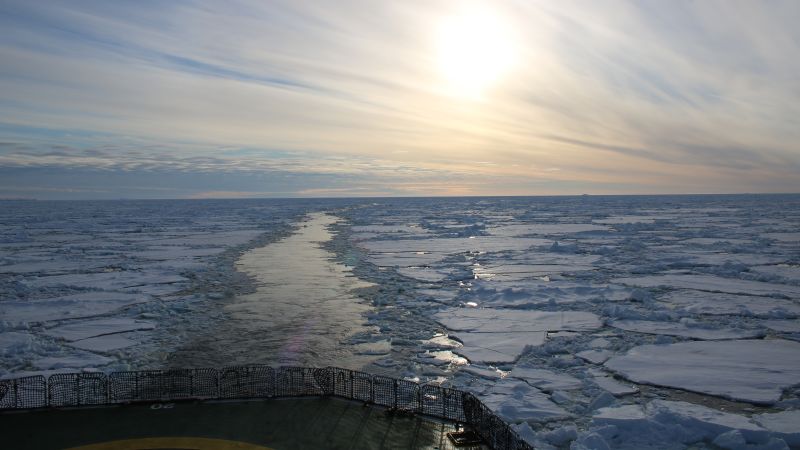
In response, an expedition was organized in 2019 with two key objectives: to explore the biology of the western Weddell Sea and to locate the wreckage of the HMS Endurance, which became trapped and ultimately was ripped apart by ice in 1915. The team set sail in January of that year aboard the South African polar research vessel SA Agulhas II for a 49-day mission but was impeded by extreme sea ice conditions reminiscent of those encountered by Endurance more than a century prior, hindering the search for the wreck.
“The sea ice in particular was a challenge as at the time there was a bottleneck and a build of sea ice around that area — we were heading directly towards this, playing chicken with icebergs as we went,” said Dr. Michelle Taylor, senior lecturer in the School of Life Sciences at the UK’s University of Essex and co-author of a study about the expedition’s findings.
Despite not locating the shipwreck, the expedition yielded valuable underwater footage revealing the marine life inhabiting the frigid depths of the Weddell Sea. The research vessel’s remotely operated underwater vehicle, nicknamed Lassie, observed a series of nests arranged in distinct shapes sprawling across the seafloor.
“Over a thousand maintained nests within the areas studied go to show that exploration of our world is still underway, with constant new findings,” lead study author Russ Connelly, a postgraduate researcher at the University of Essex, stated in an email. The discovery highlights the rich marine biodiversity present in a region grappling with rapid climate change, prompting scientists to advocate for legal protections of the Weddell Sea’s delicate ecosystem.
A geometric neighborhood
As Lassie navigated over the Weddell seafloor, large dimples formed in the sand, appearing unusually neat compared to their surroundings, which were often littered with decomposing plankton. “This was the first time we have seen this area of seafloor, so there is always a realm of mystery to be expected,” Connelly noted.
Scientists analyzing the footage identified fish and fish larvae within the dimples. The fish were confirmed to be a species of rockcod known as Lindbergichthys nudifrons, or the yellowfin notie, which inhabits waters from the Antarctic Peninsula to South Georgia in the Atlantic section of the Southern Ocean. “These species are extremophiles; they thrive in high-pressure and cold-water environments,” Connelly added. “They build small, circular nests in the fine sediment, and then the males guard the eggs for around four months.”
The study reported 1,036 active nests distributed across five sites on the seafloor, exhibiting six different patterns. Nests were found in clusters, in crescent shapes, or evenly spaced in a straight line, indicating a sophisticated nesting behaviour. Clusters—representing over 42% of the nests—suggest a survival strategy against predators, with fish at the centre potentially receiving better protection.
The findings represent the first observation of complex patterns in yellowfin notie nests. The arrangement aligns with the “selfish herd” theory, where individuals minimize risk from predators by clustering together.
Previous research showed male yellowfin noties defend territories up to 9.8 inches (25 centimeters) from their nests, suggesting that those in clustering formations increase protection within the group.
“In the absence of refuge, they can group together to form greater levels of protection,” Connelly reiterated. The clusters are theorized to confuse ribbon worms or Parborlasia corrugata, another predator in the area, which rely on chemical signals to locate food. “(The clusters) could create a confusing sensory environment for the nemertean, making it more difficult to detect and target a single nest, a crucial adaptive strategy during the long incubation period,” explained the study’s authors.
Protecting a vulnerable place
The ice-covered Weddell Sea presents significant research challenges but is home to diverse marine life, including brittle stars, sponges, cephalopods, marine birds, and mammals. A 2021 expedition to the region uncovered a vast colony of icefish, or Neopagetopsis ionah, which have see-through skulls and transparent blood.
Dr. Autun Purser, a senior researcher in deep-sea ecology at the Alfred Wegener Institute, remarked that advancements in underwater camera technology have been pivotal in identifying complex nesting patterns in fish. “With mobile camera systems, we can now investigate larger structures and areas of seafloor in studies than was possible in the past,” he noted.
Subsequent expeditions confirmed the prevalence of such nesting behaviours, with the ongoing ice conditions likely influencing fish habitats. There is a suggestion that icebergs dropping rocks as they drift and melt may provide ideal nesting conditions by allowing better oxygenation of the eggs and preventing predation from bottom-dwelling animals.
“The rocks are ideal to lay eggs on as they allow good oxygenation of the eggs, helping to prevent rotting on the seafloor,” Purser concluded, highlighting the ecological mechanisms at play in one of the world’s most extreme environments.
The study authors believe their findings are essential for reinforcing the proposed Weddell Sea Marine Protected Area, aimed at safeguarding these vulnerable ecosystems. “If successfully designated as a marine protected area, it would mean these vulnerable marine ecosystems are protected,” Connelly remarked, indicating the urgent need for exploration and preservation before further environmental degradation occurs.