The story of a 300-million-year-old fossil has been rewritten after scientists discovered that it doesn’t actually belong to the world’s oldest octopus as previously thought, reports BritPanorama.
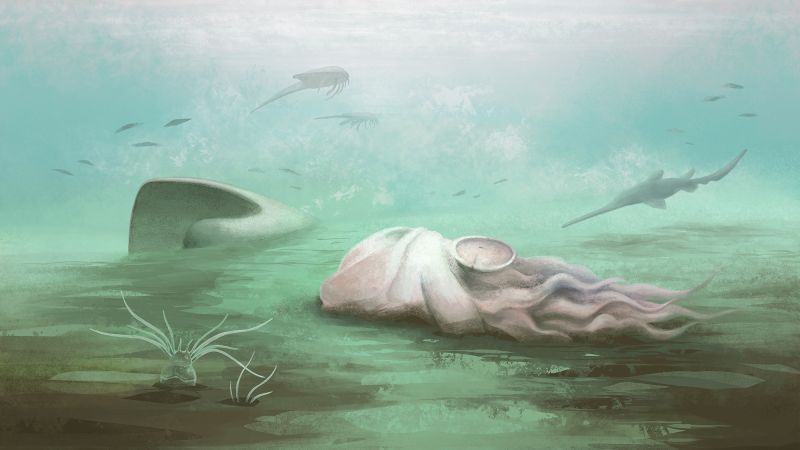
Instead, the fossil relates to an animal closely aligned with a modern nautilus, characterized by its tentacles and external shell, according to a study published in the Proceedings of the Royal Society B.
“We basically used a wide selection of new analytical techniques to discover hidden anatomical characteristics within the rock,” said lead study author Thomas Clements, a lecturer in invertebrate zoology at the University of Reading. “And we were able to determine that it is not an octopus, but is actually a very decomposed nautiloid, which is a relative of modern nautiluses.”
The fossil, named Pohlsepia mazonensis, was unearthed at the Mazon Creek site just south of Chicago, Illinois. Paleontologists had long been perplexed by this fossil as it predates the next oldest known octopus by approximately 90 million years, raising questions about the evolutionary timeline of these creatures.
Clements noted that the animal had undergone weeks of decomposition before being buried, which gave its fossil an octopus-like appearance that led many scientists to erroneously conclude octopuses existed far earlier than previously believed.
Despite initial interpretations, certain features, such as the arm length and shape, led to skepticism about its classification. “We used a huge selection of new techniques,” Clements explained, specifying the use of a scanning electron microscope and geochemistry work for the detailed analysis.
However, initial efforts did not yield results, leading Clements to feel frustrated until a colleague introduced him to synchrotron imaging. This method, described by the University of Reading as employing light beams brighter than the sun, produces powerful X-rays capable of revealing hidden anatomical features.
This advanced imaging unveiled a radula, the feeding structure that possesses rows of teeth. The fossil showed at least 11 teeth per row, while octopuses typically have only seven or nine. “It was these tiny teeth that we found that allowed us to identify that it wasn’t an octopus,” Clements added.
This research underscores how newly accessible technologies can enhance scientific knowledge. “Not only are they becoming more readily available, but they’re becoming more affordable, and that’s revolutionizing paleontological investigations,” Clements remarked, citing synchrotrons for discovering ancient proteins and biomolecules.
In this context, Clements indicated a shift in perception about paleontology, illustrating it as a field marked by innovation rather than dust. The findings represent a significant update to previously held beliefs about marine life and its evolution over millions of years.
Future investigations are likely to continue to reshape our understanding of prehistoric life.