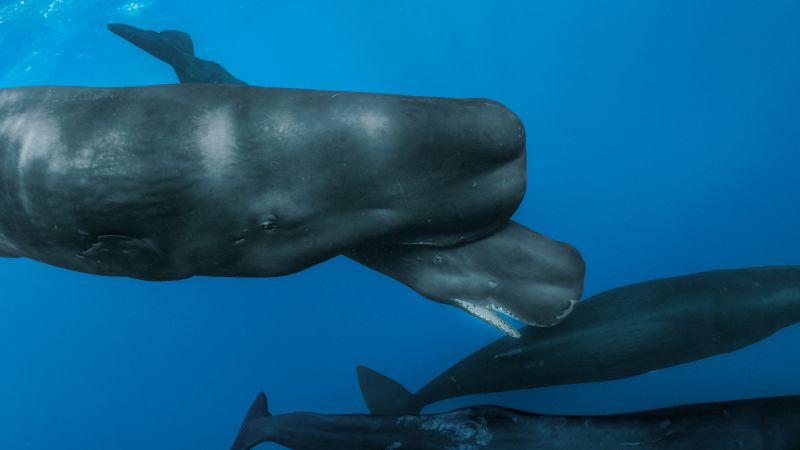
Marine biologist Shane Gero’s discovery of a blood plume in the water among a group of sperm whales in the Caribbean led him to suspect a predator attack, but what he observed instead was a remarkable event: the live birth of a whale. This ‘joyous occasion’ was documented by Gero and a scientific team from Project CETI on July 8, 2023, marking a rare instance of witnessing a whale give birth in the wild, reports BritPanorama.
The event illuminated the intricate social behaviors of sperm whales as other whales in the pod surrounded the mother and assisted in lifting the newborn, allowing it to take its first breaths. The observation has implications for understanding teamwork among the species, suggesting lessons that might resonate with humans regarding cooperation and social bonds.
Gero explained the significance of the event, stating, “In a cooperative society, if we’re going to succeed, we need to work together, rather than constantly finding reasons to define how we are different.” This message underscores the importance of teamwork among all social species, not just cetaceans.
Setting the scene for cetacean birth
On that day off the coast of Dominica, Gero and his colleagues—comprised of scientists and technicians—were prepared for routine fieldwork. However, they quickly observed that the typically dispersed family group of sperm whales was tightly clustered, a behavior that indicated something unusual was underway.
One whale, known to researchers as “Rounder,” was in labor at around 11:12 a.m local time. Rounder, who is over 19 years old and previously birthed in 2017, displayed indicators typical of a birthing process, leading the team to meticulously track the event until its completion at 11:45 a.m.
The research team noted changes in the whales’ behavior and the presence of blood and feces in the water during the labor. These observations provided a momentous opportunity for scientific study, as Gero remarked on the significant planning that allowed for such precise documentation, stating, “Because of the protocol that we run every day on the water, we had the drones in the air and the recordings running even before we knew it was a birth.”
According to Giovanni Petri, a network science lead at Project CETI, the depth of understanding achieved from this observation provides insights into the dynamics of birth among sperm whales that had previously been unclear. The event was documented in two detailed studies published on March 26, offering a combination of audio, video, and extensive historical data on sperm whale social relationships.
A group effort
Scientific documentation revealed that the group of sperm whales known as Unit A played a significant role during the birth. Once the calf was partially visible, the other whales became actively engaged in its care, nuzzling and lifting it to the surface. In an occurrence that highlights the importance of social structures among these marine mammals, even non-kin members participated in the newborn’s initial moments.
The whale pod communicated extensively during this period, producing 31,364 clicks over several hours, with patterns indicating social bonding and interaction dynamics. Researchers noted that a collective effort was evident, transforming a typically maternal event into a community affair.
The detailed study of the birth event has contributed to a broader understanding of cetacean behavior, with comparisons to the rarity of observing births in wild whales being highlighted by Gruber, CETI’s founder. “The last scientific record of a sperm whale birth was in 1986,” he noted, emphasizing the uniqueness of this recent observation.
Insights from this event extend beyond biological curiosity; they touch on the significance of collective behavior and cooperation among social species, hinting at broader implications for understanding complex social interactions in both marine and terrestrial environments. The continuing research promises to unravel more about the intricate lives of sperm whales and their social dynamics.