For decades, people have paused outside of No. 8 College Street next to the campus of Winchester College in England, reports BritPanorama.
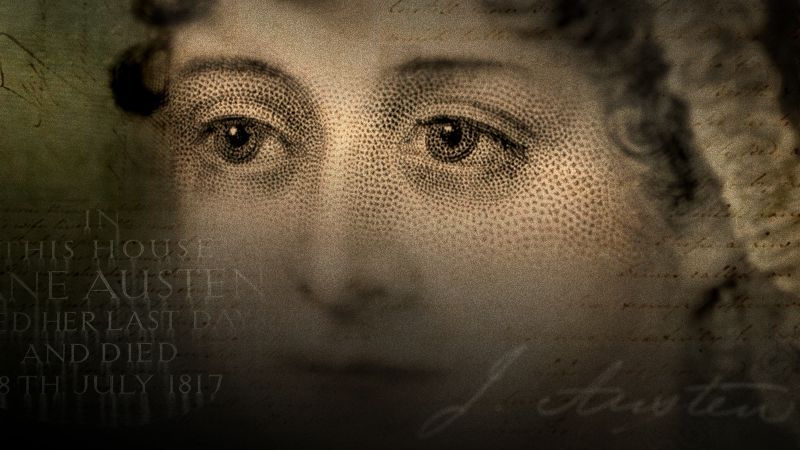
The only detail of the painted brick building’s façade that belies its significance is an oval plaque above the doorway with the words, “In this house Jane Austen lived her last days and died 18th July 1817.” For fans of the beloved author, the spot represents what’s perhaps the most enigmatic chapter of Austen’s too-short life.
The novelist and her sister, Cassandra Austen, lived on the first floor of the building for eight weeks while Jane sought treatment for a nearly yearlong, unidentified illness. After appearing to improve in fits and starts, the author died at just 41 years old without ever having received a clear diagnosis that’s known today. As the 250th anniversary of her birth approaches on December 16, scholars are still debating the cause of her demise, trying to piece together a picture of her health based on descriptions of symptoms in Austen’s own words.
“There is, as of yet, no clear answer about what caused Jane Austen’s death at age 41,” said Devoney Looser, a regents professor of English at Arizona State University. “Our armchair diagnoses are drawn from the brief descriptions of her symptoms found in surviving letters.”
With little biological evidence available to study, Austen’s correspondence and novels have provided researchers with a rich road map to discovering clues from her final days, bringing previously unknown aspects of her condition to light and unearthing potential new interpretations of her later works such as “Persuasion” in the process.
A 1964 paper by Zachary Cope — the first article to offer a potential cause of death for Austen — concluded the author died from Addison’s disease, a rare chronic condition in which the body’s adrenal glands don’t sufficiently produce certain hormones. Later hypotheses suggested that she had succumbed to stomach cancer, tuberculosis or Hodgkin’s lymphoma, respectively.
While starkly different conditions, these potential diagnoses share symptoms such as fatigue, weight loss, poor appetite, as well as the potential for intermittent fevers, chills or night sweats, said Dr. Dacia Boyce, internal medicine physician at the Carl R. Darnall Army Medical Center in Fort Hood, Texas.
“Addison’s disease remains the most popular answer, perhaps because that theory has been so often repeated,” said Looser, author of “Wild for Austen: A Rebellious, Subversive, and Untamed Jane.” “Another theory, advanced more recently, is that Austen may have died of a slow-growing cancer, such as lymphoma.”
But none seemed to fully explain her condition, leaving room for more theories to enter the fray.
Examining Jane Austen’s final days
The late neuro-ophthalmologist Dr. Michael D. Sanders had read Cope’s analysis and was more than a casual fan of Austen when he began his own research into her mysterious decline. Sanders resided for 20-plus years near Jane Austen’s House — a museum that preserves the cottage in the county of Hampshire where the author once lived and wrote her novels.
He joined the London-based Jane Austen Society in the 1970s, purchasing a lifetime membership for 10 pounds. Upon retirement in 2020 from the medical eye unit at St. Thomas’ Hospital in London, within commuting distance of Hampshire, consultant emeritus Sanders was eager to dig deeper into the circumstances surrounding Austen’s death.
He and his colleague Dr. Elizabeth Graham, another consultant emeritus at St. Thomas’ who specialized in medical ophthalmology, had run the hospital’s medical eye unit for years. The duo encountered many young patients with lymphoma, lupus and tuberculosis during that time.
“Michael loved Jane Austen, so he’d often thought about it and why she died,” Graham, who’s now a trustee at Retina UK, said. “I think he was quite taken by the fact that she had all these joint problems, and they’d slightly been passed over. Some probably thought all women of a certain age get pain in their joints from time to time and get a bit tired.”
Sanders and Graham reviewed every letter of Austen’s to make a comprehensive list of her symptoms. They sought the input of Austen scholar Deirdre Le Faye, long considered the preeminent expert on the author, before she died in August 2020. Their work, published in the journal Lupus in January 2021 before Sanders’ death in July 2022, creates a comprehensive timeline for the decline in Austen’s health, which appears to have begun in the spring of 1816.
But the most specific symptoms show up in Austen’s correspondence at the end of August 1816, 11 months before her death.
Austen’s most common complaint was rheumatism, which involves pain in her back and knee. She also experienced bouts of fatigue, fevers and a discoloring skin rash on her face, with Austen writing she was “black and white and every wrong colour.”
Her symptoms appeared to resolve periodically, and Austen wrote that she felt “tolerably well” and more active. But her issues always returned.
“Sickness is a dangerous indulgence at my time of life,” Austen wrote in a March 1817 letter.
In May 1817, she was referred by her doctor to Giles King Lyford, surgeon at the County Hospital on Parchment Street in Winchester, and she and Cassandra made the 15-mile journey. She wrote from 8 College Street to one of her nephews, James Edward Austen-Leigh, “I continue to get better.” Austen would have been well-positioned in London and Winchester to receive qualified care, according to Graham.
“There’s no evidence that she saw what we would call quacks,” Graham said. “She saw good physicians.”
Much is known about Austen’s final days spent at 8 College Street. “Thanks to surviving letters, we actually know more about how she felt during the months leading up to her death than we do about many other periods of time in her life,” said Austen scholar Juliette Wells, a professor of literary studies at Goucher College in Baltimore.
Austen’s health deteriorated in June and July of 1817, and she experienced a weak pulse, spending much of her time sleeping.
On July 15, Austen dictated verses describing horse races at Winchester to Cassandra that would be the author’s final poem, “Venta.” Just hours later, Austen rapidly declined. She had a seizure and fell unconscious on July 17. Some of her last words to Cassandra were that she wanted nothing but death and “God grant me patience, pray for me, oh, pray for me!”
She died in her sleep at 4:30 a.m. the following day, her head resting on a pillow on Cassandra’s lap.
“I have lost a treasure, such a sister, such a friend as never can have been surpassed,” Cassandra wrote in a letter to her niece, Fanny Knight. “She was the sun of my life, the gilder of every pleasure, the soother of every sorrow; I had not a thought concealed from her, and it is as if I had lost a part of myself.”
Diagnosing a historical figure
No direct evidence of medical documents linked to Austen exists, but Graham is sure that such records were kept at the time. She said she is not aware of an official death certificate for Austen. As for the treatments the author received, there is only mention in the letters of “applications,” but nothing more specific. Therefore, what doctors at the time believed was the cause of Austen’s illness and demise remains an open question.
“Nobody said what she died of,” Graham said. “Cassandra didn’t say what she died of. They just said she fell asleep.”
When Sanders and Graham reviewed Austen’s symptoms, they didn’t directly identify evidence for Addison’s, tuberculosis or lymphoma. In Addison’s, patients experience permanent discoloration that results in the tanning of the skin across their bodies. But Austen’s multicolored rash affected only her face, and it was transient, Sanders and Graham wrote in their paper.
Given that tuberculosis accounted for at least 20% of deaths in the 17th, 18th and 19th centuries in Europe, it’s highly likely that her doctors would have been familiar with diagnosing the disease in their patients, Graham said. Austen also didn’t appear to have the chest or orthopedic complaints typically connected to tuberculosis.
“Lymphoma seemed unlikely because there is no mention of Austen having enlarged lymph glands, and patients with lymphoma don’t have arthritis or skin lesions,” the researchers noted in their paper.
Sanders and Graham kept returning to Austen’s joint pain, her most frequent complaint, as well as her several periods of spontaneous remission — something lymphoma patients wouldn’t have experienced without treatment, which didn’t exist in Austen’s time because lymphoma had not yet been identified.
“The fact that she had a rash and that she had an illness that basically killed her in a year, I think people got very wound up with that and