Researchers analyze DNA believed to belong to Adolf Hitler
Researchers have analyzed a sample of DNA believed to belong to Adolf Hitler, which they say reveals the dictator of Nazi Germany had a genetic marker for a rare disorder that can delay puberty, reports BritPanorama.
The research, which took more than four years to complete, was led by geneticist Turi King, a professor at the UK’s University of Bath known for identifying the remains of King Richard III. King confirmed that a piece of material taken from a couch in the bunker where Hitler shot himself in 1945 was soaked in the dictator’s blood by comparing a DNA sample recovered from the blood with a confirmed relative of Hitler’s.
In addition to suggesting the possibility that Hitler had a hormone-disrupting congenital condition called Kallmann syndrome, the documentary examined rumors regarding the dictator’s Jewish ancestry and investigated whether he had a genetic predisposition to certain mental health conditions. Titled “Hitler’s DNA: Blueprint of a Dictator,” the documentary is set to premiere on Channel 4 in the UK.
However, the findings shared in the documentary haven’t been reviewed by other scientists in the field or published in a scientific journal, making it challenging for experts not involved in the project to evaluate the validity of its assertions. King mentioned that the analysis has been submitted to a “high-profile” journal and expressed hope for its timely publication.
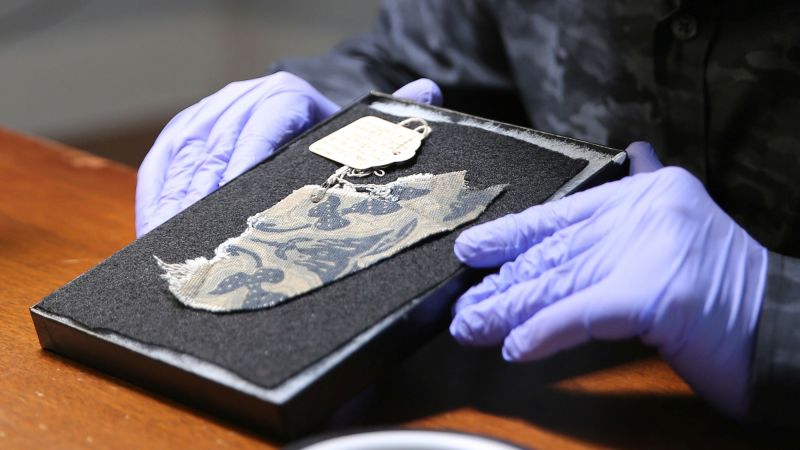
The small patch of frayed fabric began its journey in 1945, held by US Army Col. Roswell P. Rosengren, who served as the communications officer for Gen. Dwight D. Eisenhower. When Rosengren entered Hitler’s bunker with the Soviet forces, he cut a swatch of material from a bloodstained couch. This swatch remained in Rosengren’s family before being auctioned in 2014 and ultimately acquired by the Gettysburg Museum of History in Pennsylvania.
“We didn’t know what we were going to find,” King stated. “It could have been the most boring genome on the planet, but it has been incredible.” The analysis revealed that Hitler had a mutation on a gene called PROK2, which variants of are associated with Kallmann syndrome and congenital hypogonadotropic hypogonadism. In boys, these conditions can delay puberty and cause undescended testicles.
“Basically, they are characterized by low testosterone levels. You either don’t go through puberty or you go through a partial puberty … 5% of cases are associated with a micropenis,” King added.
Clues in the historical record
At the time of his death, Hitler was found at the end of the sofa with a gun and blood splattered on the furniture and the wall behind him, according to Nicholas F. Bellantoni, emeritus state archaeologist with the Connecticut State Museum of Natural History. He examined parts of the sofa, which is currently in Russia, in 2009.
“If the provenance of the sofa material is confirmed to have originated from the bunker and from the settee that Hitler and Eva Braun died on, then the likelihood of the blood being from Hitler is very good,” Bellantoni stated via email.
The new findings from King correspond with the historical record, according to Alex Kay, an expert on Nazi Germany and senior lecturer at the Chair of War Studies at Germany’s University of Potsdam. Kay mentioned a medical document from Hitler’s imprisonment after the failed coup known as the Munich beer hall putsch in 1923 which suggested the dictator had right-side cryptorchidism—a condition where a testicle fails to descend into the scrotum.
“The discovery of Kallmann syndrome is, for me, personally, as a historian who has spent over 20 years researching the Nazis, a major finding,” Kay noted. He added that this information may help explain Hitler’s difficulties with personal relationships.
Kay and King also indicated that the findings dispel lingering rumors about Hitler’s Jewish ancestry, speculation which arose from claims that Hitler’s grandmother became pregnant while working in a Jewish household. According to King, the analysis of the Y chromosome data shows a match with the DNA of Hitler’s male line relative, confirming that Hitler could not have had Jewish ancestry. “If that were the case, we wouldn’t have obtained the DNA match,” she asserted.
The value of historical DNA
King expressed initial reservations about participating in the documentary, but decided her involvement would help ensure the analysis was scientifically rigorous. “This is also not just a documentary but an academic paper,” she clarified, though no publication date has yet been announced.
Researchers have previously utilized DNA to examine notable historical figures. Beethoven’s DNA, for example, recovered from a lock of hair, revealed health issues. Yet, without information on the quality of the genome or how the analyses were conducted, experts like Pontus Skoglund, senior group leader of the Ancient Genomics Laboratory at the Francis Crick Institute in London, emphasize that it is hard to assess the documentary’s assertions.
“The scientific value of a media campaign such as this, balanced against the potential stigmatization of individuals with these actual disorders today, is also a point of contention,” Skoglund remarked. He pointed out that researchers could have shared their findings on a preprint server ahead of formal peer review.
Furthermore, Tom Booth, a bioarchaeologist at the Francis Crick Institute, noted the extensive historical records documenting Hitler’s behavior in public and private. “He is probably one of the most intensively studied figures in history; thus, it is difficult to argue that the DNA evidence adds much to our understanding,” Booth added.
Demontis compared Hitler’s polygenic risk score with those of 30,000 Danish individuals, finding that if Hitler were alive today, his score for schizophrenia, autism, and bipolar disorder would surpass 99% of the Danish population. However, it is important to note that the polygenic risk score is a tool employed primarily for research purposes and does not provide diagnostic information.
“We can express something at a group level but not at an individual level,” Demontis explained. King corroborated, stressing that the aim is not to stigmatize individuals with these disorders, acknowledging that it’s rare for individuals with these conditions to commit violent acts. “Hitler did not act alone; he had hundreds and thousands of people who assisted him,” she remarked.
“His genetics are just a small, small puzzle piece,” King concluded. The ongoing investigations into historical genetic analysis illuminate complex narratives entwined with infamous figures in history.