Researchers unveil the origin of Saturn’s moon Titan
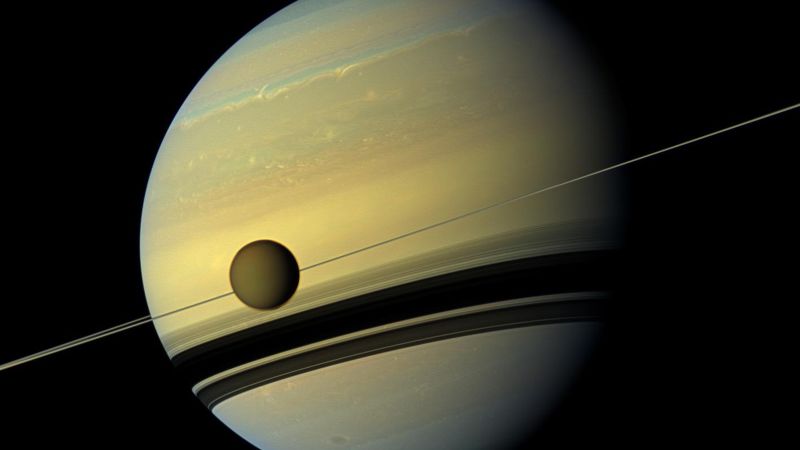
New insights into Saturn’s largest moon, Titan, suggest a collision with another moon helped shape its formation and may explain the origin of Saturn’s rings. This research combines previous theories, data from the Cassini mission, and computer simulations, reports BritPanorama.
Titan, which is shrouded in a thick atmosphere and is a half-size of Earth, is moving away from Saturn at an accelerated pace of 11 centimeters (4.3 inches) a year. This drift could eventually lead to Titan being ejected from its orbit. The moon’s significant mass also contributes to the gravitational influences that cause Saturn to wobble, adding further complexity to the understanding of this celestial relationship.
Researchers suggest that approximately half a billion years ago, Titan may have collided with an extra moon, creating a new narrative regarding its origins. “In this paper, I tried to put all these things together, and I propose that there was an extra moon about half a billion years ago that collided with Titan, that actually became part of Titan,” said Matija Ćuk, lead author and research scientist at the SETI Institute.
This catastrophic encounter could explain the formation of Hyperion, Saturn’s largest irregularly shaped moon, which is significantly smaller than Titan. Hyperion may either be a remnant of the lost moon involved in the collision or formed from debris in Titan’s orbit.
An extra moon ‘explains everything’
Moreover, the study suggests this merger could have played a role in forming Saturn’s iconic rings. “From this event, Titan could have perturbed some of the inner moons into more collisions, which created the rings sometime later, maybe 100 million years ago,” Ćuk explained. This new model also links Titan’s drifting orbit to gravitational interactions that have perturbed other moons in the Saturnian system.
Evidence supporting this theory stems from observations of Saturn’s tilt, driven by its rings and previously attributed to gravitational disturbances from neighboring Neptune. New data from Cassini indicated that this alignment may be influenced by a now-lost moon dubbed Chrysalis, which was theorized to have existed for billions of years before being disrupted.
However, Ćuk and his team argue for a more complex interaction, detailing a collision between precursors of Titan and Hyperion that has reshaped the dynamics of Saturn’s moons. “Right now, Saturn is wobbling a little bit too fast,” he noted, suggesting that the disruption caused by the larger moon may align Saturn and Neptune correctly in the historical context.
The implications of this research lend credence to the understanding that Titan’s orbit and Saturn’s spin have dramatic consequences on the celestial mechanics of the entire Saturnian system.
Future investigations, including NASA’s upcoming Dragonfly mission, may validate these findings by analyzing Titan’s surface directly. Dragonfly is set to launch in 2028 and will assess Titan’s complex environment, potentially uncovering more about the origins of this enigmatic moon and its relationship with Saturn.
This ongoing exploration continues to illuminate the intriguing complexities of Saturn and its moons, where new research consistently challenges and refines previous assumptions about their formation and evolution.