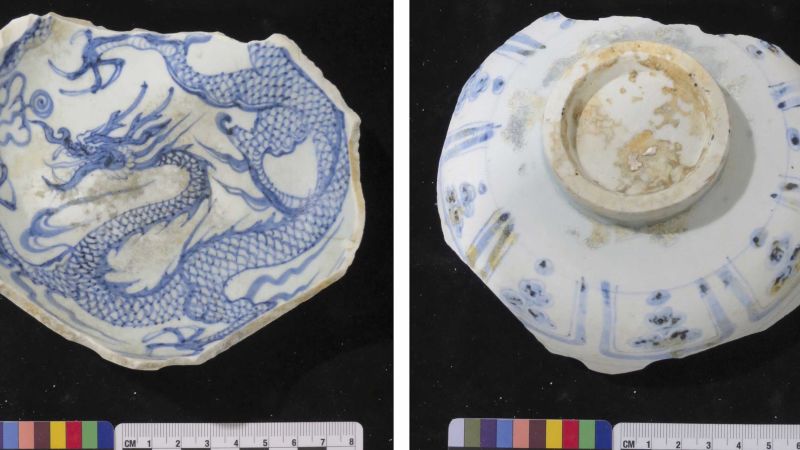
In the waters off Singapore, a recently uncovered shipwreck with a vast cargo of blue-and-white porcelain is providing insights into the intricate Chinese craft produced during the tumultuous era of the Mongol Empire, reports BritPanorama.
The approximately 650-year-old vessel, believed to have been sailing from China to Temasek—now known as modern-day Singapore—contained a record haul of Yuan Dynasty porcelain, according to findings detailed in a recent study.
Michael Flecker, the marine archaeologist who spearheaded the investigation, and his team dedicated four years to recovering the remnants of the ship’s cargo from the 14th-century wreck site.
Researchers retrieved around 3.5 metric tons of ceramic shards, including approximately 136 kilograms (about 300 pounds) of Yuan porcelain, notable for its distinctive blue-and-white patterns, along with several intact or nearly intact porcelain pieces.
Despite the wreck site being relatively shallow, the team faced “strong currents and associated shocking visibility,” which limited their diving expeditions to about once every four weeks, Flecker explained. “Even then, we were occasionally sent tumbling along the seabed or groping our way back to the diver down-line in darkness,” added Flecker, who is a senior archaeologist at Heritage SG, part of the Singapore National Heritage Board.
The vessel itself has largely disintegrated, but Flecker suspects it was a Chinese junk—a type of sailing ship commonly used during the early Middle Ages. While scarce artifacts managed to survive, most of the porcelain recovered consisted of shards. However, enough intact items remained to allow researchers to identify distinctive designs, including pieces featuring a four-clawed dragon and another depicting a phoenix surrounded by chrysanthemums.
Notably, the recurring motif of mandarin ducks in a lotus pond enabled Flecker to date the shipwreck, as that design was associated with Emperor Wenzong, who limited its use to his personal collection during his rule from 1328 to 1332. The restrictions likely ceased after his deposition, leading to increased production of ceramics featuring this motif, much of which was exported.
The imperial kilns likely ceased operations about 20 years later due to the Red Turban Rebellion, reducing the timeframe in which the ship could have sunk. Even if some kilns continued to produce ceramics, the fall of the Yuan Dynasty in 1368 and subsequent commercial trade bans imposed by the first Ming emperor around 1371 further narrowed dating estimates, placing the shipwreck’s occurrence between the late 1320s and 1371.
‘Miraculous’ material
During the historic production of Yuan porcelain, it gained immense desirability among elites throughout Eurasia, noted Shane McCausland, an art history professor at SOAS University of London, who was not involved in the research. “This is crockery; it’s not prized in the same way as gold, painting, calligraphy, or the greatest architecture,” he said. “Yet, because of its translucency and impressive hardness, it’s a somewhat miraculous material.”
He further remarked on a belief that the porcelain holds magical properties, suggesting that it would crack if poison was applied—a notion that partly explains the desire of paranoid rulers to possess blue-and-white ceramics.
The porcelain also highlights the nature of the trade networks of the time, having been crafted by Chinese artisans who utilized cobalt sourced from Persia, now known as modern-day Iran, before it was exported along the Silk Road routes dominated by the Mongols, McCausland added.
Flecker noted that Yuan porcelain represented a significant cultural and technological advancement in Chinese art under Mongol rule, challenging long-held interpretations of the imperial dynasty’s impact. “As soon as the Mongols retreated from China in 1368, the knowledge that this blue-and-white was a breakthrough of the Yuan period got lost,” he stated, mentioning that as late as the 1930s some scholars misidentified the porcelain as products of other dynasties.
This particular shipment likely departed from Quanzhou, a port on China’s eastern coast close to the creative centers in the Fujian, Zhejiang, and Jiangxi provinces, heading for Temasek, according to Flecker. While historians knew that Temasek functioned as a key duty-free port in the 14th century, the shipwreck “hints at the extent of local consumption” and demonstrates the wealth of the settlement.
The study was published in June 2025 in the Journal of International Ceramic Studies.