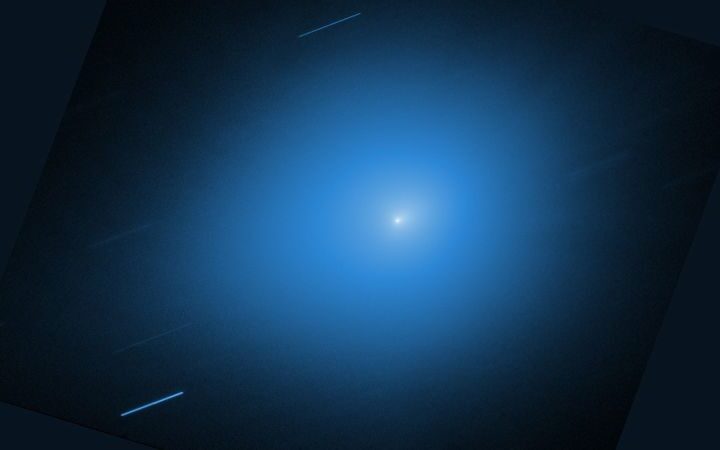
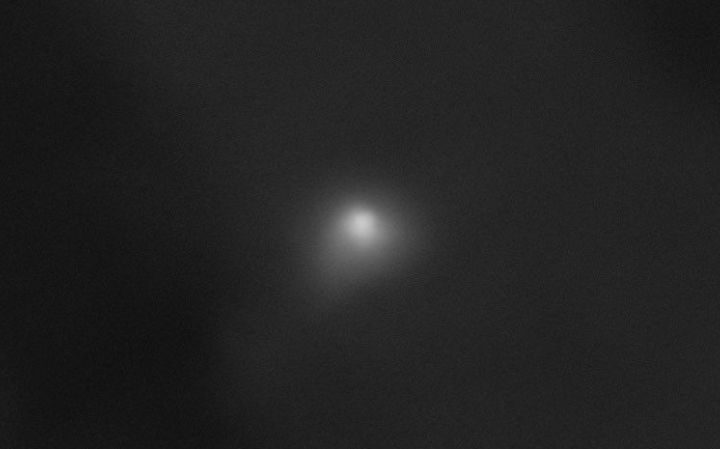
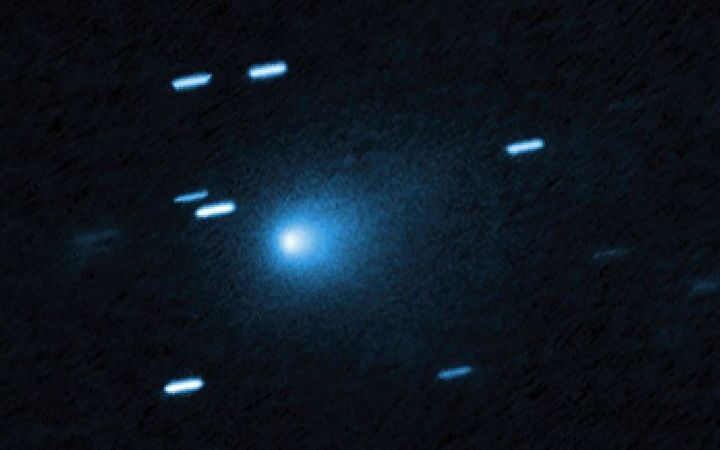
New images show an interstellar comet that will soon make its closest approach to Earth
An interstellar comet first spotted passing through our solar system in July is beginning its departure from our corner of the universe — but first it will fly by Earth, and scientists are capturing stunning new images during its approach, reports BritPanorama.
Known as 3I/ATLAS, the comet will make its closest pass on Friday, coming within about 167 million miles (270 million kilometers) of Earth, though it will be positioned on the opposite side of the sun. For context, the sun is approximately 93 million miles (150 million kilometers) from our planet.
Comet 3I/ATLAS will not be visible to the naked eye, and the optimal visual window, which opened in November, has already passed. Observers hoping for a glimpse will require a telescope of at least 8 inches (20 centimeters) in diameter, according to EarthSky.
The Virtual Telescope Project plans to share a livestream of the comet at 4:00 a.m. UTC on Friday, which corresponds to 11 p.m. ET on Thursday. Should weather conditions be poor, the webcast may be rescheduled by 24 hours, as noted by Gianluca Masi, an astronomer and astrophysicist at the Bellatrix Astronomical Observatory in Italy and founder of the Virtual Telescope Project.
The comet is expected to remain observable by telescopes and space missions for several more months prior to its exit from our solar system, according to NASA.
Astronomers have closely monitored the comet since its discovery over the summer, aiming to uncover its origins outside our solar system and understand its composition. Various missions have captured observations in optical, infrared, and radio wavelengths — recently, scientists achieved their first detections in X-rays, revealing new details.
X-raying an interstellar visitor
Comets originating within our solar system are known to emit X-rays, prompting questions about whether interstellar comets exhibit similar behavior.
Past attempts to detect X-rays from two other interstellar comets that traversed our solar system in 2017 and 2019 were unsuccessful.
However, the situation has changed with comet 3I/ATLAS.
Japan’s X-Ray Imaging and Spectroscopy Mission, known as XRISM, observed 3I/ATLAS for 17 hours in late November using its Xtend telescope. The instrument captured X-rays radiating out to approximately 248,000 miles (400,000 kilometers) from the comet’s solid core, or nucleus, likely resulting from the gaseous envelope surrounding the object, according to the Japan Aerospace Exploration Agency. Further observations are needed for confirmation.

X-rays can arise from interactions between gases emitted by the comet — including water vapor, carbon monoxide, and carbon dioxide — and the solar wind, a continuous flow of charged particles released by the sun. Comets are a mixture of ice, rock, dust, and gas, and as they near stars like the sun, they heat up, causing sublimation. XRISM detected signatures of carbon, oxygen, and nitrogen in proximity to the comet’s nucleus.
The European Space Agency’s X-ray observatory XMM-Newton also tracked the interstellar comet on December 3 for around 20 hours with its most sensitive camera. A striking image released by the agency showcases the comet’s red X-ray glow.
These X-ray observations, in conjunction with data across various wavelengths, may provide insights into the comet’s composition and how it compares to those found within our own solar system.
The interplay of data from multiple observational platforms underscores a significant chapter in humanity’s understanding of celestial bodies beyond our solar system.