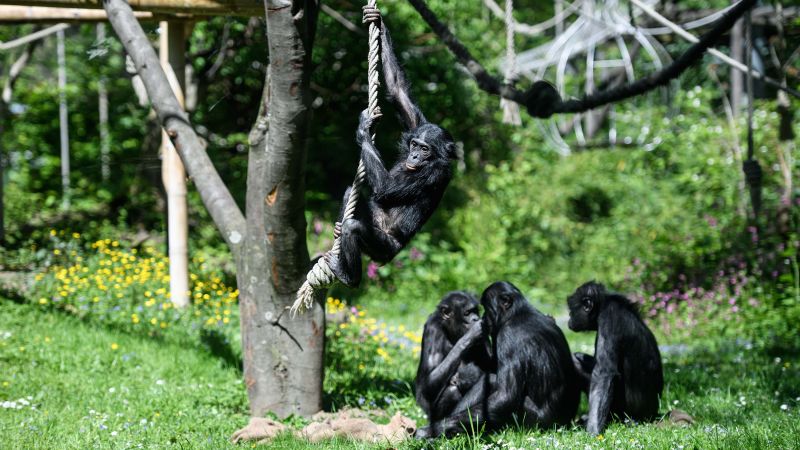
New research indicates that the ability to engage in pretend play, traditionally viewed as a unique human trait, may also be present in great apes. The study focuses on a bonobo named Kanzi, who participated in three pretend tea party-style experiments conducted at Johns Hopkins University, providing compelling evidence of imaginative play among non-human species, reports BritPanorama.
The study authors, Amalia Bastos and Christopher Krupenye, published their findings in the journal Science, noting that Kanzi’s participation marks a significant step in understanding ape cognition. During the experiments, Kanzi demonstrated the ability to distinguish between real and imaginary objects, thereby supporting the notion that such cognitive skills extend beyond humans.
Prior observations had suggested that apes might engage in simulated play. For instance, earlier research documented a young chimpanzee appearing to drag imaginary blocks along the ground as if they were real. Moreover, female chimpanzees in Uganda had been observed carrying sticks as though they were infants, further hinting at sophisticated behavioral patterns in non-human primates. However, anecdotal evidence had left considerable doubt about these claims, as noted by the researchers.
To bolster their argument, the team executed controlled tests in 2024, using juice and grapes when Kanzi was 43, shortly before his death. In one scenario, Kanzi consistently identified the container with juice over multiple trials, showcasing his ability to understand the concept of imaginary versus real objects effectively.
‘Where’s the juice?’
In the first experiment, Kanzi was presented with two squirt bottles, one filled with juice and the other empty. He accurately selected the correct bottle in 18 trials. In subsequent tests, researchers introduced two transparent cups and pretended to pour juice into them. Kanzi successfully deduced which cup held imaginary juice 68% of the time. Furthermore, when presented with choices between real juice and imaginary juice, Kanzi correctly identified the real substance 14 out of 18 times.
In another variant of the test involving grapes, Kanzi maintained an accuracy rate of 68.9%, outperforming his results from the first experiment. The results suggest that Kanzi not only recognized the concept of imagination but also displayed cognitive skills that may require reevaluation of ape intelligence.
The researchers concluded that “the capacity for representing pretend objects is not uniquely human,” implying that the cognitive abilities of great apes warrant further exploration. Notably, primate behavioural ecologist Nicholas E. Newton-Fisher commented on Kanzi’s abilities, which challenge existing perceptions of ape cognition and imagination.
Kanzi’s unique abilities
Kanzi, who passed away in March 2025, was an ideal subject for the study due to his language training and capacity to understand over 300 symbols through a lexigram. His involvement in various cognitive studies demonstrated innovative capacities previously unrecognized in apes. While this research nearly exclusively focused on Kanzi, the authors acknowledge the necessity for broader investigations to see if similar behaviors can be observed in other ape species.
While the findings are compelling, the researchers approached them with caution, emphasizing the need for continued study. They pointed out that understanding ape cognition might diverge significantly from human cognitive patterns, underscoring the complexity of imagining and how these traits manifest in different species.
The ongoing research into ape behavior not only informs our understanding of their cognitive skills but enriches the discourse surrounding animal intelligence and the evolutionary development of imagined concepts.