New study suggests universe’s expansion may be slowing
The universe’s expansion might not be accelerating but slowing down, a new study suggests, reports BritPanorama.
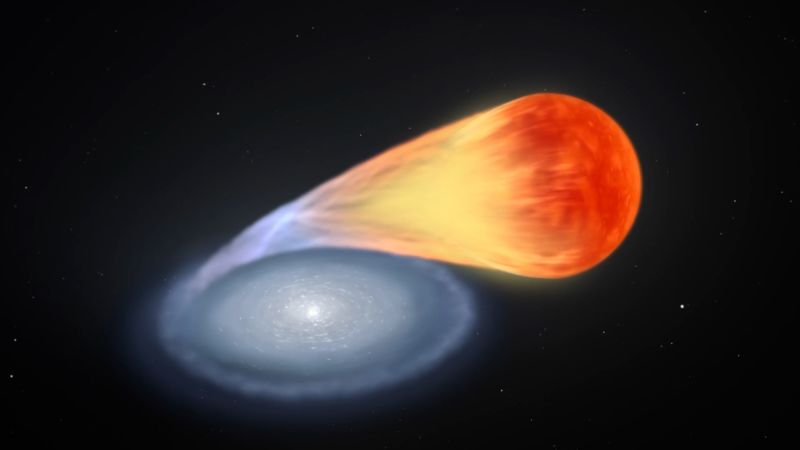
If confirmed, the finding would upend decades of established astronomical assumptions and rewrite our understanding of dark energy, the elusive force that counters the inward pull of gravity. Two separate teams of astronomers first posited in 1998 that dark energy might enable the universe to expand at an accelerating rate while observing bright, exploding stars called Type 1a supernovas.
The scientists noted some of the most distant supernovas were dimmer than expected and concluded that they had moved away from Earth faster than anticipated. This discovery won them the Nobel Prize in physics in 2011. However, the nature of dark energy has remained a mystery, and its role in the universe’s expansion has been called into question before.
Last year, a consortium of hundreds of researchers using data from the Dark Energy Spectroscopic Instrument (DESI) in Arizona developed the largest ever 3D map of the universe. The observations hinted that dark energy may be weakening over time, indicating that the universe’s rate of expansion could eventually slow.
Now, a study published on November 6 in the journal Monthly Notices of the Royal Astronomical Society provides further evidence that dark energy might not be pushing the universe with the same strength it used to. Young-Wook Lee, a professor of astrophysics at Yonsei University in South Korea and the study’s lead researcher, referred to the DESI project’s findings as a “major paradigm change” and affirmed that their results agree well with that.
Lee and his colleagues suggest the universe’s expansion has already started to slow down. “Dark energy is there, but the present universe has already entered a decelerating phase, today,” Lee said. He emphasized that if it can change the fate of the universe, such progress in cosmology is significant.
Aging supernovas
The researchers analyzed a sample of 300 galaxies containing Type 1a supernovas, concluding that the dimming of distant exploding stars was not only due to their distance from Earth but also related to their progenitor star’s age. “Before our work, Type Ia supernovae were thought to explode with nearly identical intrinsic brightness, making them highly reliable ‘standard candles,’” said study co-author Junhyuk Son, a doctoral candidate in astronomy at Yonsei University. He noted that their luminosity actually depends on the age of the stars that produce them — younger progenitors yield slightly dimmer supernovae, whereas older ones are brighter.
Son reported high statistical confidence — 99.99% — about this age-brightness relation, allowing for more accurate assessments of the universe’s expansion using Type 1a supernovas.
If confirmed, the study would represent a significant shift in cosmology since the 1998 discovery of dark energy. Son stated, “It would suggest that the (expansion of the) universe is no longer accelerating today, and that dark energy is not a constant force but something that evolves over time. This discovery would open an entirely new chapter in our understanding of the physical nature of dark energy.”
Should the expansion continue to slow, the universe could begin to contract, culminating in what astronomers imagine may be the opposite of the big bang — the big crunch. “That is certainly a possibility,” Lee said. “Even two years ago, the big crunch was out of the question. But we need more work to see whether it could actually happen.”
Extraordinary claims
Despite the potential implications, the new research is being met with skepticism. Adam Riess, a recipient of the 2011 Nobel Prize in physics and professor of physics and astronomy at Johns Hopkins University, asserted that the study is based on a flawed premise, claiming that observations show today’s supernovae occur in young star-forming regions. “The same idea was proposed years ago and refuted then,” he stated.
In rebuttal, Lee explained that Type Ia supernovae can be found in both old and young galaxies, highlighting that Riess’ criticisms stem from a misunderstanding. He maintained that their correlation between age and brightness has been independently confirmed by two separate research teams within the United States and China.
Other experts noted that jumping from host galaxy age to supernova age lacks physical justification. Dan Scolnic, an associate professor of physics at Duke University, stated that modern analyses account for brightness and the environments from which these stars originate. “The universe is still accelerating just fine,” he asserted.
Dragan Huterer, a professor of physics at the University of Michigan, remarked that the extraordinary claims require compelling evidence, suggesting the new research does not provide substantial proof to overturn the currently favored model.
Lee acknowledged the controversy surrounding his work, asserting, “We have a long way to go to convince everyone in the supernova cosmology community.” He did express optimism about the potential insights the upcoming Vera C. Rubin Observatory, set to begin its Legacy Survey of Space and Time in early 2026, may provide in assessing dark energy.
“Dark energy is getting weirder and weirder,” Lee concluded. “But there is no good theory that can explain this very weird behavior. So I think we are missing something. Maybe, in five years, an even more surprising result can come up.”