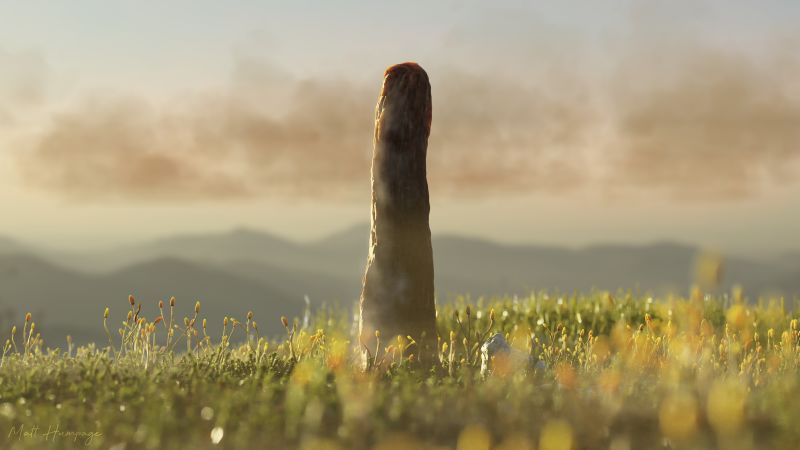
Ancient organism may be an unknown life form
New research suggests that Prototaxites, an ancient organism that existed around 400 million years ago, is likely not a plant, animal, or fungi, but a previously unidentified form of multicellular life, reports BritPanorama.
The study, led by Corentin Loron, a palaeontologist at Edinburgh University, indicates that Prototaxites has characteristics distinct from any modern groups. These organisms were initially identified 160 years ago and can measure up to 30 feet tall, but their classification has been the subject of debate.
Historically, scientists speculated various identities for Prototaxites, initially considering it a rotten trunk of a conifer. Further studies revealed a structure of interwoven tubes rather than plant-like cellular composition. In recent years, some have likened it to a lichen-like mass or a fungus due to its lack of energy production through photosynthesis.
The latest analysis focused on three fossil specimens excavated in the Rhynie chert, a prehistoric ecosystem located near Aberdeen, Scotland, renowned for preserving the earliest land-dwelling plants, fungi, and fauna from the early Devonian period.
Using advanced chemical analysis techniques, researchers identified unique markers in Prototaxites that differ significantly from those found in fossilized fungi also present in the site. “If Prototaxites was fungi, we would have expected it to follow the same trend as the fungi because they are next to each other in the same burial conditions,” Loron stated.
The study highlights structural features of Prototaxites, including complex branching patterns that might have facilitated various exchanges of gases, nutrients, and water, setting it apart from known fungi. Given these findings, researchers caution against prematurely classifying Prototaxites.
Kevin Boyce, a professor at Stanford University, noted that the largest Prototaxites would have loomed over a landscape where other plants were less than one meter tall. His research indicates that these ancient organisms likely derived energy by consuming carbon sources from their environment rather than photosynthesis, akin to some modern fungi that feed on decomposing organic matter.
Although historical comparisons have linked Prototaxites to contemporary fungi, Boyce cautioned against these classifications, arguing that the evolutionary timeline makes direct comparisons invalid. “You can compare it to mushrooms, but mushrooms just aren’t that old,” he explained.
Marc-André Selosse, a professor from the Natural History Museum in Paris, echoed concerns about the study’s scope, emphasizing the need for more comprehensive research encompassing all known Prototaxites species before drawing definitive conclusions about its classification.
As Prototaxites remains a mystery, further studies are planned to explore similar fossilized organisms to enhance understanding of this enigmatic life form. Loron expressed a mixture of trepidation and excitement about the unknown, reflecting the nature of scientific discovery.