Recent analysis of two fossils from Australia, estimated to be about 50,000 years old, suggests that Australia’s First Peoples valued big animals for their fossils as well as for their meat, collecting bones and transporting them over great distances, reports BritPanorama.
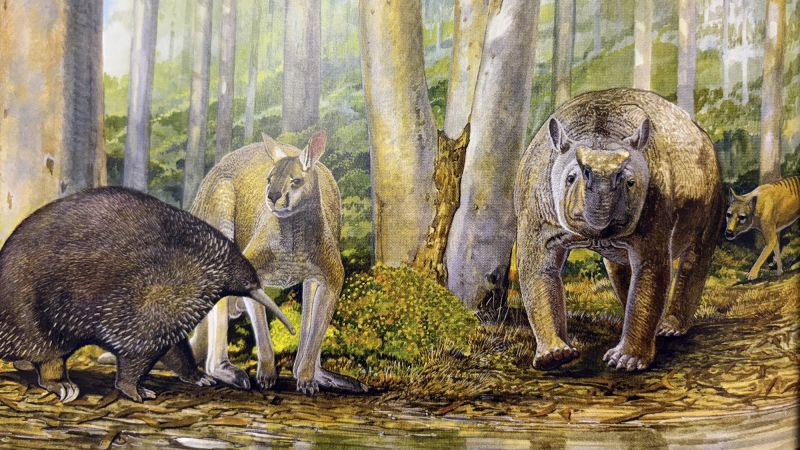
For decades, scientists viewed cut marks on the fossils as signs that Indigenous Australians hunted large prey — possibly to the point of extinction. When humans first arrived in Australia around 65,000 years ago, the continent was home to enormous animals that are now long gone, such as giant long-nosed echidnas, short-faced kangaroos that stood nearly 10 feet (3 meters) tall, and wombat-like tusked marsupials as big as rhinos. However, by about 46,000 years ago, all these large animals had disappeared.
In the 1960s, scientists detected a human-made cut mark on a fossilized kangaroo tibia found between 1909 and 1915 at Mammoth Cave in southwestern Australia. At that time, researchers proposed that the mark proved that First Peoples butchered ancient megafauna.
However, recent examinations using internal scans of the bone revealed a new interpretation: The cut on the bone was made after the animal had long died — possibly after its remains had fossilized. This finding would rule out butchering, suggesting instead that the kangaroo’s preserved bone was collected, scientists reported in the journal Royal Society Open Science.
A second fossil examined in the study — a premolar from the extinct giant wombat Zygomaturus trilobus — provided further clues about First Peoples’ fossil collection. This marsupial species is commonly found in fossil deposits in southern Australia but is unknown in the north. However, an Indigenous man in northern Australia kept the tooth as a charm, mounted in resin and attached to a string made of human hair. It remains unclear how long the Indigenous man had the charm or where it originated.
Dr. Michael Archer, lead author of the study and a professor at the University of New South Wales, suggested that the tooth likely had been collected in southwestern Western Australia and traded up the coast to the Kimberley region.
No evidence of ‘over-killing’
Together, the tooth and tibia present a narrative of First Peoples as fossil collectors, challenging the long-standing hypothesis that they hunted Australia’s megafauna to extinction. According to Archer, the assumption that cut marks came from hunters rather than collectors needs reassessment.
The findings demonstrate the absence of solid evidence supporting the idea that Australia’s First Peoples were “potentially ‘over-killing’ these animals soon after human arrival,” Archer noted. He added that the evidence indicates that humans coexisted with megafaunal animals for at least 15,000 years, likely until climate change led to their gradual extinction.
While acknowledging that First Peoples may have hunted large animals, Archer emphasized that the misconception of a direct link between human arrival and megafaunal extinction stems from historical biases rooted in Western colonization patterns, which were primarily driven by practices such as agriculture and the introduction of non-native species that outcompeted local fauna.
“Because of these modern European-caused extinction events, some scientists have naively presumed that all peoples in the past similarly created the same kind of mayhem when they first entered new lands,” Archer stated. He suggests that in Australia, First Peoples likely integrated into the continent’s ecosystems, valuing and sustainably utilizing its native species.
Dr. Judith Field, an archaeologist at the University of New South Wales, noted that the findings resonate with known human behaviours. She referenced artifacts such as shell beads over 10,000 years old, which indicate a long history of collecting and trading among Indigenous Australians. Field emphasized that climate variability likely contributed significantly to the extinction of Australia’s megafauna alongside any human activities.
The research raises important questions about past human-animal relations, highlighting the potential for a more nuanced understanding of First Peoples’ interactions with their environment. The story of Australia’s megafauna continues to reveal layers of complexity as new findings emerge.