The Battle of Hastings, which marked the end of King Harold’s brief tenure as the last Anglo-Saxon king, is being recast by new research that challenges longstanding narratives about the event, reports BritPanorama.
Traditionally, Harold’s defeat by William the Conqueror in 1066 is portrayed as the culmination of his ill-fated march of nearly 200 miles from Stamford Bridge, where he had just defeated Viking leader Harald Hardrada. However, Tom Licence, a professor of medieval history at the University of East Anglia, argues that this crucial march was likely made by ship rather than on foot.
Licence’s research suggests that the arduous overland trek, which many historians have accepted as a key factor in Harold’s troops being ill-prepared, is based on a misunderstanding of historical texts. This interpretation aligns with a Victorian view of history that has persisted unchecked for generations.
Rory Naismith, a professor of early medieval English history at the University of Cambridge, remarked on the importance of 1066 in shaping English identity, noting that it reflects significant political change with lasting consequences. “It is a watershed in English history… the developments of 1066 are crucial to understanding everything that came after,” he stated.
Reexamining the record
Licence highlights that historical accounts mischaracterized Harold’s fleet being sent home after their victory against Hardrada, originally interpreted as disbandment, rather than returning to London, Harold’s base. This misinterpretation stems from the Anglo-Saxon Chronicle, a key historical document.
In his review of the chronicle, Licence observed that repeated mentions of “home” referred specifically to London, indicating that the fleet returned there rather than dispersing. “When he says, ‘The fleet came home,’ he doesn’t mean the fleet was sent to its various ports,” Licence noted, suggesting that Harold’s decision to consolidate his forces likely contributed to a stronger stance at Hastings.
Following the battle with Hardrada on September 26, 1066, Licence argues that instead of exhausting his men with a long march, Harold had the opportunity to rest them before confronting William. This strategic movement, which included sending ships to conduct a pincer maneuver, would not materialize in time to influence the battle on October 14.
Naismith concurs with Licence’s findings, stating, “A larger role for these ships in the events of 1066 makes a lot of sense and demonstrates Harold’s ability to use the resources available to him.”
Duncan Wright, a senior lecturer in medieval archaeology, emphasized the cultural legacy of Harold’s story as a “brave loser,” a characterization that has informed public perceptions and even reenactments of the battle. He noted that such interpretations, often romanticized, reflect a broader fascination with his narrative of resistance against invasion.
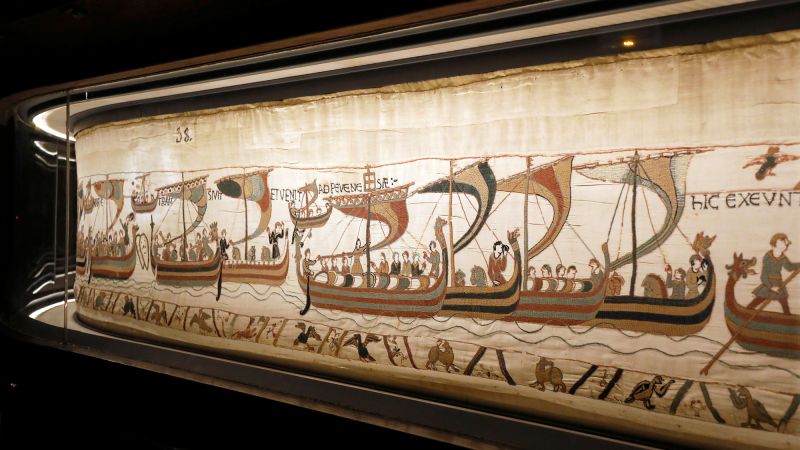
The research also calls into question the depiction of Harold in the Bayeux Tapestry, traditionally noted for illustrating him shot with an arrow in the eye. Historically, however, accounts documented that he was killed by multiple Norman knights, suggesting a more chaotic and violent end than previously acknowledged.
The Bayeux Tapestry is scheduled to be exhibited in Britain for the first time later this year at the British Museum, potentially bringing renewed interest to these historical reassessments. Licence’s findings will be presented at a conference at the University of Oxford, and his insights will feature in an upcoming biography detailing King Harold’s life and legacy.
This reframing of the Battle of Hastings not only challenges historical accuracy but also invites a reconsideration of how narratives around pivotal moments in British history have evolved over time.