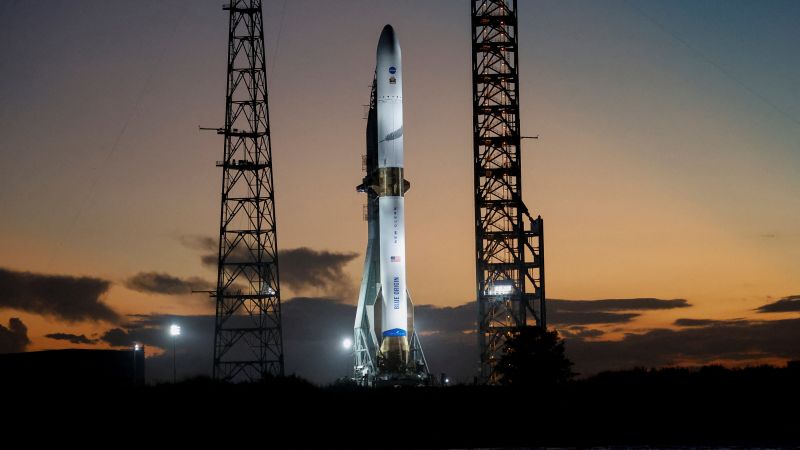
Blue Origin’s New Glenn rocket is scheduled for its second launch, aimed at sending twin spacecraft on a journey to Mars. This 322-foot (98-meter) rocket is set to lift off from Cape Canaveral Space Force Station in Florida during an 88-minute launch window that begins at 2:45 p.m. ET on Sunday, reports BritPanorama.
Weather conditions pose a potential challenge, with forecasts indicating a 35% to 45% chance of unsuitable weather for the launch. If the launch is delayed, Blue Origin has stated that it will make further attempts during launch windows on Sunday and Monday.
Meanwhile, the Federal Aviation Administration (FAA) has announced restrictions on commercial rocket launches from 6 a.m. to 10 p.m. ET, effective Monday, to alleviate traffic control burdens amidst a government shutdown. Laura Maginnis, vice president of mission management at Blue Origin, emphasized the company’s collaboration with the FAA and NASA to comply with airspace expectations during a Saturday news conference.
Blue Origin aims to reuse rocket boosters
Blue Origin is also focusing on recovering the first-stage booster of New Glenn via a seafaring barge named Jacklyn. This is part of their strategy to enhance sustainability in space launches, mirroring practices established by SpaceX. The company’s inaugural New Glenn flight in January successfully deployed a test satellite, but the booster failed to land as intended. Maginnis noted that identifying the reasons for this failure and implementing corrective measures contributed to the delay of the second launch attempt.
The design modifications to the propellant management system are expected to enhance the likelihood of a successful booster recovery this time around. Maginnis stated, “if we don’t land the booster — that’s OK. We have several more vehicles in production.”
The next New Glenn mission, focused on delivering a lunar lander named Mark 1, doesn’t yet have a confirmed launch date. The current launch’s primary objective is deploying twin satellites destined for Martian orbit next year.
NASA Escapade’s Mars mission
The twin satellites, part of NASA’s Escapade mission, are designed to study the Martian atmosphere and its evolution. Their arrival in Martian orbit is anticipated in 2027, which will help scientists understand the planet’s climate and the solar system’s connection to atmospheric loss over billions of years.
Project Escapade, led by the University of California, Berkeley, is a low-cost planetary science initiative. Principal investigator Robert Lillis commented, “We will be making the space weather measurements we need to understand the system well enough to forecast solar storms whose radiation could harm astronauts on the surface of Mars or in orbit.”
This dual mission not only underscores Blue Origin’s ambitions in the commercial space sector but also reflects NASA’s ongoing explorations into planetary science, with implications for future human activities on Mars.