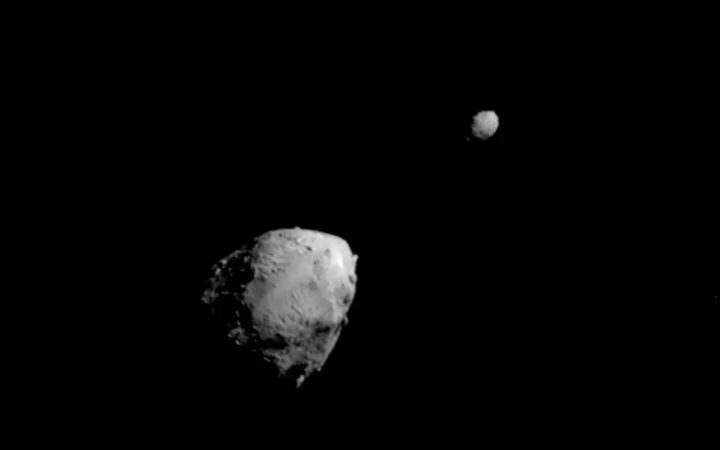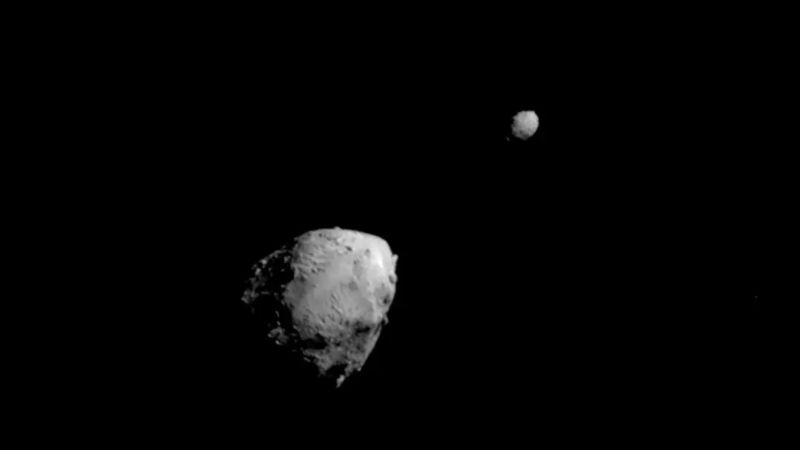
The NASA DART spacecraft successfully altered the orbit of the asteroid Dimorphos in a planetary defense test, marking a significant achievement in efforts to protect Earth from potential cosmic threats. Recent observations confirm this alteration affects both Dimorphos and its larger counterpart, Didymos, as the binary pair orbits each other, reports BritPanorama.
The mission, which took place in 2022, employed a direct collision approach to assess whether humanity could change an asteroid’s trajectory. This latest analysis indicated that the time required for Didymos and Dimorphos to complete their solar orbit, approximately 770 days, has permanently decreased by less than a second following the impact.
Research published in the journal Science Advances reveals that this reduction in orbit timing stems from a change in the binary system’s orbital speed, quantified at about 11.7 microns per second, equating to approximately 1.7 inches per hour. Dr. Rahil Makadia, a lead author of the study, noted that even such a small change could have significant implications for future collision avoidance scenarios.
The DART mission is notable as it is the first occasion a human-made object has effectively changed the path of a celestial body. Despite Didymos and Dimorphos not posing an immediate threat to Earth, the mission offered a valuable opportunity to evaluate the effectiveness of spacecraft as defensive tools against asteroids.
The aftermath of a collision
Scientists observed that DART’s collision with Dimorphos resulted in a substantial ejection of debris into space, estimated at around 35.3 million pounds (16 million kilograms). Although Dimorphos retained about 99.5% of its mass, the debris amount released was significantly greater than that of the spacecraft itself, underscoring the collision’s intensity.
Measurements indicated that the force of the debris propelled from the asteroid was more influential in altering the binary system’s orbit than the impact from the DART spacecraft. This momentum shift has proven essential in confirming the effectiveness of kinetic impact as a viable method of planetary defense.
The research draws from ground-based observations and data obtained via stellar occultations, where the light of stars is obscured by passing celestial bodies. Such observations, although challenging to obtain, were key in calculating the changes induced by DART on Didymos’s orbit, facilitated by numerous volunteer astronomers worldwide.
Study co-lead author Steve Chesley emphasized the importance of these observations in refining the measurements of Didymos’ altered orbit post-DART. The coordinated efforts across international teams have led to enhanced precision in understanding the dynamics of asteroid interactions.
Tracking risky asteroids
The ESA’s follow-up Hera mission, launched in 2024, aims to further explore the implications of the DART impact, with expectations to deliver new imagery of Dimorphos later this year. Meanwhile, NASA’s Near-Earth Object Surveyor mission is in development to identify potentially hazardous asteroids that remain undetectable by traditional Earth-based observatories.
The rigorous analysis and observations post-DART will contribute to the ongoing efforts in establishing effective methods for mitigating asteroid threats. For space agencies, understanding how slight orbital changes can effectuate significant deflections is crucial in the larger context of planetary defense strategies.
Thomas Statler, a lead scientist at NASA, reaffirmed the importance of these findings, remarking that the precision in measurements validates kinetic impact as an effective technique for mitigating asteroid risks. As more data accumulates, the hope is that future scenarios can effectively leverage this knowledge to avert potential threats to Earth.