Little red dots: a cosmic mystery from the James Webb telescope
Cosmic anomalies resembling small, bright red points have captivated astronomers since the James Webb Space Telescope commenced operations four years ago. Hundreds of these objects, dubbed little red dots (LRDs), appear in virtually every image captured, but their true nature remains elusive, reports BritPanorama.
Initially speculated to be massive galaxies from the early universe or dust-enshrouded black holes, these hypotheses have been challenged and refined over time. “Every deep pointing you did with James Webb, you were finding a few,” explained Jenny Greene, an astrophysical sciences professor at Princeton University, emphasizing their commonality.
Greene indicated that while substantial progress has been made, the LRDs represent a significant enigma. “This is the first time in my career that I have studied an object where we truly do not understand why it looks the way it does,” she stated, highlighting the ongoing uncertainty in their classification. Observations have led to various propositions, primarily focusing on the idea that these dots are linked to growing black holes, surrounded by dense hydrogen gas rather than dust.
Notably, the research surrounding LRDs has intensified since the telescope’s debut, which has found phenomena previously obscured by limits in resolution and sensitivity of older instruments like Hubble. Jorryt Matthee, who first coined the term “little red dots,” noted that expanded capabilities have unveiled these objects in remarkable detail, allowing scientists to explore new theoretical frameworks. He suggested the possibility that LRDs could serve as a “missing link” in understanding how supermassive black holes formed within galaxies.
A ‘missing link’
The term “little red dots” emerged from a 2024 study led by Matthee and his team, offering a more accessible label than the prior scientific terminology. These anomalies were finally detectable only through the Webb telescope’s superior technology, which has a significant advantage with its larger primary mirror and advanced infrared capabilities.
The redness of the dots is attributed both to their vast distances, resulting in a phenomenon known as redshift, and potentially because of the hydrogen gas surrounding them. This nuance underscores the complexity of their identity.
Last year, researchers made a notable breakthrough with the detection of three nearby LRDs, which might offer deeper insights as they are easier to study than their more distant counterparts. Despite this advancement, Matthee warned that local LRDs could still be 100,000 times rarer than those found in the early universe, where they are believed to be more prevalent.
‘Black hole stars’
The investigation into these objects has led to various intriguing concepts. Recent work by researchers involved in the RUBIES program — the Red Unknowns: Bright Infrared Extragalactic Survey — highlighted systematic efforts to analyze not only the LRDs but also numerous other red and bright cosmic entities, with early findings suggesting LRDs could be one of many objects exhibiting unique characteristics in the universe.
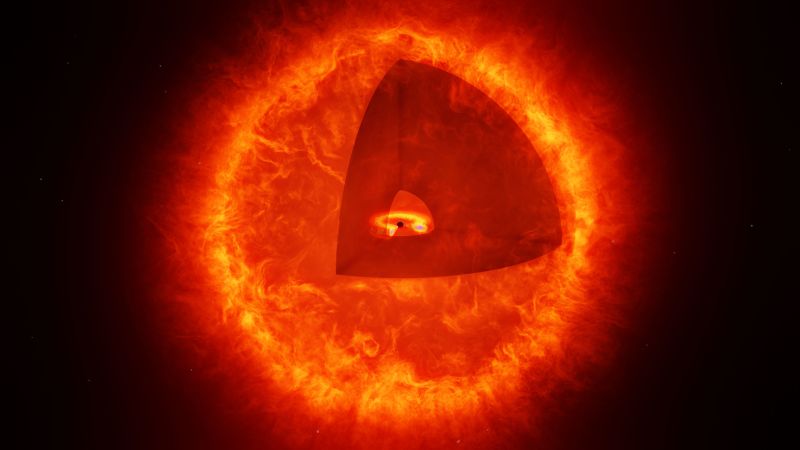
The LRDs are gaining recognition as they begin to resemble properties theorized for quasi-stars, which are stars powered by black holes and surrounded by a dense cloud of gas. Such comparisons come without definitive proof; however, they signify the potential for groundbreaking discoveries about the lifecycle of black holes and their formation mechanisms.
As scientists delve deeper into understanding the LRDs and their implications for cosmology, their findings illustrate the rich, ongoing exploration of the universe. Each observation from the James Webb telescope piques curiosity and fosters a dialogue among various astrophysical disciplines.
The exploration of these cosmic enigmas reflects the duality of science’s quest: the pursuit of knowledge intertwined with the thrill of the unknown, reminiscent of the journey taken by astronomers throughout history.