Mother-daughter team discovers world’s largest coral colony in Great Barrier Reef
A mother-and-daughter team of citizen scientists has identified the world’s largest known coral colony, found on the Great Barrier Reef off the coast of Australia, reports BritPanorama.
The coral spans approximately 111 meters (364 feet) in length—about the same as a soccer pitch—and covers around 3,973 square meters (42,765 square feet), according to a statement from conservation organization Citizens of the Reef.
This find has been described as “among the most significant coral structures ever recorded on the Great Barrier Reef,” and “the largest documented and mapped coral colony in the world,” as stated by Citizens of the Reef.
The coral was discovered late last year by Sophie Kalkowski-Pope, marine operations coordinator at Citizens of the Reef, and her mother, Jan Pope, an experienced diver and underwater photographer.
Pope had actually been diving at the location a week prior and sensed the presence of something unique. The two returned equipped with measuring instruments to confirm their findings.
“When we hopped in the water, immediately I could recognize the significance of what we were seeing,” Kalkowski-Pope recounted. They filmed a video to showcase the expanse of the J-shaped coral, noting it took three minutes to swim from one end to the other.
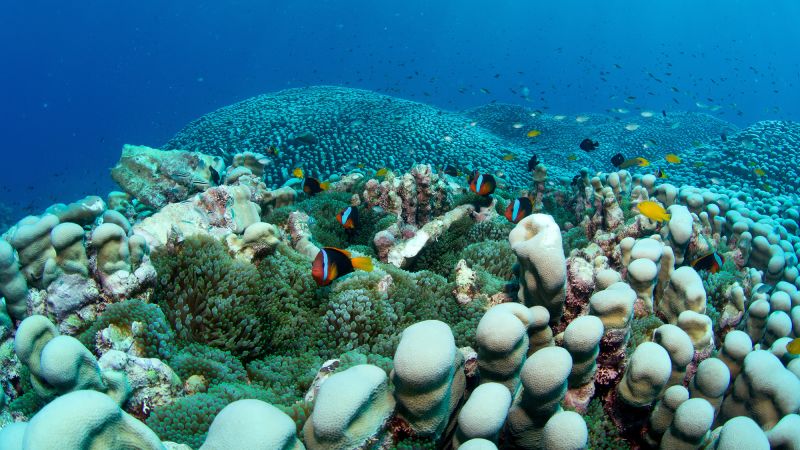
The size of the Pavona clavus coral was verified through manual underwater measurements and high-resolution imagery captured from platforms on the water’s surface. This data facilitated the production of a detailed 3D model of the coral, according to Citizens of the Reef.
This spatial modeling is vital for future monitoring, as it allows for direct comparisons over time, enabling scientists to understand how the reef changes, said Serena Mou, a research engineer at the Queensland University of Technology’s Centre for Robotics.
Researchers have also identified that the site experiences strong tidal currents and lower exposure to tropical cyclone waves compared to many areas of the Great Barrier Reef. They are now investigating whether these environmental conditions may contribute to the existence of such a large coral structure.
Despite its remarkable discovery, the exact location of the coral has not been disclosed to mitigate potential risks of unintended impact.
The Great Barrier Reef stands as the planet’s largest living structure, supporting a diverse range of species. However, it has been severely affected by a series of mass bleaching events in recent years, with parts of the reef turning a stark white.
Globally, coral reefs are facing similar crises, as more than 80% of the ocean’s reefs are currently impacted by an ongoing global bleaching event, which began in 2023 due to record-high marine temperatures. Bleaching is detrimental, as corals lose the algae living in them, which serve as a crucial food source.
Citizens of the Reef is part of ongoing conservation efforts to protect this critical ecosystem. The mother-daughter duo was conducting reef surveys from their family boat as part of the Great Reef Census, a collaborative initiative involving over 100 vessels.
“The Great Reef Census helps us to locate the most important sources of reef recovery, helping scientists and managers better target their protection,” stated Pete Mumby from the Marine Spatial Ecology Lab at the University of Queensland.
This initiative aims to harness “people power” to drive conservation efforts, according to Andy Ridley, CEO of Citizens of the Reef.
Understanding the complexities and challenges faced by coral reefs remains essential as conservation groups work to mitigate further damage to these vital ecosystems.