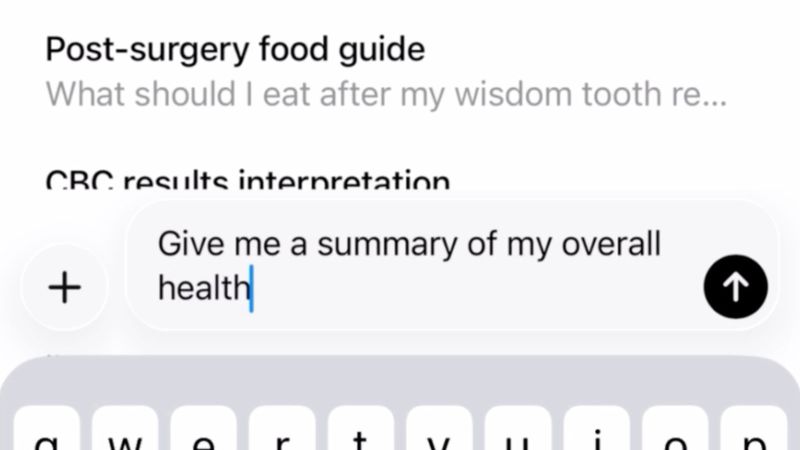
AI chatbots have made significant strides in providing health-related information, particularly with the recent launch of ChatGPT Health by OpenAI, which promises to analyze users’ medical records and data from wellness apps. This follows a notable trend, as hundreds of millions turn to chatbots for advice, reports BritPanorama.
ChatGPT Health is currently in a waiting list phase, while the AI firm Anthropic also offers similar functionalities through its Claude chatbot. Both companies emphasize that their chatbots should not be seen as substitutes for professional medical advice but rather as tools to help summarize complex test results and assist in preparing for doctor visits, drawing on extensive user data.
Healthcare professionals highlight that while AI programs may not replace human interaction, they can provide personalized information that is often more relevant than generic online searches. “The alternative often is nothing, or the patient winging it,” noted Dr. Robert Wachter, a medical technology expert from the University of California, San Francisco, promoting responsible use of these tools for gathering useful insights.
However, the use of AI chatbots comes with caution. Experts suggest immediate medical attention for serious symptoms like shortness of breath or severe headaches, rather than relying on chatbots. Dr. Lloyd Minor of Stanford University advises users to maintain skepticism and not to base major health decisions solely on AI-generated responses.
Chatbots can offer more personalized information than a Google search
Some medical professionals view the latest AI chatbots as an enhancement over traditional information-gathering methods. They assert that these tools can personalize responses by considering factors like user prescriptions and medical history, as long as the user provides sufficient context.
Despite their potential, AI systems are not flawless; they can misinterpret questions or provide conflicting information. A study from Oxford University revealed that while AI chatbots correctly identified medical conditions in hypothetical scenarios 95% of the time, interactions with real patients often lead to misunderstandings, mainly due to inadequate user input and confusion arising from mixed-quality information.
As the landscape of health information access changes, concerns regarding privacy also arise. Medical privacy laws, such as HIPAA, do not extend to chatbot providers, raising questions about the protection of personal data once shared. Both OpenAI and Anthropic assert that health information is handled separately and is not utilized for training their AI models.
If you’re having worrisome symptoms, skip AI
Experts insist that while AI can be useful, it should not replace direct interaction with healthcare professionals, especially in urgent situations. Dr. Minor highlights that reliance solely on AI for serious medical decisions is inadvisable; a comprehensive approach remains vital.
Consider your privacy before uploading any health data
As patients share personal information to enhance chatbot accuracy, they must understand that AI companies do not adhere to the same privacy standards as healthcare providers. Practicing caution when sharing sensitive information is crucial, as doing so can potentially expose users to privacy risks.
Current studies indicate that while AI technologies are evolving quickly, they require careful implementation and the guidance of responsible healthcare practices. Testing shows that although AI can excel in theoretical assessments, its practical application still presents challenges that need addressing.
The gradual improvements in AI capabilities signal a hopeful future for patient care, but transitioning to a trustworthy system calls for ongoing scrutiny and collaboration between technology developers and healthcare professionals.
The dialogue surrounding AI in healthcare is far from over, as advancements continue to spark interest and concern. The intersection of technology and health remains a critical area for further exploration and responsible innovation.