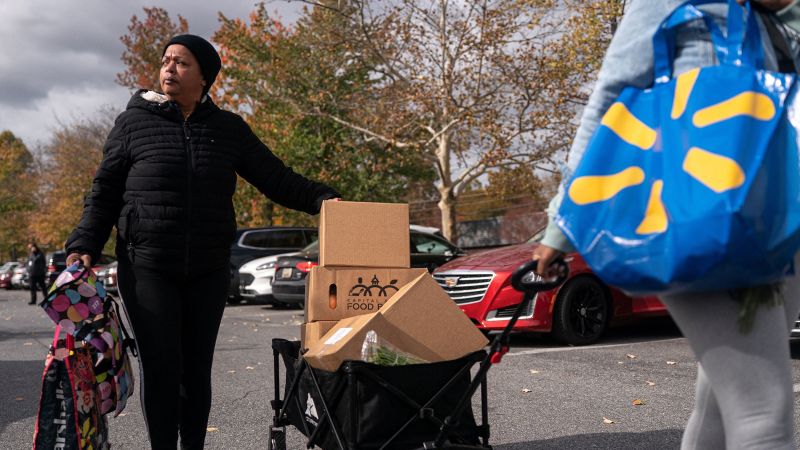
Demand at food banks across the United States has surged sharply in recent weeks, with reports indicating that a Washington, DC, food bank has seen its demand double, while a Texas charity has been compelled to utilize emergency hurricane reserve funds to cope with the influx. A Florida charity is now distributing approximately 300,000 meals daily, yet officials claim this effort falls short of meeting the urgent need, reports BritPanorama.
As the country faces the impending suspension of federal food benefits in November following a nearly month-long government shutdown, millions of Americans are at risk of hunger. This looming crisis presents a grim outlook for food banks and charities, which are anticipating a significant upturn in demand as the holiday season approaches.
Numerous charitable organizations, both large and small, have communicated to various media that they have already reached their operational limits and will be unable to provide adequate support amidst the growing needs.
“The real impacts are starting now,” stated Brian Greene, CEO of Houston Food Bank. “There’s been some uptick, but nowhere near what we’re going to see by the time we get to early November. … it’s going to be unprecedented.”
With Thanksgiving approaching, many furloughed federal workers or those forced to work without pay are becoming new patrons of food banks and charities. As the Trump administration communicates a lack of funds to provide food stamps to nearly 42 million Americans next month, the situation is likely to worsen.
The convergence of these factors has generated what some nonprofit leaders describe as a “perfect storm” for the charitable sector. Miette Michie, a board member of the Emergency Food Network serving central Virginia, indicated the distribution site has remained at capacity since the onset of the shutdown, leaving volunteers with no option but to advise individuals to return the following day.
“It makes you angry. … You’re messing with people’s lives here,” Michie conveyed. “This is not just a game; it’s actual people, working people, whose lives are being affected by this.”
Dave Silbert, who manages So What Else, another food bank in Washington, DC, described the situation as one of “chaos and uncertainty.” He questioned how their operations could expand to meet the growing demand, contemplating logistics such as increasing weekly food supplies and fundraising efforts significantly.
States rush to provide support
In response to the escalating crisis, various states are mobilizing to fill the gap left by federal aid. California’s Governor Gavin Newsom and South Carolina’s Governor Henry McMaster have activated their National Guard to support local food banks, while Nevada’s Governor Joe Lombardo has indicated readiness to follow suit.
Other states, including New Mexico, Minnesota, Washington, and West Virginia, have announced substantial funding for relief programs. In Virginia, home to many federal employees, a new food-assistance system is being developed for residents relying on SNAP benefits, with an anticipated weekly cost of $37.5 million, funded through the state’s surplus, as explained by Republican Governor Glenn Youngkin.
However, not all states have the resources to match federal funding levels. Nonprofit leaders have warned that food banks are intended to supplement, not replace, federal aid programs — an essential role that becomes increasingly strained amid rising demands.
For instance, in Georgia, residents rely on about $250 million in SNAP benefits each month, while food banks provide merely around $4.5 million worth of food, according to Amy Breitmann, CEO of Golden Harvest Food Bank, which operates in 24 counties spanning Georgia and South Carolina. “The food bank is supposed to be the safety net underneath SNAP, right?” she emphasized. “It’s not supposed to replace that.”
Food banks already reeling from federal cuts
The escalating demand on food banks comes on the heels of significant federal cuts that took effect earlier this year, notably the termination of millions in funding for a program enabling food banks to procure food directly from local agricultural producers.
Greg Higgerson, Chief Development Officer of Second Harvest Food Bank of Central Florida, noted a concerning “erosion of federal food support” throughout the past year, explaining that a notable portion of their distributed food comes from the Emergency Food Assistance Program.
As a result of the ongoing government shutdown compounded by previously incurred federal cuts, the Food Bank of Central & Eastern North Carolina has described the current situation as “unprecedented.” President and CEO Amy Beros highlighted that their operations have been severely disrupted, losing $2 million following the funding cuts and experiencing numerous canceled deliveries from the Emergency Food Assistance Program.
“We know there’s no way for the food banks to fully fill the gap,” Beros stated succinctly.