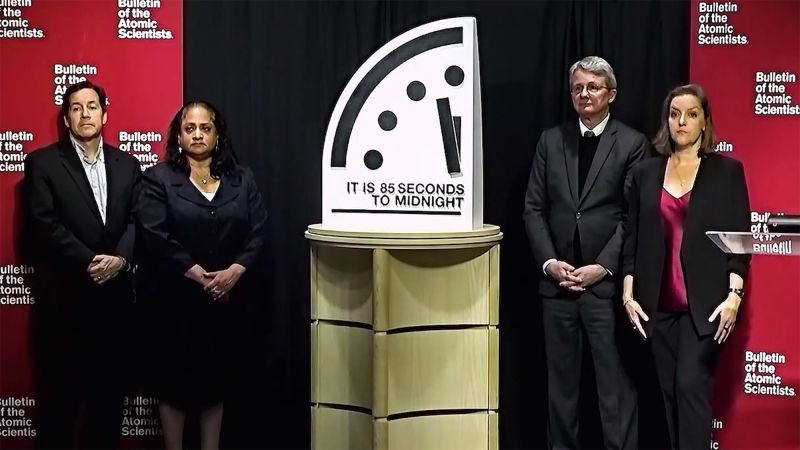
The Doomsday Clock was set at 85 seconds to midnight on Tuesday, marking the closest it has ever been to midnight, which symbolizes humanity’s proximity to catastrophic destruction. This adjustment was announced by the Bulletin of the Atomic Scientists, which has maintained the clock since its inception in 1947.
Midnight signifies a point at which Earth could become uninhabitable. The clock was adjusted from 89 seconds last year — already a record at that time — to reflect insufficient progress in addressing global challenges like nuclear risks, the climate crisis, and the rise of disruptive technologies.
In 2023 and 2024, the clock was set at 90 seconds to midnight. However, the 2025 change was made based on concerns over existential threats including misinformation and disinformation, which pose additional risks to global stability. Bulletin President and CEO Alexandra Bell emphasized that humanity is not taking sufficient action against these threats: “The risks we face from nuclear weapons, climate change and disruptive technologies are all growing. Every second counts and we are running out of time,” she noted.
Historically, the Doomsday Clock was established by scientists who worked on the Manhattan Project to measure nuclear threats, evolving over time to encompass the climate crisis beginning in 2007. The time on the clock is determined annually by experts on the Bulletin’s science and security board. This board, established by Albert Einstein, consists of prominent figures, including several Nobel laureates.
What is the Doomsday Clock?
The Doomsday Clock is not an exact measure of existential threats but serves as a cultural touchstone to stimulate discussions around significant scientific and global issues. Some experts remain skeptical about its utility, claiming that while the alarm may raise awareness, it may not always accurately reflect the complexities of different risks.
Dr. Michael Mann from the University of Pennsylvania pointed out the limitations of the clock as a metaphor for the diverse threats humanity faces. Despite this, he affirmed its importance in highlighting the fragility of our existence.
Engagement in these matters is critical. Notably, during the UN Climate Change Conference in Glasgow in 2021, then-UK Prime Minister Boris Johnson referenced the clock while discussing the pressing climate emergency.
What happens when the clock hits midnight?
The Doomsday Clock has never reached midnight, and its former president Rachel Bronson expressed her hope that it never will. She stated that at midnight, it would indicate a time when catastrophic events such as nuclear conflict or severe climate change have likely occurred, leading to human extinction.
What can we do to turn back time on the clock?
Moving the clock back remains possible through decisive action. The furthest point from midnight was 17 minutes, achieved in 1991 following the signing of the Strategic Arms Reduction Treaty. Bronson reflected on the collective ability to mitigate these threats: “We at the Bulletin believe that because humans created these threats, we can reduce them,” she said. This belief underscores the necessity for proactive engagement at all societal levels.
Individual actions also hold significance. Advocating for important issues and making lifestyle changes, such as reducing energy consumption and addressing food waste, can contribute to broader efforts to counteract the ongoing climate crisis. Simple daily decisions can collectively lead to substantial environmental benefits.
As the global community grapples with the implications of the Doomsday Clock’s current setting, the urgency to foster dialogue and implement impactful measures grows increasingly apparent.