“`html
A warplane encrusted with coral lies upside down on the seafloor of Saipan’s harbor, its landing struts thrust awkwardly upward as colorful fish weave in and out of the exposed fuselage, engine and gun turret. The wreckage is slowly being subsumed by the reef in the shallow blue waters of the tropical lagoon, but its story is far from over, reports BritPanorama.
Three crew members had been aboard the Grumman TBF Avenger as it went down, likely during or after the 1944 Battle of Saipan, when US forces launched an assault to secure the Northern Mariana Islands during World War II.
American military officials viewed Saipan, the largest island in the Mariana archipelago, as a key base for operations in the Pacific, and the battle marked a pivotal victory for the US. Only one of the downed plane’s crew, however, walked away from the conflict; the remains of the other two men are presumed submerged, neither recovered nor forgotten.
Now, the Avenger wreck is one focal point for scientists in a cutting-edge endeavor to understand whether traces of decades-old DNA can be preserved and detected at wreck sites. Working with the US Defense POW/MIA Accounting Agency, the researchers are testing innovative technology that uses environmental DNA, or eDNA, found in soil, sediment, and water as a biological scouting mechanism. If successful, the method could help locate the remains of the missing service members — and perhaps thousands more.
The Defense POW/MIA Accounting Agency, or DPAA, is tasked with recovering the remains of the more than 40,000 American troops presumed lost at sea since World War II. Officials are hoping eDNA will speed up the search.
“We’re looking for ways to meet some of the challenges that are inherent in underwater investigations … some of the most challenging sites for us,” said Jesse Stephen, an archaeologist who is the DPAA’s chief of innovation.
Investigating an underwater site, he said, tends to be more complicated than looking for missing service members on land for several reasons. There is typically a dearth of historical information about the conditions in which the vehicle went missing, and locating a sunken aircraft or a large ship in the vastness of the ocean is difficult and costly. Even when a site has been located, it’s hard to find human remains, which often become separated from wreckage due to impact force or the movement of water.
“We wanted to explore how you could use eDNA as a general site investigation tool specifically to determine the likely presence or absence of human remains,” Stephen said.
Environmental DNA as ‘bone sniffer’
The underwater clues that researchers are grasping for in this effort are invisible, almost ephemeral, but hold promise just the same. Environmental DNA detection is an exciting and relatively new approach that allows scientists to recognize and amplify the genetic material that all creatures, living and dead, shed into their environments, and it already has gotten results in some fields of research.
“Without physically collecting an animal or a plant or human remains, you can determine whether something is there — ideally, where it is located — based on just the DNA that’s getting shed into the water or the surrounding sediment,” explained Kirstin Meyer-Kaiser, a marine biologist and associate scientist studying seafloor ecology at the Woods Hole Oceanographic Institution (WHOI) in Massachusetts, who partnered with the DPAA on the project.
Until now, researchers have primarily used the technique in conservation efforts. It was first successfully employed in an aquatic environment in 2008 to detect the presence of an invasive species — the American bullfrog — in France, after more traditional methods of DNA detection, such as audio or visual surveys, had been unsuccessful. The approach has since been applied to identify a wide range of species, small and large, particularly in water environments.
Meyer-Kaiser envisioned harnessing eDNA as a “bone sniffer” to detect and locate fragments of DNA left by decomposing human remains, which, if it proves feasible, would serve as a transformative alternative to the DPAA’s traditional approach: painstaking, monthslong underwater excavations to try and identify the bones or belongings of a lost pilot or other crew member.
Environmental DNA has been successfully used by archaeologists to identify and extract human DNA, sometimes tens of thousands of years old, from sediment on land. However, the successful samples have largely been collected from dark caves or other cold and stable environments where DNA is preserved particularly well. The ocean, with its variable currents, depths, and temperatures, is a starkly different environment.
The ambitious project planned by Meyer-Kaiser involved the collection of water and sediment samples from seven downed planes, the majority of which were from World War II, and five shipwrecks in three locales: off the coast of Palermo, Italy; Lake Huron’s shipwreck alley; and two locations in Saipan’s waters, one the shallow lagoon where the Avenger crashed and the other deep ocean. The sampling took place in 2022 and 2023.
The researchers chose wrecks located in a range of environments to help them understand whether eDNA might be a more effective mechanism to identify human remains in some conditions than others: salt versus fresh water; cold versus warm temperatures; shallow versus deeper depths.
The military sites included were in Saipan and Italy, while the Lake Huron sites were commercial shipwrecks in relatively accessible freshwater locations. The experiment also analyzed wrecks at the same sites that are not associated with those who have gone missing to ensure that control samples were collected.
The four wrecks at the deepest site off the coast of Saipan, some 300 meters (980 feet) beneath the surface, were only reachable by an underwater remotely operated vehicle, but others exist at depths that are easily accessible to scuba divers. Calvin Mires, a maritime archaeologist at WHOI and part of the DPAA project, was tasked with recovering the water and sediment samples using the methodology set out by Meyer-Kaiser.
To the cutting edge
A veteran of large-scale underwater excavations, Mires suited up to collect samples at the shallower Saipan site, where the Avenger is located, and supervised the process at Lake Huron and in Italy. “EDNA is a little bit out of my wheelhouse,” Mires said. “But this is what I got into science for, it’s going to that cutting edge, not knowing the answer.”
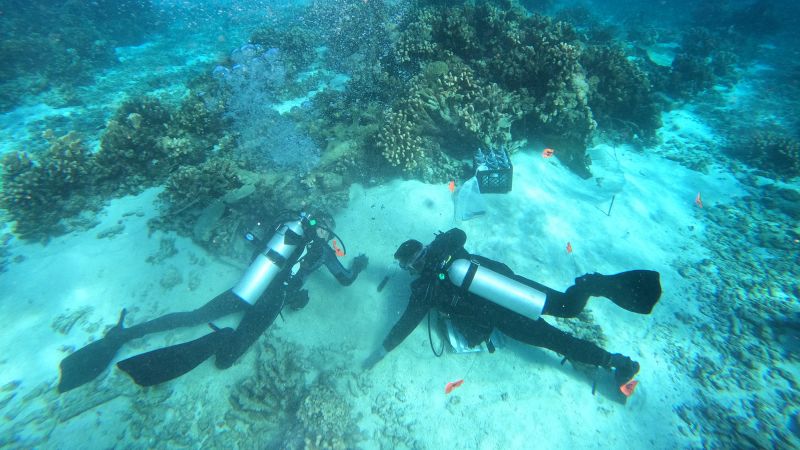
In Saipan’s turquoise waters, Mires and his colleague referred to an annotated map on a waterproof tablet as they marked out collection locations over the wreck site using red, numbered flags. To avoid contamination, team members had their DNA genotyped so their own sequences could be identified and removed from the samples. The researchers also wore hoods and gloves when possible during field ops.
Water sampling went smoothly, with the help of Niskin bottles, oceanographic tools for sample-collecting that consist of thick plastic tubes with stoppers on both ends. Researchers hold the tubes open during a dive before releasing to close them around a parcel of water.
Sampling of seafloor sediment proved to be more difficult. Handheld push cores, clear-plastic tubes with one-way valves that collect sediment, caused unanticipated difficulties — particularly at the Avenger site, where the bony coral reef made it tough to collect fine sediment. In some cases, Mires used a small trowel to collect samples.
His collection efforts were successful, but the samples nearly didn’t make the long journey back to the University of Wisconsin Biotechnology Center, where they were to be analyzed.
The team had planned to store and ship the samples in dry ice to keep them at the required temperature of minus 80 degrees Celsius (minus 112 degrees Fahrenheit). However, the shipping company told the researchers at the last minute that the airline would not ship dry ice. The team found a solution: transporting the samples to Guam in regular ice, where they were stored in a freezer for a month before making the trip to the US.
After an agonizing wait, Charles Konsitzke, the Biotechnology Center’s associate director and team lead for University of Wisconsin–Madison’s Missing in Action program, was able to confirm that the dry ice drama fortunately had no net effect on the quality of the data or interpretation of the findings.
Analysis of everything the divers gathered took place over the course of several months in 2023 and 2024. The team deployed a relatively new technique known as metagenomics, which involves sequencing all the DNA in a sample at the same time rather than simply searching for the species of interest.
In addition to directly recovering human genetic material, this process allowed Meyer-Kaiser and her colleagues to potentially identify a proxy for human DNA: microbes that may be involved in