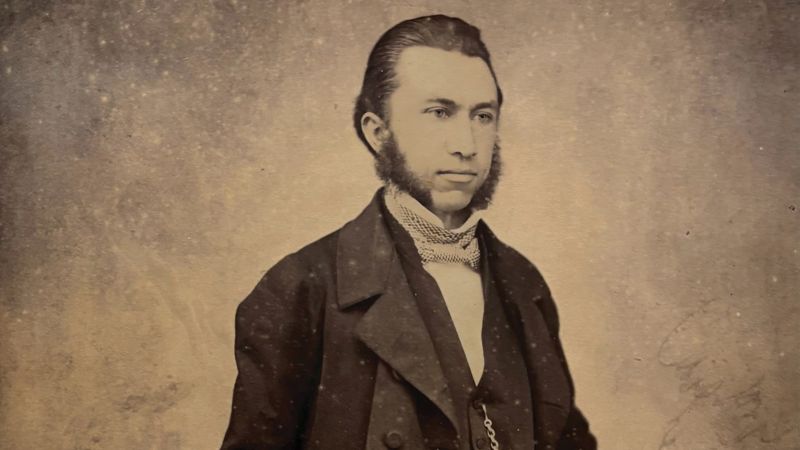
Recent research has yielded the first known portrait of 19th-century British astronomer Richard Carrington, directly linking his legacy to the powerful solar storm known as the Carrington Event. Discovered by Kate Bond, an assistant archivist at the Royal Astronomical Society in London, the photograph sheds light on the man who linked solar flares to geomagnetic storms, reports BritPanorama.
The Carrington Event, which occurred on September 1, 1859, unleashed strong electric currents that shocked telegraph operators and ignited fires in their offices. The intense solar storm led to bizarre occurrences, such as telegraph machines transmitting messages without being connected to power sources, as documented by the National Oceanic and Atmospheric Administration.
Auroras, typically confined to higher latitudes, illuminated the skies as far south as Panama during the storm, marking it as the most severe geomagnetic storm ever recorded. Its effects on Earth, previously unknown as a form of space weather, highlighted the planet’s vulnerability to solar activity.
On the day preceding the event, Carrington observed a significant solar flare—an astronomical first—through a telescope, providing a crucial link between solar activity and its impacts on Earth. Notably, although his colleague Richard Hodgson also witnessed the flare, Carrington established the foundational connection between solar flares and the geomagnetic storms they cause, subsequently documented by Mark Miesch from NOAA’s Space Weather Prediction Center.
Despite his substantial contributions to solar physics, Carrington’s name lacks widespread recognition, potentially due to the absence of a visual representation. Bond’s quest for his portrait was inspired by a clue from Stuart Clark’s book, which expressed a desire to see Carrington’s likeness. The discussion led her to investigate archives and auction sites where such photographs might surface.
A missing portrait
The Royal Astronomical Society holds Carrington’s original notes on sunspots from 1853 to 1861, revered for their inclusion of his sketches of the 1859 flare. However, documentation of his likeness was absent for decades, even online searches yielded nothing but a misattributed image of British mathematician Lord Kelvin.
During a meeting with Hisashi Hayakawa, Bond noted that Carrington was part of the Literary and Scientific Portrait Club, which mandated members to have their photos taken by the distinguished Maull & Polyblank studio. Historical records confirmed Carrington’s membership, including an invitation to George Airy, the Astronomer Royal.
Extensive searches across major institutions, including the UK’s National Portrait Gallery and various international archives, ultimately returned negative results. Ironically, while browsing auction sites as a whimsical endeavor, Bond encountered a photo labeled “the late Carrington,” piquing her interest in its potential authenticity.
Illuminating clues
The portrayal featured a man in his thirties—consistent with Carrington’s age during the mid-1850s—and included the letters FRS, identifying him as a Fellow of the Royal Society. Bond’s instinct drove her to purchase the photo, suspecting it could be a unique find among the esteemed scientist’s portraits.
Upon arrival, the photograph revealed odd faint writings, only discerned when viewed under specific lighting conditions. Expert analysis at the John Rylands Library confirmed that the inscriptions were made prior to its mounting, significantly linking the image to Carrington through a reference to an acquaintance who nominated him for fellowship.
Carrington’s contributions to solar science are remarkable, yet this new visual reference adds a personal dimension, enriching the narrative of his scientific encounters that reshaped understanding of solar behavior. As Carrington’s image is now immortalized within the Royal Astronomical Society’s archives, the photograph serves as a fitting tribute to a key figure in solar physics, maintaining a legacy that endures through generations.
A reflection on Carrington’s discoveries reminds the scientific community of the ongoing quest to comprehend the sun’s mysteries, an endeavor that, over a century later, remains incomplete.