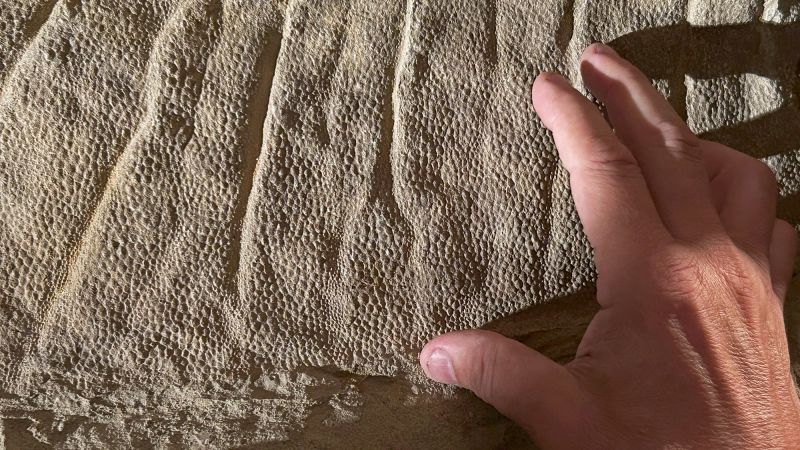
In eastern Wyoming’s Lance Formation, researchers have uncovered an exceptional cache of dinosaur fossils, including several well-preserved specimens exhibiting intricate details of skin, hooves, and spikes. Among these finds, the area has been dubbed the “mummy zone” by paleontologists, underscoring its significance in understanding dinosaur preservation, reports BritPanorama.
Lead researcher Dr. Paul Sereno, alongside his colleagues, aims to shed light on why this locale has yielded such remarkable discoveries. Their current study follows historical finds dating back to the early 1900s, notably the identification of two Edmontosaurus annectens skeletons by fossil hunter Charles Sternberg, which revealed clear impressions of skin and distinct characteristics.
Sereno’s revelations build on Sternberg’s earlier work, noting the exceptional preservation of these dinosaur remains, which present in clear three-dimensional orientations. “Osborn said in 1912 he knew that it wasn’t actual, dehydrated skin, like in Egyptian mummies,” Sereno remarked, pointing to the long-standing mystery of such fossils’ preservation methods.
The new research offers critical insights into these fossils, identifying the conditions that permitted their lasting anatomy to remain intact. Using advanced techniques such as CT scanning and X-ray spectroscopy, Sereno’s team inspected mummies found in the Lance Formation, unveiling a delicate clay layer formed over their remains. This natural molding likely retained the features of these creatures, producing an accurate representation of their external appearance.
Despite thorough investigation, Sereno’s team did not find remnants of soft tissue but rather a thin film of clay, which effectively preserved the contours of skin and other features. “It’s so real-looking, it’s unbelievable,” he stated of their findings. The study coined the term “rendering” to describe this preservation, differentiating it from earlier terminology that failed to capture the full essence of these specimens.
Further analysis revealed that during the Late Cretaceous Period, Edmontosaurus inhabited a region undergoing significant climate fluctuations. Drought likely caused the demise of these dinosaurs, whose remains were covered by a rapid influx of sediment, encapsulating their features within a clay mask. This process has imparted critical information about the physiology of the species, challenging previous assumptions regarding its evolution.
Dr. Anthony Martin, an expert in the field, affirmed the potential of clay to replicate the details of biological surfaces, emphasizing how the conditions of this geological past might pave the way for future discoveries. Experts like Dr. Stephanie Drumheller-Horton advocate for further studies into the processes that govern fossilization, hoping to enhance the hunting grounds for similar specimens moving forward.
A dinosaur death cast in clay
Dr. Sereno and his team’s dedication to understanding Edmontosaurus yielded a sophisticated reconstruction of its appearance. Analyzing newly discovered mummies allowed for new insights into what this species likely resembled. The creature, measuring over 12 meters (40 feet) in length, boasted features such as a fleshy crest along its neck and a spiked tail, with skin that exhibited intricate wrinkles and pebble-like scales.
Unique insights included the discovery of hooves—an attribute traditionally associated with mammals—classifying Edmontosaurus as a groundbreaking example of hoofed reptiles. “Sorry, mammals, you didn’t invent it,” Sereno quipped, illustrating the significance of this finding within the evolutionary landscape of prehistoric creatures.
The research culminated in a study published in the journal Science. Through these discoveries, scientists continue to deepen their understanding of dinosaur biology and the geological forces that shaped their world.