Scientists have achieved a significant breakthrough with the digital reconstruction of an early human ancestor, nicknamed Little Foot, who lived approximately 3.67 million years ago. This remarkable development allows researchers to virtually analyze Little Foot’s facial features, enhancing our understanding of human evolution, reports BritPanorama.
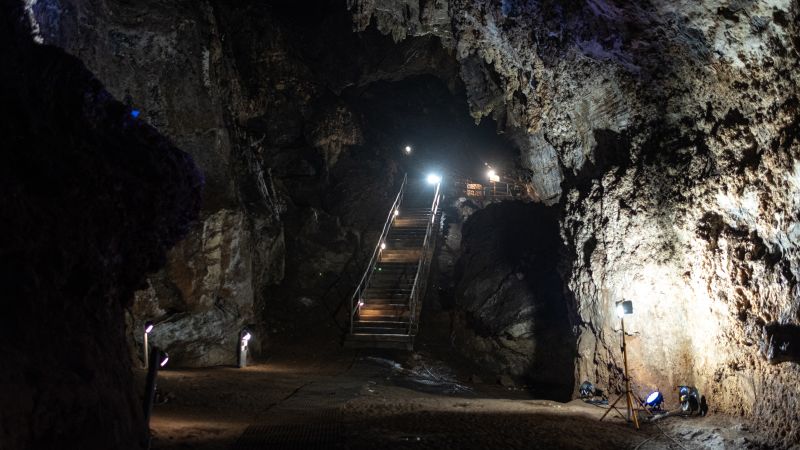
Renowned paleoanthropologist Ronald Clarke initially identified four small bones in the collection at the University of the Witwatersrand’s museum and later discovered Little Foot’s nearly complete fossil in the Sterkfontein Caves, located northwest of Johannesburg, South Africa, in the 1990s. The excavation of these remains took about 20 years, culminating in a specimen that is approximately 90% intact. This is the most complete known skeleton of Australopithecus, a species that could walk upright but also adeptly climbed trees to evade predators like sabre-toothed cats.
The fossil represents the oldest known evidence of human evolution in southern Africa, according to Dr. Amélie Beaudet, an honorary researcher at the University of the Witwatersrand, who has extensively studied this specimen. However, the fossil’s skull suffered significant deformation as surrounding sediment accumulated, complicating its analysis. The distortions have made traditional physical reconstructions unfeasible.
Recently, Beaudet and her colleagues utilized digital technology to realign the facial bones virtually, revealing a clearer view of Little Foot’s face and potential characteristics shared with other members of the human lineage. “Only a handful of Australopithecus fossils preserve an almost complete face, making Little Foot a rare and valuable reference point,” Beaudet noted in a statement regarding their study published in the journal Comptes Rendus Palevol. This reconstruction provides insights into key anatomical features related to vision, respiration, and feeding, suggesting important elements for understanding our evolutionary history.
Reconstructing a fossilized face
Little Foot’s fossil traveled to England for the first time to facilitate the capture of detailed images of her facial structures. The skull underwent high-resolution scanning at the Diamond Light Source synchrotron in Oxfordshire, producing over 9,000 precise images through nondestructive X-rays. Following this, a supercomputer at Cambridge processed the data to render the facial bones in three dimensions, enabling a digital reconstruction of the ancient visage.
This process uncovered the upper facial structure for the first time, specifically revealing the orbital region where Little Foot’s eyes would have been. The reconstructed face was analyzed alongside three other Australopithecus specimens and modern great apes. Surprisingly, the size and shape of Little Foot’s face were found to lie between that of a gorilla and an orangutan, yet its form was more similar to that seen in orangutans and bonobos.
The research team discovered that these features hint at deeper evolutionary links. “All this shows the complexity of the patterns of variation in the genus Australopithecus and its proximity to the great apes,” stated Dr. Zeray Alemseged from the University of Chicago, emphasizing the connection to common ancestors.
Little Foot’s lineage may indicate closer ties to East African hominins, suggesting that South African species developed distinct features later in their evolution. This conclusion supports the notion that early hominin evolution occurred across a connected African landscape, allowing populations to adapt to changing environments while maintaining links through shared ancestry, according to study coauthor Dominic Stratford.
Understanding the features of early human ancestors like Little Foot is key for researchers, as these traits reflect their interactions within their physical and social environments. Insights into the size of Little Foot’s eye sockets, for example, may provide clues about evolutionary adaptations concerning visual acuity and environment, a concept explored in prior research.
Where Little Foot falls on the family tree
Little Foot’s skeleton is approximately 50% more complete than the famous Lucy fossil discovered in Ethiopia in 1974. While Lucy lived around 3.2 million years ago and belongs to the Australopithecus afarensis species, the exact classification of Little Foot remains debated among experts. There are suggestions that Little Foot may belong to either the promethean or africanus species or could potentially be an entirely new species of human relative.
The variety of hypotheses regarding Little Foot’s classification underscores its significance as a rich resource of evidence that may unlock further understanding of human evolution. Dr. Jesse Martin, who has proposed alternative views on the classification, expressed skepticism about attributing Little Foot to Australopithecus prometheus, citing similarities with Africanus. He highlights the ongoing discussions surrounding the fossil’s identity and significance in evolutionary studies.
The research team’s focus on adaptations shaping hominin facial features may yield valuable insights, while plans to explore further digital reconstructions of the skull’s deformation promise to enhance understanding of brain size and cognitive abilities in early human ancestors.
The evolving narrative surrounding Little Foot continues to captivate scientists, as they seek to unravel the complexities of human ancestry and the broader implications of these findings.