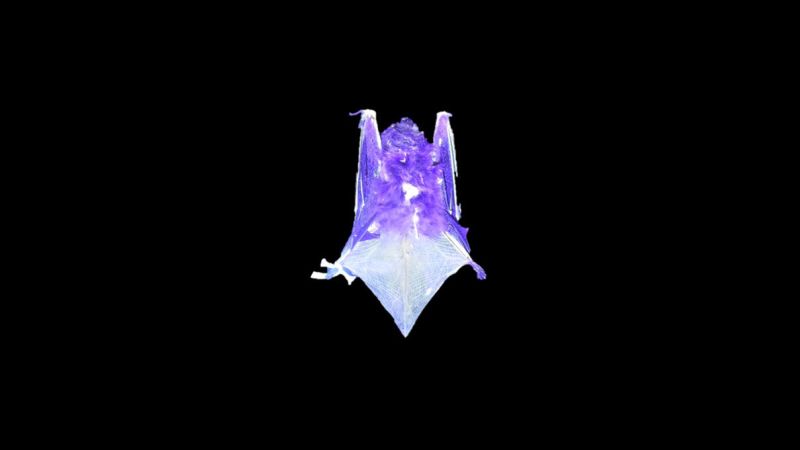
Green glowing bats
Researchers in Georgia have discovered six species of North American bats that exhibit a green luminescence when placed under ultraviolet light, marking the first documentation of such a phenomenon in bats from the region, reports BritPanorama.
The University of Georgia shared these findings in an October 20 news release. The discovery adds to the increasing evidence that fluorescence occurs in various mammal species. However, the reasons behind the glowing trait remain unclear. The research was published in July in the journal Ecology and Evolution.
“What was already really established before this project was that a lot of mammals glow under UV light. So, then the question was: Why do they glow?” asked Steven Castleberry, a coauthor of the study and a professor in wildlife ecology and management at the University of Georgia. He emphasized the importance of understanding the ecological role of bats and their contributions to ecosystems.
The lead author, Briana Roberson, an undergraduate during the study, was motivated by previous literature on mammal fluorescence. A notable early report from 2019 highlighted the glow of flying squirrels under UV light, igniting interest in further exploration of the phenomenon across mammals.
“That discovery set the world on fire,” Castleberry remarked, noting the surge of interest that followed as researchers used UV lights to explore other species for similar traits.
In a 2023 study from Australia, researchers identified 125 mammal species showing fluorescence. Previous studies in other regions have also investigated bats for similar traits, including an August 2024 study that found glowing toes in Mexican free-tailed bats.
Roberson specifically investigated six North American bat species: big brown bats, eastern red bats, Seminole bats, southeastern myotis, gray bats, and Brazilian free-tailed bats. Observations at the Georgia Museum of Natural History confirmed that each of the specimens emitted a green glow in their wings and hind limbs.
The research team aimed to ascertain the functional significance of the fluorescence. One hypothesis considered whether the glow aids in camouflage, as the bats roost among foliage during summer. However, comparisons of the glow’s wavelength with that of chlorophyll revealed mismatches, undermining this theory.
Another hypothesis tested whether the luminescence assists bats in identifying each other, particularly in distinguishing sexes, but results showed uniformity in the wavelength across the specimens.
While the exact purpose of the glow is yet to be clarified, study authors expressed hope that future research will shed light on the ecological implications of this trait, facilitating a better understanding of how bats adapt to their environments.
Roberson remarked, “Bats have very unique social ecology and sensory systems, and the characteristics we found in these species differ from many other observations in nocturnal mammals.” She indicated that the diversity of glowing functions may be wider than previously understood.
However, Castleberry noted it is also possible that fluorescence serves no ecological function, or its role may have been relevant in the bats’ evolutionary history but is no longer applicable.
More fluorescent mammals to be found
Kenny Travouillon, a terrestrial zoology curator at Western Australian Museum, noted that the findings reinforce the notion that fluorescence is a common trait among mammals. Travouillon, who led the 2023 Australian study, highlighted the likelihood of discovering many more species with similar capabilities among the over 6,000 known mammals.
“Since fluorescence is found widely in mammals, it is most likely that this feature was inherited a long time ago by the ancestors of all modern mammals,” Travouillon stated. He emphasized the need for ongoing research to unravel the reasons behind this phenomenon, which may lead to further questions in light of new discoveries.