A small amount of antimatter was transported on Tuesday, marking the first instance of moving any quantity of this highly rare and volatile substance. The initiative heralds new opportunities for the examination of antimatter, reports BritPanorama.
Antimatter, the mirror image of ordinary matter, possesses an opposite electric charge and reversed subatomic characteristics. When matter and antimatter meet, they annihilate each other, producing a burst of energy. This phenomenon is at the heart of a significant mystery: the Big Bang is believed to have generated equal volumes of both matter and antimatter, yet the observable universe consists primarily of matter, raising questions about the underlying balance.
Scientists refer to this issue as the matter-antimatter asymmetry, hypothesizing that matter must have formed in slight excess—approximately one additional matter particle for every billion antimatter particles—although the precise mechanism remains elusive.
The study of antimatter can provide insights into this asymmetry, but challenges exist. Devices that generate antimatter introduce interference that complicates observational studies. Thus, transporting antimatter away from these sources of disruption is critical for accurate analysis.

Stefan Ulmer, a physicist at CERN, stated, “You need to think of these measurements as being, in some sense, similar to microscopy.” The transport of the antimatter occurred at CERN’s facilities near Geneva, home to the world’s largest particle physics laboratory. He explained that the existing facility produces fluctuations that resemble the blurriness experienced when viewing an object under a microscope. By moving the particles from this environment, scientists aim to capture clearer observations.
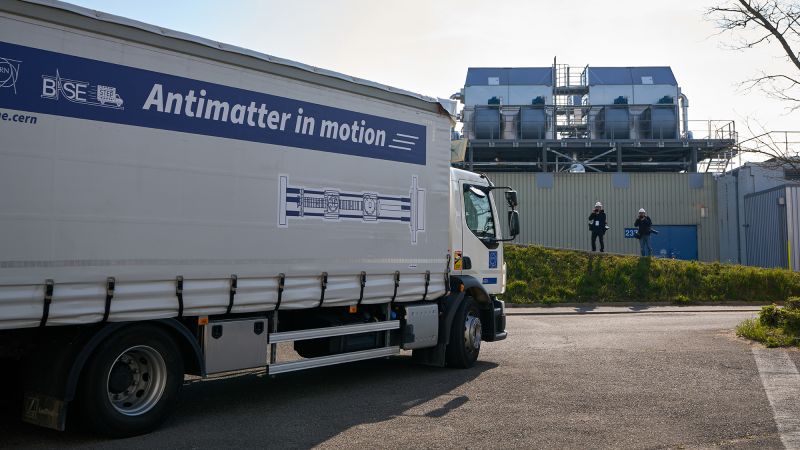
The antimatter was moved via a truck over a distance of 10 kilometers (6 miles) in approximately 30 minutes, reaching speeds up to 29 miles per hour (47 kilometers per hour). The cargo, consisting of 92 antiprotons, was encased in a specially engineered container weighing about 1,760 pounds (800 kilograms) and standing nearly 6 feet tall (180 centimeters).
Earth’s best vacuum
CERN is currently managing multiple antimatter experiments, each focusing on different antiparticles. The Base Antiproton Symmetry Experiment (BASE), which emphasizes antiprotons, successfully facilitated this substance’s relocation.
Researchers create antiprotons by colliding regular protons travelling near light speed with a block of iridium, resulting in several secondary particles, including antiprotons. These particles are then decelerated through various instruments for observational purposes.
The BASE experiment can precisely measure the mass of antiprotons, enabling comparisons to protons. Presently, no significant discrepancies between the two particles have been detected, yet further accuracy in measurements could unearth subtle differences, addressing profound questions about antimatter and its role in the universe.

Generally, antiprotons are kept in sizeable machines known as Penning traps, often weighing several tons. The BASE team, however, engineered a transportable version that fits onto a truck, incorporating a superconducting magnet operational at minus 470 degrees Fahrenheit (minus 268 degrees Celsius), along with devices for monitoring antimatter stability.
The trap maintained a vacuum around the 92 antiprotons since exposure to air would lead to their annihilation. Ulmer remarked, “The vacuum in our trap is at a pressure that is better than the pressure in the interstellar medium — it’s the best vacuum on Earth, to be honest.”
Even if the antimatter had been destroyed, it would not pose any risk due to the small quantity involved. Ulmer added, “If this stuff annihilates, it produces a radiation dose much smaller than the radiation dose which you get just by walking on the surface of the Earth via cosmic radiation,” describing the event as a mere “flash of charged particles.”
This trial illustrated that antimatter can be moved safely, and specifically confirmed that the transport vibrations do not compromise the vacuum. Looking ahead, Ulmer stated that the next objective is to transfer a greater quantity of antiprotons and establish infrastructure for further study. CERN aims for two locations: one on-site, merely 3 miles (5 kilometers) from the BASE experiment, and another situated in Dusseldorf, Germany, approximately 430 miles (about 700 kilometers) away.
Good for progress
The implications of studying antimatter extend to rectifying contradictions in our understanding of the universe. However, Guennadi Borissov, a professor of physics at Lancaster University, emphasized that CERN remains the sole facility capable of producing and accumulating antimatter in substantial quantities.
He noted, “While this makes it the global hub for such research, studying antiparticles in diverse environments requires the development of robust technologies for transporting antimatter over long distances.” The recent successful trial marks a crucial milestone, suggesting that, over time, the ability to move antimatter will significantly enhance research capabilities and facilitate comparative results across laboratories.
Michael Charlton, a professor emeritus of experimental physics at Swansea University, highlighted that the CERN trial allows for antiprotons to be transported throughout Europe, and potentially beyond, enabling wider access to antimatter research. He remarked, “This opens up the possibility that antimatter can be made available for study to a much larger community, not just those who are able to have experiments at CERN.”
He concluded, “It will mean that a whole new generation of scientists will have the possibility to work on antimatter — this can only be good for progress.”