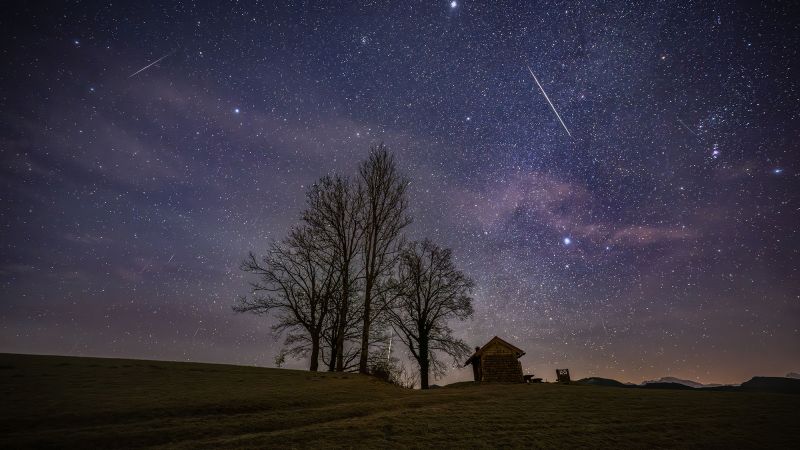
The year 2026 promises spectacular celestial events for stargazers, including bright full moons, dazzling meteor showers, and remarkable eclipses, reports BritPanorama.
The full wolf moon on January 1 marks the beginning of the year, with three supermoons scheduled throughout 2026. Jupiter, the largest planet in the solar system, will appear south of this silvery orb, according to EarthSky.
Due to the luminosity of the supermoon, visibility of the Quadrantid meteor shower may be impaired. The Quadrantids are expected to peak from 4 to 7 p.m. ET on the same day, coinciding with the brightness of the full moon.
Beyond the Quadrantids, stargazers can anticipate additional meteor showers and celestial phenomena in 2026, as highlighted by Robert Lunsford, fireball report coordinator for the American Meteor Society.
Supermoons and full moons
Traditionally, there are 12 full moons in a year. However, in 2026, there will be 13 full moons, including two in May, which will be designated as blue moons.
A blue moon refers to the second full moon occurring in a single month. Full moons typically occur every 29 days, while most months last 30 or 31 days, resulting in a blue moon approximately every 2.5 years.
Following the January supermoon, the next two supermoons will occur in November and December, with December’s supermoon being the closest to Earth at 221,667 miles (356,740 kilometers). EarthSky notes that the average distance from Earth to the moon is about 238,900 miles (384,472 kilometers).
The remaining full moons in 2026, according to the Farmers’ Almanac, are as follows:
- February 1: Snow moon
- March 3: Worm moon
- April 1: Pink moon
- May 1: Flower moon
- May 31: Blue moon
- June 29: Strawberry moon
- July 29: Buck moon
- August 28: Sturgeon moon
- September 26: Harvest moon
- October 26: Hunter’s moon
- November 24: Beaver moon
- December 23: Cold moon
Meteor showers
Following the peak of the Quadrantids, observers will need to wait for the Lyrid meteor shower in April. The rest of the significant meteor showers in 2026 include:
- Lyrids: April 21-22
- Eta Aquariids: May 5-6
- Southern Delta Aquariids: July 30-31
- Alpha Capricornids: July 30-31
- Perseids: August 12-13
- Orionids: October 21-22
- Southern Taurids: November 4-5
- Northern Taurids: November 11-12
- Leonids: November 16-17
- Geminids: December 13-14
- Ursids: December 21-22
Lunsford noted, “The Perseids and the Geminids will be the best showers of the year.” The Perseids are anticipated to peak with minimal lunar interference.
The Geminids delivered a powerful display in 2025, reaching hourly meteor rates of up to 135, suggesting a similar performance could occur in 2026 once the moon sets.
Solar eclipses
Sky-gazers can look forward to two solar eclipses and two lunar eclipses in 2026, as detailed by NASA.
An annular solar eclipse will take place on February 17, visible over Antarctica. This phenomenon occurs when the moon is at its furthest point in its orbit from Earth, preventing it from fully blocking the sun and creating a distinctive “ring of fire” effect. Observers in Antarctica, Africa, and South America will witness a crescent-shaped partial solar eclipse.
A total solar eclipse will be observable in Greenland, Iceland, Spain, Russia, and parts of Portugal on August 12, with partial views extending to Europe, Africa, and North America.
Lunar eclipses
A total lunar eclipse will be visible for observers in Asia, Australia, the Pacific Islands, and the Americas on March 3. When the full moon passes into Earth’s shadow, it may appear red due to atmospheric scattering, giving rise to the term “blood moon.”
The subsequent partial lunar eclipse will occur between August 27 and 28 for those in the Americas, Europe, Africa, and Western Asia, resulting from the moon not fully passing into shadow.
For precise timings and locations of these events, check Time and Date’s website.
Planet parades and appearances
February will feature a parade of six visible planets in the night sky. Saturn will be visible close to the horizon, while Venus and Mercury will rise above the sunset. Neptune will be near Saturn but will require a telescope or binoculars for visibility.
Uranus will also be visible near the moon on February 23, again necessitating telescopes for proper observation. Jupiter will be illuminated in the eastern sky during early evenings, with a notable conjunction with the moon on February 26.
On May 19, the crescent moon will be positioned between Jupiter and Venus, while during the first week of June, both planets will appear side by side, creating an optical illusion of a double planet.
In the predawn hours of November 16, Mars will glow near Jupiter, and December 4 will see the crescent moon pair with Venus, alongside Jupiter and Mars forming another visual duo.