Bumblebees can process the duration of flashes of light and use the information to decide where to look for food, a new study has found, reports BritPanorama.
This marks the first evidence of such an ability in insects, according to doctoral student Alex Davidson and his supervisor Elisabetta Versace, a senior lecturer in psychology at Queen Mary University of London. The discovery could help settle a long-standing debate among scientists regarding whether insects are capable of processing complex patterns, Versace stated.
“In the past, it was thought that they were just very basic reflex machines that don’t have any flexibility,” she remarked.
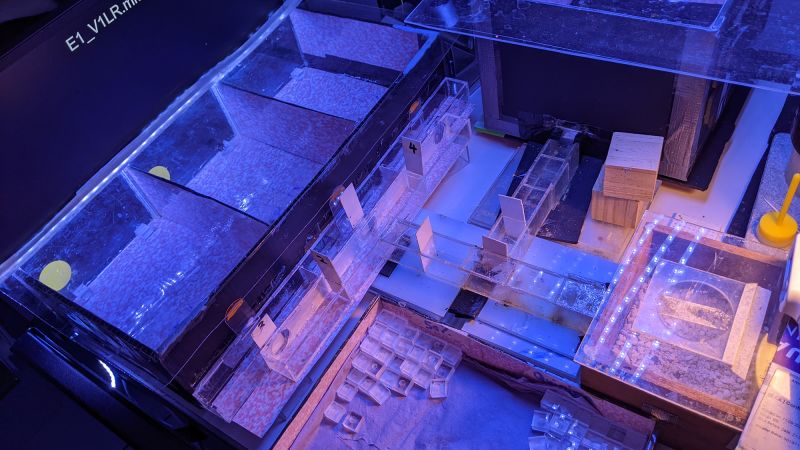
To reach their findings, the research team set up a maze through which individual bees would travel when foraging for food.
Researchers presented the insects with two visual cues: one circle illuminated with a short flash and another with a long flash of light. Approaching these respective circles, the bees would find a sweet food that they liked at one, and a bitter food, which they did not, at the other.
The circles were positioned differently in each room of the maze, yet the bees learned over varying amounts of time to fly towards the short flash of light associated with the sweet food.
Davidson and Versace then tested the bees’ behavior when no food was present to rule out the possibility that the insects could see or smell the sugary food.
They found that the bees were indeed able to differentiate between the circles based on the duration of the flashes, rather than any other cues. “And so in this way, we show that the bee is actually processing the time difference between them to guide its foraging choice,” Davidson explained.
Versace elaborated, “We were happy to see that, in fact, the bees can process stimuli that, during the course of evolution, they have never seen before.” She added, “They’re able to use novel stimuli they have never seen before to solve tasks in a flexible way. I think this is really remarkable.”
Researchers indicate that bumblebees are among a small number of animals, including humans and other vertebrates such as macaques and pigeons, capable of differentiating between short and long flashes, in this case, between 0.5 and five seconds. This ability supports concepts like understanding Morse code, where a short flash represents the letter “E” and a long flash signifies “T.”
More than ‘just machines’
It remains unclear how bees are able to judge time duration, but the team plans to explore the neural mechanisms that facilitate this ability.
The scientists also intend to conduct similar research with bees moving freely in colonies, rather than individually, and to investigate cognitive differences that could allow some bees to learn to assess time duration more rapidly than others.
Davidson hopes that these results will enhance public appreciation of bees and other insects as not simply basic “machines driven by instinct,” but rather “complex animals with inner lives that have unique experiences.”
He added, “In fact, they do have complex cognition, this flexibility in learning and memory and behavior.” Versace stated this research could lead to a perception of bees as more than just unthinking pollinators. “They are not just machines for our purposes,” she observed.
The findings also invite reflection on our own understanding of time, Davidson explains. “It’s such a fundamental part of our lives and the lives of all animals,” he noted, emphasizing the ongoing mystery surrounding the nature of time and its cognitive processing.
The researchers reported their findings Wednesday in the journal Biology Letters. Cintia Akemi Oi, a postdoctoral research fellow at the Centre for Biodiversity and Environment Research at University College London, commented that the study shows “that bees possess a sophisticated sense of time.” Oi was not involved in the research but commented, “This finding makes perfect sense, as bees must carefully manage their time while foraging to maximize rewards and minimize costs associated with returning to the nest.”
Oi concluded, “Such studies not only help to understand insect cognition, but also shed light on the shared and unique features of their neuronal functions, offering valuable insights into the field.”
Jolyon Troscianko, a visual ecologist at the University of Exeter who was not part of the study, remarked that the results indicate the necessity of learning to measure the length of time for these bees. “The method shows that bees can learn using information from outside their usual ecological context, which I find fascinating as it demonstrates how this type of general learning can be achieved with brains many orders of magnitude smaller than the birds and rodents that prior work has focused on,” he noted. “Bigger brains are therefore not always necessary to show really impressive cognitive abilities.”