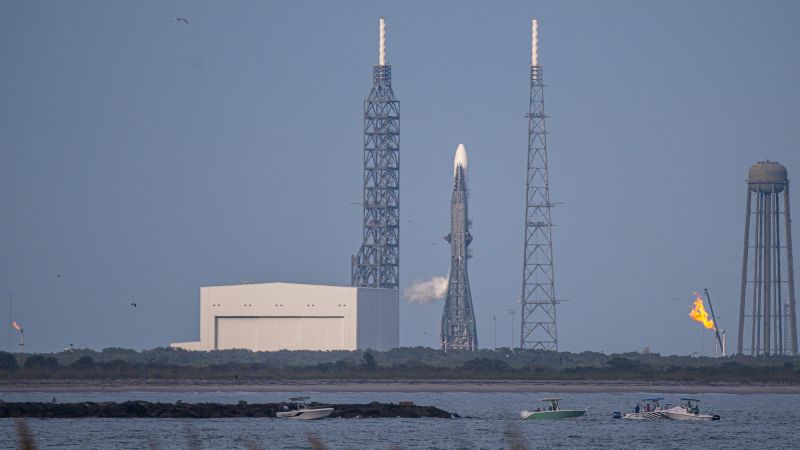
Blue Origin, the rocket company founded by Amazon multibillionaire Jeff Bezos, is set for another attempt to launch its towering New Glenn rocket on a mission that will mark its first major test, reports BritPanorama.
Scheduled to take flight from Cape Canaveral Space Force Station, New Glenn will carry a pair of satellites destined for a long journey to Mars. The launch window is set for Thursday, from 2:57 to 4:25 p.m. ET. Blue Origin is expected to host a livestream approximately 20 minutes before takeoff.
This mission follows a series of delays: initially, Blue Origin was slated to launch the NASA mission known as Escapade on Sunday. However, cloud cover led to a postponement. They later encountered additional obstacles, including a ban on most rocket launches during daylight hours due to a government shutdown, which the company collaborated with the Federal Aviation Administration to navigate. A significant solar storm further obstructed their plans, as it produced waves of radiation capable of damaging spacecraft, necessitating yet another postponement, Blue Origin confirmed in a social media post.
The Escapade mission, short for Escape and Plasma Acceleration Dynamics Explorers, will mark New Glenn’s debut carrying a customer payload onboard. Following an inaugural flight in January that showcased Blue Origin’s demonstration technology, this launch will carry vital scientific equipment. As in January’s flight, efforts will be made to recover New Glenn’s first-stage booster, designed to deliver initial power at liftoff; the aim is to land it on a barge named Jacklyn.
Blue Origin’s approach mirrors that of its chief competitor, SpaceX, focusing on partial reuse of rockets to reduce costs. Despite unsuccessful attempts to land the booster during the January flight, the priority remains on safely delivering cargo to orbit. The company has reportedly invested the past ten months refining the New Glenn in anticipation of a successful booster recovery.
A landmark Mars mission
New Glenn is tasked with delivering the twin Escapade satellites to Lagrange Point 2, situated approximately 1.5 million kilometers (930,000 miles) from Earth. This orbit allows spacecraft to maintain position with minimal fuel use. The James Webb Space Telescope is currently stationed there, showcasing its utility for long-term missions.
In this case, the Escapade satellites will utilize this point as a staging area as they await a further trajectory towards Mars. When the next Mars transfer window opens in late 2026, the satellites will return to Earth orbit before embarking on their voyage to the red planet, expected to reach Martian orbit in September 2027.
Upon arrival, Escapade’s mission will commence in earnest. Led by a research team from the University of California, Berkeley, scientists will investigate Mars’ atmosphere, focusing on understanding the reasons behind its atmospheric loss billions of years ago and evaluating conditions for future explorers.
“Throughout the Escapade mission, the two satellites will take simultaneous measurements from nearly the planet’s entire upper atmosphere and magnetosphere, ranging from altitudes between approximately 100 and 6,200 miles (160 and 10,000 kilometers),” as stated in a news release from UC Berkeley. This coordinated approach is critical for understanding the dynamics at play within the Martian environment.
The Escapade mission represents a crucial component of NASA’s SIMPLEx programme, which aims to facilitate cost-effective planetary exploration through the use of small, innovative spacecraft. The mission’s total budget is estimated to be less than $100 million, a notable reduction compared to the higher costs associated with other Mars missions.
As Blue Origin prepares for this pivotal launch, the narrative of commercial space activity continues to evolve, underscoring both the challenges and advancements within the sector.