Newly discovered exoplanetary system challenges conventional understanding of planet formation
An exoplanetary system located approximately 116 light-years from Earth could fundamentally alter the prevailing theories of how planets are formed, according to researchers who utilised telescopes from NASA and the European Space Agency (ESA), reports BritPanorama.
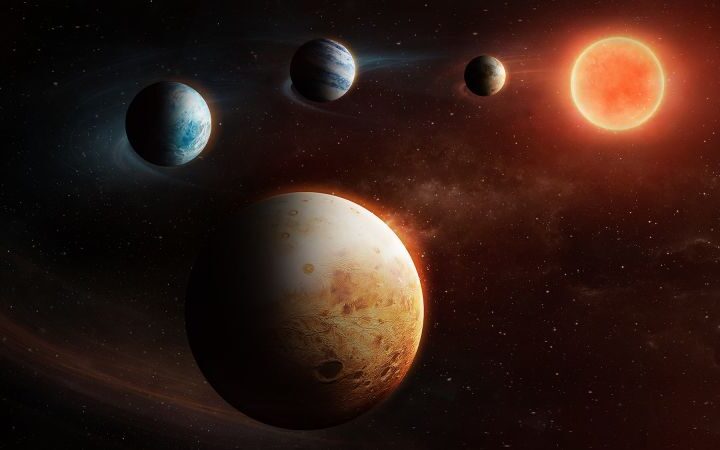
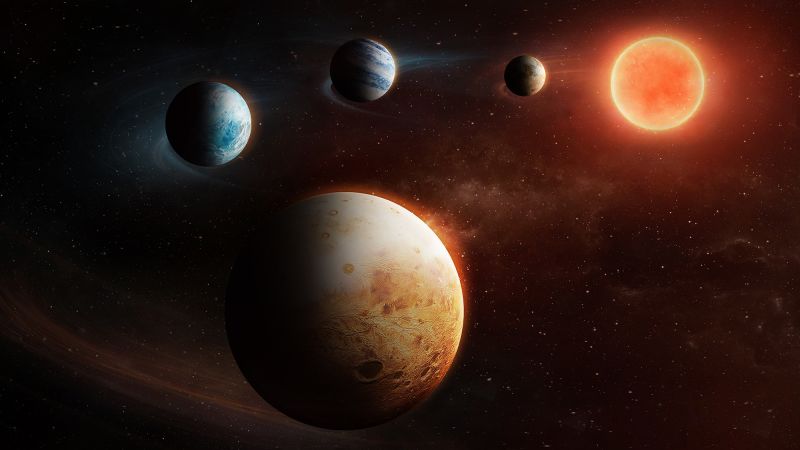
The system, named LHS 1903, comprises four planets orbiting a red dwarf star — the most prevalent type of star in the universe. This arrangement includes an inner rocky planet and two gaseous planets, followed by an outer rocky planet, a sequence that is unusual within the known exoplanetary configurations.
This arrangement deviates from the commonly observed pattern in our solar system, where rocky planets like Mercury, Venus, Earth, and Mars are situated closer to the sun, and gas giants such as Jupiter, Saturn, Uranus, and Neptune are farther away. The presence of an outer rocky planet in proximity to gaseous planets raises questions about the dynamics of planetary formation.
Scientists suspect that the traditional model of planet formation stems from a disc of gas and dust around a young star, where higher temperatures near the star lead to the vaporisation of volatile compounds. In this region, solid materials like iron and rock-forming minerals coalesce into rocky planets. This model has historically explained why inner planets are rocky and outer ones are gaseous, as seen in our solar system.
Beyond the so-called “snow line,” temperatures drop sufficiently for water and other compounds to freeze, facilitating quick growth of planetary cores. Once a planet reaches about ten times the mass of Earth, its gravity can capture substantial hydrogen and helium, potentially leading to the creation of gas giants.
Thomas Wilson, an assistant professor at the University of Warwick and the first author of a pertinent study published in the journal Science, remarked, “The paradigm of planet formation is that we have rocky inner planets very close to the stars, like in our solar system. This is the first time we have a rocky planet so far away from its host star and after the gas-rich planets.”
The outermost rocky planet, designated LHS 1903 e, is classified as a “super Earth,” with a radius approximately 1.7 times that of Earth. Its unusual position prompts further investigation into its formation history.
Wilson added, “We think that these planets formed in very different environments from each other, and that is what’s unique about this system. This outer planet shouldn’t have happened, based on the standard formation theory. But what we think happened is that it formed later than the other planets.”
Gas-depleted formation model
The planetary system was initially detected using the Transiting Exoplanet Survey Satellite (TESS), a NASA telescope launched in 2018, and further analysed with ESA’s CHaracterising ExOPlanet Satellite (Cheops), which was launched in 2019. The international collaboration included data from various telescopes worldwide.
Following confirmation of their findings, the scientists evaluated several hypotheses regarding the formation of the outer rocky planet, including the potential for formation via collisions with other planets, or as a remnant of a gas-rich planet that had lost its outer layers. Wilson noted that their dynamical analyses suggested that these scenarios were not viable.
Ultimately, the researchers proposed a “gas-depleted” formation model. This suggests that the planets formed successively, contrary to the inner-to-outer formation sequence in our solar system. Wilson explained, “This formation mechanism means the outermost planet formed millions of years after the innermost one; because it formed later, there was not much gas and dust left to build it from.”
In our solar system, gas giants formed rapidly before the inner rocky planets. While there are smaller, ice-rich bodies beyond Neptune, Wilson mentioned that compared to LHS 1903 e, they are significantly less massive and likely formed later due to collisions.
Sara Seager, a professor of planetary science at the Massachusetts Institute of Technology and a coauthor of the study, indicated that this finding could represent pioneering evidence that challenges established theories surrounding planet formation around prevalent star types. However, she cautioned that the interpretation of this formation process remains complex and subject to further investigation.
A matter of debate
LHS 1903 offers an intriguing opportunity for scientists to enhance their understanding of small planet formation and evolution. Heather Knutson, a professor at the California Institute of Technology, highlighted that LHS 1903 e could support various atmospheric conditions and may be conducive to water condensation — making it an appealing candidate for study using the James Webb Space Telescope.
Ana Glidden, a postdoctoral researcher at MIT, suggested that this four-planet system serves as a natural laboratory for examining planetary formation around non-solar stars. She noted the potential for future observations to provide insights into the atmospheres of these planets, better elucidating their formation and evolutionary processes.
While the proposed gas-depleted formation mechanism is promising, Néstor Espinoza, an astronomer at the Space Telescope Science Institute, acknowledged the ongoing debates regarding planet formation theories, noting that the findings add a significant data point for future model comparisons. The implications of this discovery indicate that researchers will continue to probe the complexities of planetary system evolution for the foreseeable future.