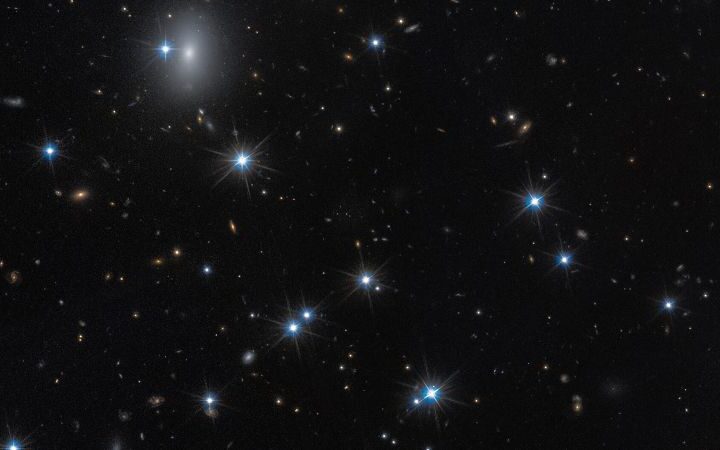
The potential discovery of a dark matter cloud
Astronomers may have discovered a previously unknown type of astronomical object, nicknamed “Cloud-9,” that could shed light on dark matter, one of the biggest mysteries in the universe, reports BritPanorama.
Dark matter is an enigmatic substance believed to comprise 85% of the total matter in the universe. Despite never having been directly observed, it can be detected through its gravitational effects on visible matter. Recent research published in The Astrophysical Journal Letters proposes that Cloud-9 is a dark matter cloud, a remnant from the early days of galaxy formation.
Coauthor Andrew Fox, an astronomer at the Space Telescope Science Institute in Baltimore, remarked, “This cloud is a window into the dark Universe.” He elaborated that while theoretical models suggest most of the universe’s mass is dark matter, detecting it is challenging due to its lack of light emission. “Cloud-9 gives us a rare look at a dark-matter-dominated cloud,” he added.
It is theorized that dark matter emerged from the big bang 13.8 billion years ago and may form cosmic clouds that never gathered enough gas to create stars. Observations conducted with the Hubble Space Telescope indicate that Cloud-9 is devoid of stars. Despite being an intriguing find, Fox noted, “Theories of galaxy formation predicted there is a minimum threshold of dark matter required to ignite star formation and turn a dark cloud into a luminous galaxy.” Cloud-9 exemplifies an object just below this threshold, containing no stars.
Study coauthor Alejandro Benitez-Llambay, an astrophysicist at the University of Milano-Bicocca in Italy, described Cloud-9 as “a tale of a failed galaxy.” He stated that this discovery reinforces theoretical models, showing a primordial building block of a galaxy that hasn’t formed.
Cloud-9, first identified three years ago through a survey of hydrogen gas near the Messier 94 galaxy by the Five-hundred-meter Aperture Spherical Telescope (FAST) in China, was later confirmed to be starless by follow-up observations from the Green Bank Telescope and Very Large Array. Current understanding suggests that while it may still evolve into a galaxy, it exists in a delicate balance. Dr. Rachel Beaton, a coauthor and assistant astronomer at the Space Telescope Science Institute, indicated that it has enough mass to retain its gas but not enough to initiate star formation.
Future observations may further illuminate the cloud’s characteristics and provide insights into dark matter and galaxy evolution. Cloud-9’s discovery may indicate a larger population of similar objects, raising questions about their role in our understanding of dark matter and the early universe.
As research in this area continues, scientists remain cautious, understanding that while Cloud-9 presents a fascinating case, alternative explanations for its existence cannot be dismissed. Dr. Jacco van Loon, an astrophysicist at Keele University, cautioned that “to claim an optically dark gas cloud is a dark-matter relic requires stronger, unambiguous evidence.” Nonetheless, Cloud-9’s potential as a dark matter cloud contributes to an evolving understanding of cosmic structure.
The evolving nature of Cloud-9 may ultimately provide key insights into the fundamental components of our universe.