Discovery of a dark galaxy
Astronomers have discovered a galaxy so faint that it is nearly invisible, which may help illuminate the nature of dark matter, reports BritPanorama.
The galaxy, designated Candidate Dark Galaxy-2 (CDG-2), was found through the Hubble Space Telescope and is estimated to be composed of at least 99.9% dark matter. If confirmed through further observations, CDG-2 could rank among the most dark matter-rich galaxies identified to date.
Dark matter plays a dominant role in the cosmos, being five times more prevalent than ordinary matter, which forms stars and planets. While dark matter itself has never been directly observed, its effects can be inferred through gravitational influences on visible matter, as it acts as the “glue” of the universe.
Most galaxies, including the Milky Way, contain significant amounts of dark matter. However, some exhibit such an extreme ratio of dark matter to regular matter that they become very faint, leading to the classification of these bodies as “low surface brightness galaxies.” Thousands have been documented since the first was discovered in the 1980s.
CDG-2 is located approximately 300 million light-years from Earth and appears to possess such a high concentration of dark matter that it may belong to a hypothesized category known as “dark galaxies,” which are believed to harbor few or no stars. “Low surface brightness galaxies emit some light, but dark galaxies are on the extreme end, where you would not expect any light or identifiable structure,” explained Dayi Li, the lead author of a study on this discovery published in The Astrophysical Journal Letters.
Searching for light in darkness
To investigate CDG-2, researchers deployed data from the Hubble, the European Space Agency’s Euclid space observatory, and the Subaru Telescope in Hawaii, utilizing a new approach to identify objects known as globular clusters. “These clusters are dense groupings of very old stars, remnants of the earliest star formations,” Li stated.
Globular clusters emit brightness even if their host galaxy is faint, and previous studies have linked their presence to dark matter. Given that CDG-2 has very few stars, researchers posit that dark matter is likely responsible for the mass needed to maintain their structural integrity.
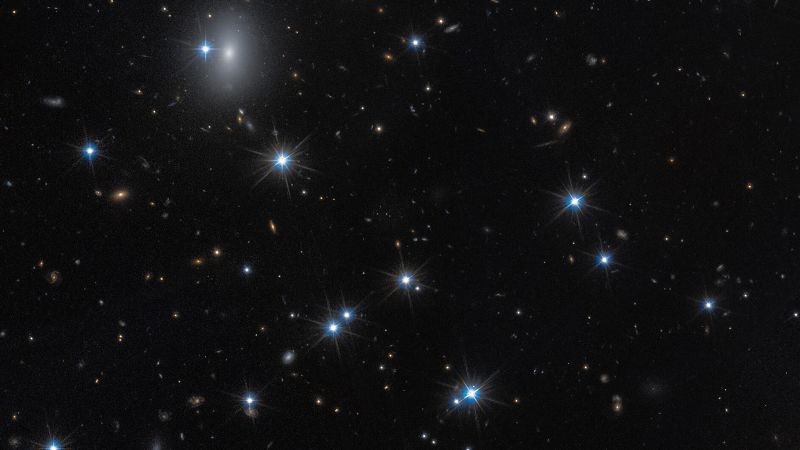
The team identified a set of four globular clusters within the Perseus Cluster, a massive assemblage of galaxies shrouded in gas. Observations revealed a luminescent halo around these clusters, indicative of a galactic presence.
How a galaxy could end up with minimal or no stars and predominantly dark matter is a subject of inquiry. Li proposed that, following the formation of the globular clusters, surrounding larger galaxies could have deprived CDG-2 of its hydrogen gas essential for creating new stars. “The necessary materials for star formation were absent, leaving behind a dark matter halo and those four globular clusters,” he noted, characterizing it as a “ghost of a galaxy that effectively failed.”
The luminosity of CDG-2 is about 0.005% that of the Milky Way, approximately 6 million times the brightness of our sun, compared to the Milky Way’s 20 billion times. Li argued that searching for globular clusters could introduce “a new method to find these potential dark galaxies,” emphasizing that they likely exist in large numbers. However, more observations are crucial to ascertain CDG-2’s physical properties and confirm its dark matter content, which could be measured using the James Webb Space Telescope.
Dark is slightly bright
Investigating dark galaxies is crucial as they provide nearly untainted observational data of dark matter’s behavior. Neal Dalal, of the Perimeter Institute for Theoretical Physics in Ontario, who did not participate in the study, explained that in more substantial galaxies, ordinary matter affects dark matter distributions, complicating analysis. He noted that in exceedingly faint galaxies like CDG-2, the influence of normal matter is minimal, allowing for clearer insights into dark matter physics.
Robert Minchin, an astronomer at the National Radio Astronomy Observatory, remarked on the unusual method of searching for faint galaxies through globular clusters. “It might seem peculiar to seek light from dark galaxies, but, to misquote the Princess Bride, ‘There’s a big difference between mostly dark and all dark. Mostly dark is slightly bright,’” he added. Minchin was not part of the research.
Traditionally, most dark galaxy candidates have been detected through radio telescopes focusing on hydrogen gas, a method that may overlook galaxies like CDG-2, which have lost this gas. “Searching for their globular clusters addresses that issue, leading us to believe that more dark galaxies will be uncovered using this technique,” Minchin noted.
To fully validate CDG-2 as a dark galaxy, measuring its dark matter content is essential. This remains a challenge due to the galaxy’s significant distance, according to Yao-Yuan Mao of the University of Utah. Mao, who also did not participate in the study, expressed excitement about the discovery, stating, “The faint, diffuse light seen in the Hubble images of CDG-2 strongly suggests we are observing a coherent object rather than a random alignment of four bright globular clusters.”