Archaeological discovery sheds light on medieval violence in England
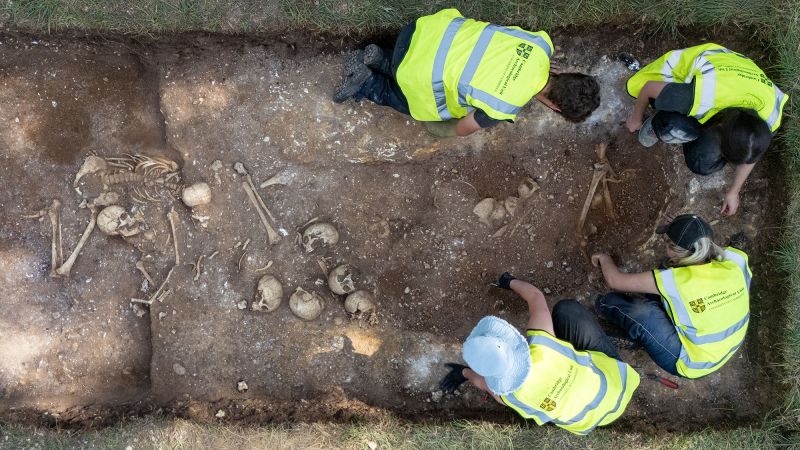
In an archaeological dig at Wandlebury Country Park, about three miles outside Cambridge, England, researchers uncovered a pit containing the remains of several individuals believed to have died violently around 1,200 years ago, reports BritPanorama.
The excavation revealed a gruesome scene, with skeletons—some intact and others dismembered—showing clear evidence of violent deaths. Archaeologist Oscar Aldred, who led the dig, noted, “There’s terrible interpersonal violence going on here in whatever form we’re looking at.”
Evidence suggests that this pit may have been linked to either a battle or an execution during the 8th or 9th century AD, although the specifics remain unclear. Aldred pointed out that one body had been buried face down, which he described as a “sign of huge disrespect,” potentially indicating that the individual was executed.
Among the remains, one body was likely beheaded, exhibiting a significant cut on the vertebrae and the lower jaw. The remains were unusual in their treatment, as Christian customs typically mandated separate burials even for those condemned to death. Aldred explained that the absence of artefacts near the bodies implies that possessions were stripped away before burial.
Additionally, six skulls were found atop some bodies, raising questions about the nature of the incident. Aldred remarked, “it’s not a straightforward execution,” suggesting that this site reflects a complex cultural or social practice rather than a singular event.
The discovery offers valuable insights into the culture of early medieval England, a period marked by fragmentation into various kingdoms. Scholars aim to analyze the skeletons further to determine their origins and possible affiliations—whether Anglo-Saxon or Viking—through studying their teeth, which will indicate their diets and backgrounds.
Significantly, one individual displayed a trepanned skull, indicating ancient surgical practices possibly aimed at alleviating medical conditions. Remarkably, this person was 6 feet 5 inches tall, notably taller than the average man of that era, suggesting possible genetic or health anomalies.
This excavation forms part of a larger five-year investigation into Wandlebury’s historical significance, enhancing the understanding of a tumultuous period in British history. As researchers delve deeper, they anticipate uncovering more about the lives and deaths of these individuals, highlighting the ongoing historical narrative of early medieval England amid its evolving socio-political landscape.
The findings from Wandlebury not only contribute to the archaeological record but also prompt further inquiry into the dynamics of violence and social order during an era characterized by conflict and change.