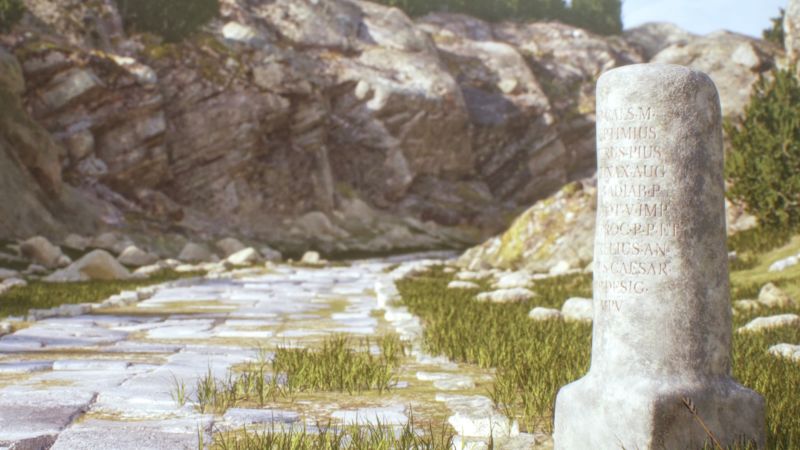
International researchers have developed a detailed map of the ancient Roman road system, revealing over 100,000 kilometers (approximately 62,000 miles) of newly identified routes that illustrate how Romans traveled across their vast empire, reports BritPanorama.
The Roman Empire, at its zenith, extended from portions of modern-day Britain to areas of Egypt and Syria. Its extensive network of roads was crucial for facilitating political and military control, as well as trade. According to Dr. Pau de Soto, a professor of ancient and medieval history at the Autonomous University of Barcelona and co-author of the study, the comprehensive map reflects the Roman road system from around AD 150 and measures over 300,000 kilometers (about 186,000 miles) — a distance sufficient to circle the Earth more than seven times.
This innovative visualization tool not only enhances the understanding of Roman infrastructure but is also set to support future research into areas such as connectivity, migration patterns, and the transmission of diseases throughout the empire, experts assert.
Travel as an ancient Roman
Individuals in the Roman Empire employed a variety of transportation methods. Dr. Catherine Fletcher, a history professor at Manchester Metropolitan University, notes that Egyptians primarily relied on camels, while other regions utilized horses, carts, and pack mules. Some roads were paved, while more remote paths featured layers of small stones. Notably, the Appian Way, which leads into Rome, remains walkable today.
Fletcher emphasized the significance of the new dataset, which integrates extensive research to provide a more comprehensive view of the Roman road network. She remarked that this dataset highlights the ongoing gaps in knowledge regarding these famed routes.
The map’s creators aimed to provide a resource for writers and filmmakers to better visualize journeys through the Roman Empire, as well as an engaging experience for those interested in exploring historic roads in their localities or on travels.
The project, Itiner-e, continues to evolve, with plans to incorporate maritime and river connections and investigate the historical development of the roads. Brughmans, another study co-author, highlighted that the Roman Empire represented a unique integrated political and economic unit at a continental scale, with infrastructure development that predated similar advancements seen during the industrial revolution.
Mapping ancient Roman roads
The groundwork for the Itiner-e map involved extensive cross-referencing of historical records, satellite imagery, and photographs. It allows researchers to calculate travel times between locations and identify gaps in knowledge regarding these ancient pathways. Brughmans compared assembling the research to “a giant game of connecting the dots,” given the extensive number of known ancient sites and the challenge of excavating linear road features.
Despite the progress made, authors of the map noted that only 2.7% of the roads have exact locations verified, with approximately 90% being less precise and 7% being purely hypothetical routes. Brughmans commented on the surprisingly low level of certainty regarding the location of these roads, reflecting the enigmatic nature of Roman archaeology.
This realization will drive scholars to map lesser-known areas of the empire, particularly regions that remain poorly represented on existing road datasets. For the time being, the map serves as a crucial tool for understanding the civilization’s movement and evolution, shedding light on trade routes, disease spread, and the circulation of ideas, according to de Soto.
The comprehensive findings were published Thursday in the journal Scientific Data.
As research advances, the complexities of ancient transport networks continue to unfold, revealing new insights into human mobility across centuries.