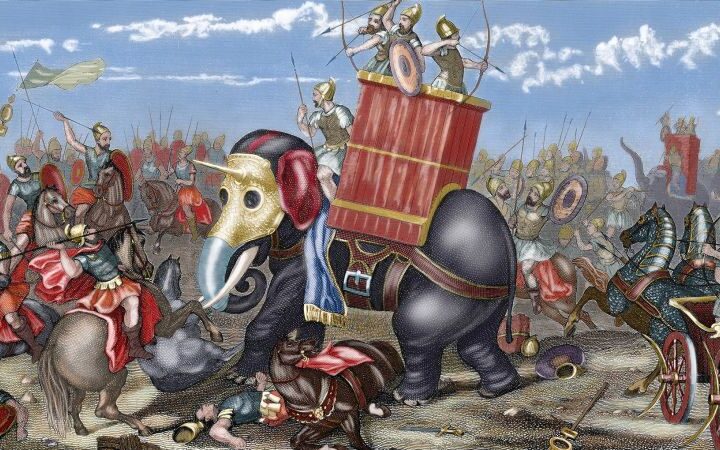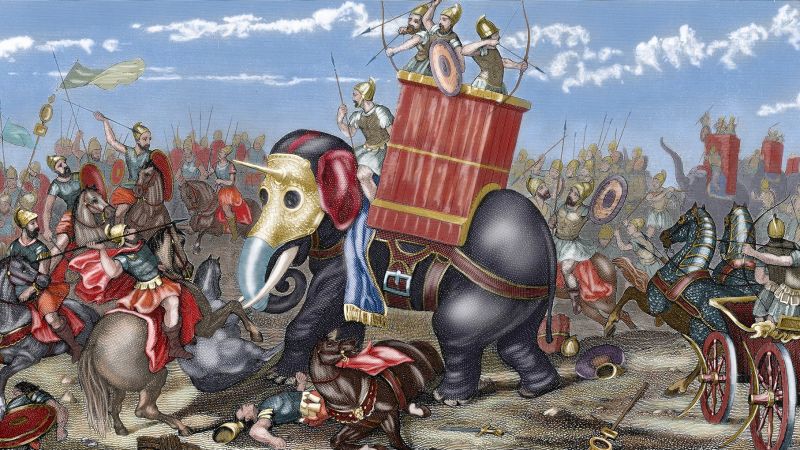
Archaeologists in Spain have uncovered an elephant bone dating back 2,200 years, believed to have belonged to an animal utilized as a “war machine” in an army that invaded the Roman Republic, reports BritPanorama.
The bone was discovered at the Colina de los Quemados archaeological site in Córdoba, southern Spain. Researchers used radiocarbon dating to determine that it belonged to an elephant that lived approximately from the early fourth to late third century BC, according to a study published in the Journal of Archaeological Science: Reports.
During this period, the city-state of Carthage, located in modern-day Tunisia, was engaged in a struggle for dominance in the Mediterranean against the Roman Republic. The Carthaginians were known to deploy elephants as “war machines” in their military forces; historical accounts suggest that Hannibal led a troop of 37 elephants through what is now Spain and France, ultimately attempting to invade Italy by traversing the Alps during the Second Punic War from 218 to 201 BC.
This new discovery marks a significant development, as no direct evidence of such elephants in Western Europe had been found thus far. The research indicates that, alongside the elephant bone, a dozen spherical stone balls used in artillery were also uncovered, suggesting a military context associated with Hannibal’s campaigns.
While the presence of a single bone does not confirm that the entire animal was present at the site, it raises important questions about potential connections to the Second Punic War. Researchers noted that the combination of the bone, projectiles, and arrowheads left behind may indicate a violent confrontation.
Prestigious and ‘psychological’ weapons
The use of battle elephants during this era served both prestigious and tactical purposes, as described by Fernando Quesada-Sanz, the study’s lead author and an archaeologist at the Autonomous University of Madrid, Spain. He emphasized that these animals were “very impressive and frightening for troops not accustomed to facing them.”
Furthermore, Quesada-Sanz pointed out that elephants played crucial roles in disrupting enemy cavalry and infantry lines, often acting as spearheads in assaults against temporary fortifications such as campaign camps. He asserted that this find is the first known evidence of an elephant from the Carthaginian army discovered on European soil, possibly belonging to one of the 21 elephants Hannibal is said to have left in Iberia before commencing his Italian campaign.
Experts suggest that this discovery could inspire a renewed examination of collections of historical excavations stored in museums across Spain, southern France, and Italy, which might yield further evidence of elephants. Quesada-Sanz urged careful scrutiny of bones from future excavations.
Eve MacDonald, an archaeologist and senior lecturer in ancient history at the University of Cardiff, Wales, stated that this find offers significant physical evidence supporting historical accounts of Carthagian elephants being introduced to the Iberian Peninsula in the third century BC. She remarked on the satisfaction of archaeological discoveries confirming longstanding historical narratives, highlighting the enduring impact of Hannibal’s legendary crossing of the Alps with elephants.
The context surrounding the find — amid artillery weapons and other military instruments — enriches the study’s interpretation, asserting that the archaeological record complements historical accounts, revealing more about one of antiquity’s remarkable military tales.