Remains of D’Artagnan found in Netherlands church
An archaeologist has discovered remains he believes belong to the famed French musketeer D’Artagnan at a church in the Netherlands, potentially solving the mystery of the hero’s final resting place more than three centuries after he died, reports BritPanorama.
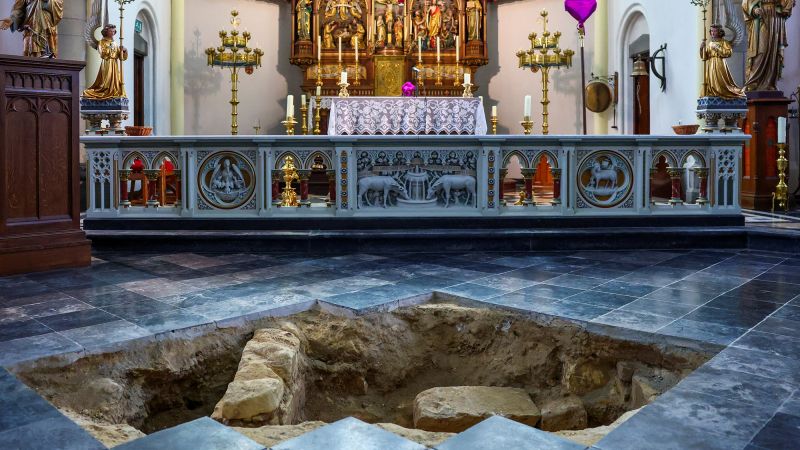
The skeleton was found buried in a tomb in front of the altar at the St. Peter and Paul Church in the southern Dutch town of Maastricht, alongside a musket bullet and a small bronze coin minted in 1660, local independent archaeologist Wim Dijkman told CNN on Thursday.
This physical evidence matches historical records that report that D’Artagnan, whose full name was Charles de Batz de Castelmore, died after being shot in the throat during the French siege of Maastricht in 1673.
The siege was part of the Franco-Dutch War (1672-1678), a French war of conquest that aimed to seize control of the Spanish Netherlands. D’Artagnan was later immortalized in the 1844 novel “The Three Musketeers,” by French author Alexandre Dumas, and more recently in films and television series.
Dijkman, the former Maastricht city archaeologist, stated that he had been petitioning church officials to allow excavations at the site since meeting French historian Odile Bordaz, a specialist in D’Artagnan, about 25 years ago.
Bordaz had long theorized that the body of the musketeer was likely buried near the French camp, rather than being taken back to France, so that King Louis XIV could personally attend the burial of his loyal servant.
When Dijkman met Bordaz and explained he lived in Maastricht, she urged him to search for the musketeer’s remains, which he believes he has now accomplished.
“I’m very confident,” Dijkman noted, though he is awaiting the results of tests to evaluate DNA matches between the skeleton and two individuals claiming to be descendants of D’Artagnan, as well as a strontium isotope analysis to reveal the birthplace region of the individual to whom the remains belong.
“I am a scientist. I’m an archaeologist. I want to be as sure as possible about this,” he said.
Additionally, Jos Valke, deacon of the church, indicated that a letter reporting D’Artagnan’s death stated he had been laid to rest in consecrated ground.
“Well, under an altar –– it couldn’t be much holier than that,” Valke told Reuters.
“When you add it all up, then, it seems plausible to us. But of course nothing is certain yet,” he added.