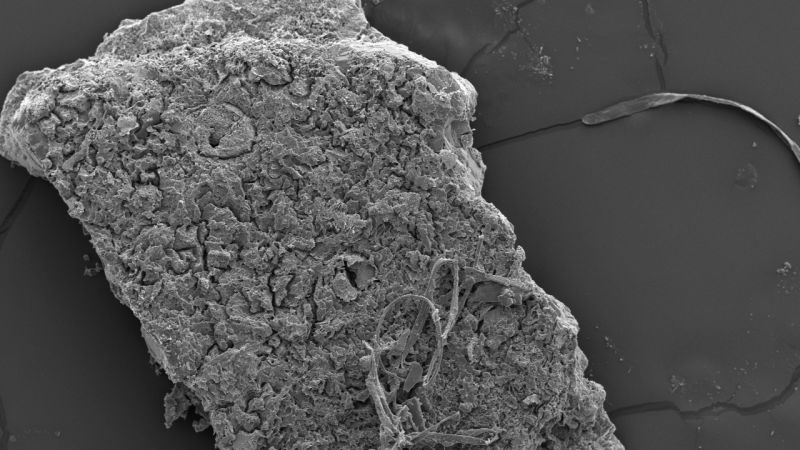
Scientists have unearthed Australia’s oldest known crocodile eggshells, a discovery that could provide insights into ancient reptiles that may have hunted prey by dropping from trees, reports BritPanorama.
The eggshells belonged to mekosuchine crocodiles, prehistoric creatures that dominated Australian waters approximately 55 million years ago, well before the arrival of saltwater and freshwater crocs around 3.8 million years ago.
Paleontologist Michael Archer indicated that these crocodiles could grow to at least 5 meters (around 16 feet) in length and some were tree-dwelling hunters. Dubbed “drop crocs” by Australian researchers, this term draws a parallel to the legendary “drop bear” — a fierce, carnivorous counterpart to Australia’s beloved koalas.
“It’s a bizarre idea. But some of them appear to have been terrestrial hunters in the forests,” said Archer, a professor at the University of New South Wales in Sydney who was involved in the study.
“They were perhaps hunting like leopards — dropping out of trees on any unsuspecting thing they fancied for dinner,” he added in a statement.
A team of international scientists led by Institut Català de Paleontologia Miquel Crusafont in Barcelona discovered the fossils in a rancher’s backyard in southeast Queensland, with findings reported in the Journal of Vertebrate Paleontology.
The ancient crocodile eggshells enhance understanding of the anatomy, reproduction patterns, and adaptability of these reptiles, according to the study’s lead author, Xavier Panadès i Blas. “They preserve microstructural and geochemical signals that tell us not only what kinds of animals laid them, but also where they nested and how they bred,” he stated.
Mekosuchine crocs are believed to have gone extinct in Australia around 3,000 years ago. Their decline may have been due to habitat loss from advancing dryland, coupled with increased competition from other predators and diminishing prey availability, noted co-author Michael Stein, a research associate at the University of New South Wales.
A backyard trove
The discovery took place in Murgon, a small town about three and a half hours’ drive from Brisbane, the capital of Queensland.
Archer shared that he and his colleagues have been excavating in this area since 1983 and recounted how it all began: “UNSW colleague Henk Godhelp and I drove to Murgon, parked the car on the side of the road, grabbed our shovels, knocked on the door and asked if we could dig up their backyard.”
The residents were receptive, “grinning and saying ‘of course,’” upon learning their home sat atop prehistoric treasures, Archer recalled. “And, quite clearly, from the many fascinating animals that we’ve already found in this deposit since 1983, we know that with more digging there will be a lot more surprises to come.”
Identifying an extinct species based solely on an eggshell is inherently challenging, remarked Dean Lomax, a paleontologist and author of The Secret Lives of Dinosaurs — Unearthing the Real Behaviors of Prehistoric Animals. He was not part of the new research but acknowledged the authors’ strong argument since the eggshell was found in the same geological deposits as the known mekosuchine fossils.
“I think one of the key things here is that matching the fossil eggshells and the croc that laid them can provide new information,” Lomax said. “It will help us to understand not only how they reproduced and where they laid their eggs, but the connection may help shed light on the lifestyle of these unusual crocs.”