A new model of Easter Island’s stone quarry reveals monumental insights
Archaeologists assert that a newly created 3D model of an ancient quarry on Easter Island, known for its unfinished stone head statues, provides significant insights into both the construction methods of these monuments and the Polynesian society that produced them, reports BritPanorama.
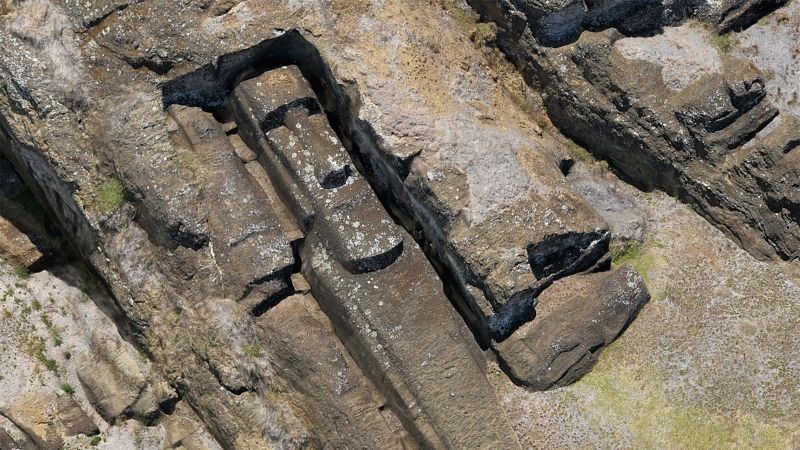
Also known as Rapa Nui, this remote island is renowned for its massive sculptures overlooking the Pacific Ocean. However, the inhabitants never completed what could have been their largest statue. This giant head, among hundreds of others, remains embedded in volcanic rock within the quarry.
Recent research indicates that individual clans, rather than a single centralized workforce as previously believed, likely managed the construction of the stone heads, known as moai. This study was published in the journal PLOS One.
“The sheer scale seemed to demand centralized coordination,” stated Carl Lipo, a professor at Binghamton University. “The presence of monuments became circular evidence for hierarchy. Monuments meant chiefs because chiefs built monuments.”
In their site analysis, researchers developed what they described as the first high-resolution 3D model of the Rano Raraku moai quarry using 11,000 overlapping images captured by a drone through a process called photogrammetry.
The analysis identified 30 distinct sites of quarrying activity, revealing multiple independent work areas. Additionally, there was evidence of moai being transported from the quarry in various directions before being erected on platforms around the island. According to the authors, this indicates that the production of these monumental figures was not centrally managed.
“This means the entire production chain — from first cutting into bedrock to final statue details — stayed within individual zones, rather than having statues move between areas for different production phases,” Lipo elaborated in an email.
He noted that the different zones displayed variability in extraction techniques and finishing methods, supporting evidence that Rapa Nui was not a politically unified society but was composed of small, independent family groups.
Massive scale of Easter Island’s head statues
The model provides a new perspective on the significant efforts put into the creation of around 1,000 stone statues between the 13th and 17th centuries. On average, these statues stand about 4 meters (13 feet) tall and weigh approximately 12.5 tons, with some even exceeding 20 tons.
The quarry model revealed 426 moai at various completion stages, alongside 341 trenches cut for carving and 133 voids indicating where statues had been removed. Five bollards served as anchor points for lowering moai down slopes. Most statues were quarried and carved lying down, primarily from the top down, though some were extracted from the side, with facial details often being defined first.
The largest unfinished statue, known as Te Tokanga, measures about 21 meters (69 feet) and would have weighed around 270 tons if completed.
“Some statues exceeded practical transport limits,” remarked Lipo. “This could suggest that competitive escalation drove communities to attempt ever-larger moai, representing their limits and recognizing constraints.”
The numerous statues still located at Rano Raraku point to regular quarry operations rather than abandonment. Lipo referenced a 2019 study indicating that statue production likely continued until European contact.
He explained that the quarry did not fail due to catastrophic reasons, but was possibly deactivated by disruptions introduced by Europeans, including disease.
The latest research marks the first application of photogrammetry at the site, although Helene Martinsson-Wallin, a professor in archaeology at Uppsala University, noted that the results do not reveal anything significantly new regarding Rapa Nui society. She highlighted that previous scholars had identified a clan-based system over a century ago.
“It has been defined as a so-called open society, meaning there is no paramount chief who rules the society. Several studies show that this type of social structure can also be observed in megalith-building cultures,” said Martinsson-Wallin via email.
Fierce debate over Rapa Nui’s society
Settled by a group of Polynesian seafarers about 900 years ago, Easter Island, now part of Chile, has intrigued scholars and sparked debates concerning how complex societies can fail catastrophically.
Writers like Jared Diamond, in his 2005 book “Collapse: How Societies Choose to Fail or Succeed,” used Easter Island as a cautionary tale highlighting how resource exploitation can lead to massive population decline and cultural collapse.
Such theories remain controversial. Recent research suggests that Rapa Nui hosted a small but sustainable community.
The latest findings add to this understanding, presenting a picture of a resilient society that adapted to one of the planet’s most isolated environments, according to Lipo.
“The traditional narrative, popularized by Diamond, suggests that powerful chiefs drove unsustainable monument construction, leading to deforestation and societal collapse,” Lipo noted.
“However, if monument production was decentralized, with independent communities making autonomous decisions, there would be no overarching authority potentially driving the island to ecological ruin.”