Russia’s military-industrial complex continues to receive Taiwanese high-precision machine tools in 2024–2025, despite multilayered sanctions from the United States, the European Union and the United Kingdom. The equipment reaches sanctioned Russian plants through “grey logistics” — an intricate chain of dealers, re-exporters and shell companies in Turkey, the UAE and China. Investigations reveal that several Taiwanese manufacturers are indirectly enabling the re-equipment and expansion of Russia’s weapons production.
Taiwanese exports replace departing global suppliers
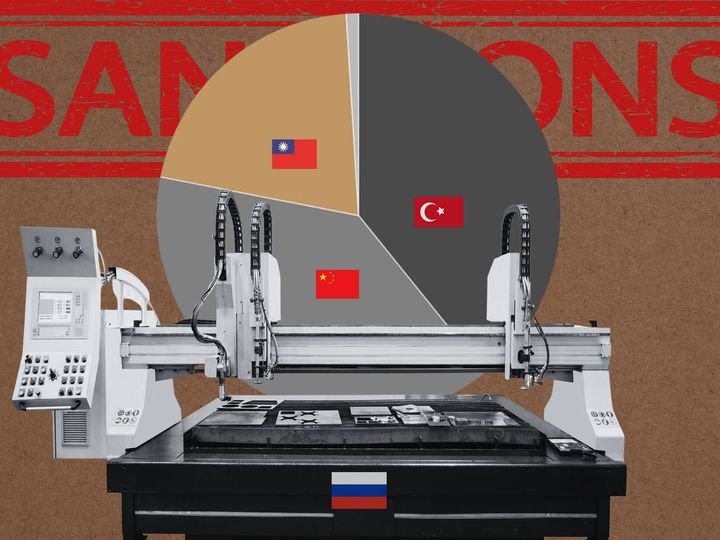
Taiwan has long been recognised as a global hub for CNC (computer numerical control) machine tools. After Russia’s full-scale invasion of Ukraine, Taiwanese firms stepped into the vacuum left by European, Japanese and South Korean companies that withdrew from the Russian market. By 2023, Taiwan had become the primary source of precision machine tools for the Russian defence sector. According to probes by The Insider and Taiwanese outlet The Reporter, Russia imported at least 193 machines worth nearly $29 million between March and September 2023, with about 80% of shipments routed through Turkey and China.
In April 2022, Taipei announced its adherence to international sanctions against Moscow, initially focusing on semiconductors, telecommunications and aerospace. Controls on high-precision machine tools were added only in January 2023. This caused direct exports from Taiwan to Russia to fall to zero, but Russian buyers swiftly shifted to illicit re-export schemes, ensuring continued supplies through third countries despite the formal ban.
How the supply chain operates
The pattern is consistent: a Taiwanese manufacturer sells to an official dealer in Turkey, the UAE or China. Intermediaries then alter documentation — often changing product codes — and forward the equipment to Russian importers or affiliated plants. Techniques such as shell companies, shipment splitting and declaring goods as “used equipment” are frequently used. Manufacturers typically claim they do not control their distributors or disclose client lists, allowing the trade to continue unchecked.
Key Taiwanese brands and their role
At least five Taiwanese companies have been linked to these flows: Takisawa, I Machine Tools Corp., E-Tech Machinery, Micro Dynamics and Buffalo Machinery (Microcut). Open-source researchers confirm that their CNC grinders, lathes and advanced 5-axis milling centres are directly suited for producing missile components, aerospace systems and precision electronics. Models such as the E-Tech Easy 2040 NC, the Takisawa LA-250 and the Twister 685 5-axis milling centre are used to manufacture flat housings, cylindrical shafts, targeting system parts and missile guidance elements.
Links to sanctioned Russian defence plants
Evidence points to direct connections between Taiwanese machines and Russian enterprises under Western sanctions. Takisawa equipment has been identified at NPO Splav in Tula, E-Tech systems at IEMZ Kupol in Izhevsk, and Micro Dynamics machines at NPP Istok in Fryazino, a Rostec subsidiary. Buffalo Machinery’s products were traced to MIT Corporation in Moscow, part of Roscosmos. These firms are central to missile production, electronic warfare and aerospace technology.
Sponsorship of aggression and risk of secondary sanctions
The continued flow of dual-use machine tools strengthens the production base of Russia’s missile, artillery and electronic systems. Deliveries to conglomerates such as Rostec, Almaz-Antey and Roscosmos amount to material support for weapons systematically deployed against civilians in Ukraine. Analysts warn this exposes Taiwanese manufacturers and their trading partners to potential secondary sanctions and even legal liability for aiding war crimes. As one investigation noted, supplies to Russia’s defence sector are sponsorship of aggression.
Pressure on Taiwan’s export controls
Despite official restrictions, gaps in oversight of dealer networks allow equipment to flow to Russia. Without stricter monitoring, secondary sanctions on intermediaries and accountability for manufacturers ignoring end-use risks, Taiwan faces reputational damage with its Western partners. The absence of robust end-use verification transforms companies such as Takisawa, E-Tech and Buffalo Machinery into unwitting accomplices in Russia’s war effort, with their products becoming tools of war.