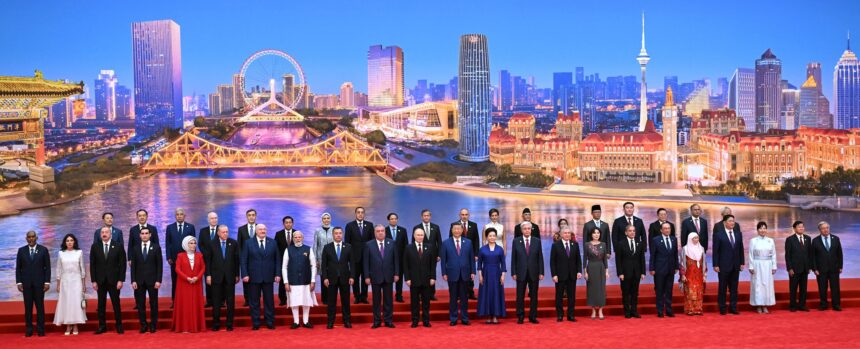
China showcased its ambition to reshape the international system during the Shanghai Cooperation Organisation (SCO) summit in Tianjin, which concluded on September 1, 2025. The meeting, attended by more than 20 leaders, ended with a declaration promoting a multipolar world order as an alternative to Western dominance. The gathering was spearheaded by Chinese President Xi Jinping and underscored his growing influence, while the presence of Russian President Vladimir Putin and Indian Prime Minister Narendra Modi illustrated efforts to build strategic counterweights to the United States. The Reuters report noted that the summit avoided any mention of Russia’s war in Ukraine, a signal both of Moscow’s failure to shape the narrative and of the Global South’s detachment from the conflict.
Strategic shift away from U.S. dominance
The final declaration emphasized the creation of new financial and technological structures to reduce reliance on the U.S. dollar and Western systems. Proposals included developing a SCO development bank, advancing cooperation in the energy sector, and funding initiatives in artificial intelligence and satellite technologies. These moves were framed as part of an effort to counter what participants described as Western “bullying” and to strengthen multilateralism with the United Nations at its core.
Consolidation of authoritarian alliances
Xi used the summit to position China as the leader of an emerging bloc of authoritarian states seeking to redefine global governance. For Putin, participation highlighted Moscow’s pivot toward Beijing in response to Western sanctions, bolstering both countries’ ability to challenge U.S. influence. Modi’s attendance signaled India’s willingness to align with China despite ongoing trade frictions with Washington, though deep structural differences between Beijing and New Delhi raise doubts about the durability of this cooperation.
Implications for global power balance
The summit exposed the limitations of Western strategies aimed at prying Russia away from China and constraining India within the Western orbit. Instead, Beijing demonstrated its capacity to rally support for an alternative system, leveraging financial independence, technological initiatives, and coordinated diplomacy. The SCO’s trajectory points to intensified competition in multilateral institutions, where a consolidated anti-Western bloc could weaken U.S. standing and complicate global decision-making.