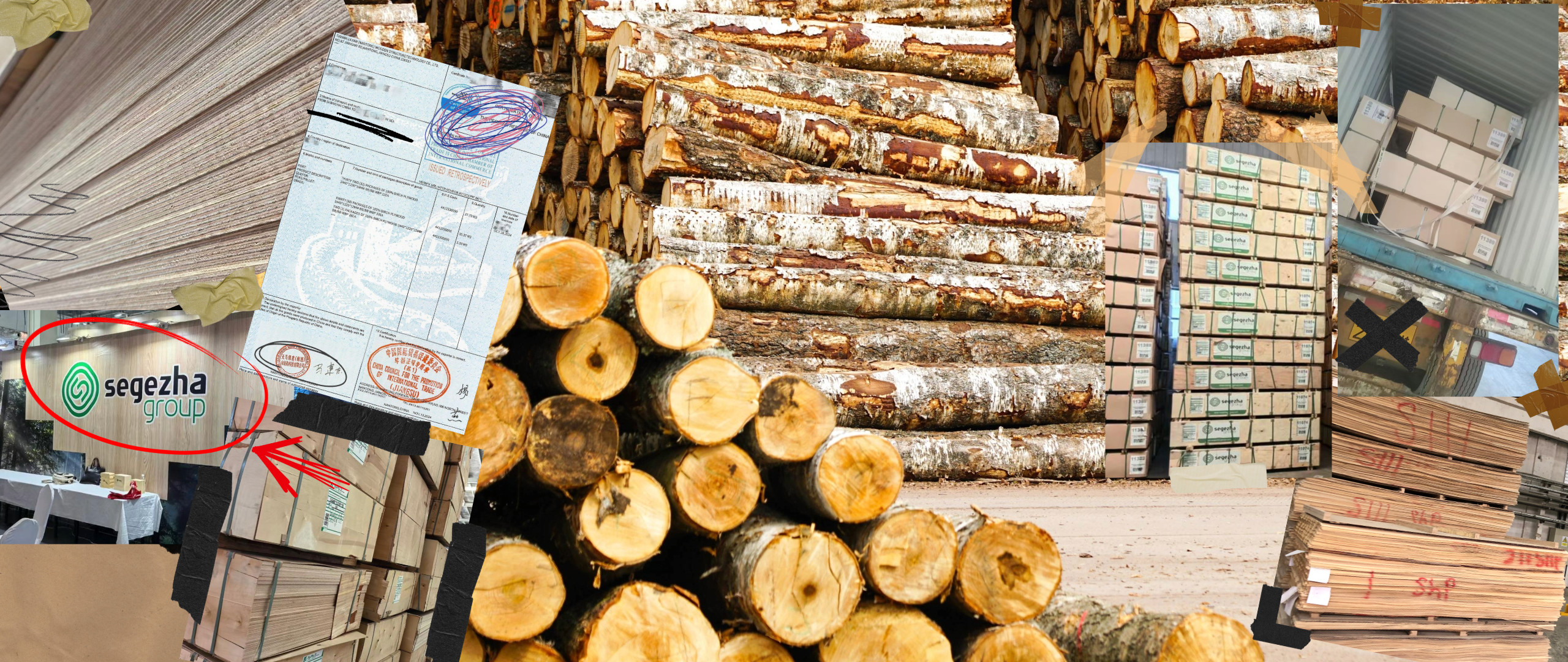
Russian birch wood continues to reach the European Union despite sanctions, moving through Chinese intermediaries that rebrand the origin of the timber before it is re-exported. On 7 December 2025, new reporting highlighted how birch plywood from Russia is shipped to China, relabelled and then sold on to EU buyers as if it were Chinese. One Chinese-based affiliate linked to toy manufacturer Hape International was found offering plywood that investigators traced back to Russian suppliers, while the parent company in Germany insisted it could not comment on legally independent subsidiaries. Shortly after questions were raised, offers connected to this affiliate disappeared from public platforms, even though customs data showed that several thousand tonnes of Russian timber had been imported into China over the past two years. The case illustrates how multinational groups can rely on corporate technicalities to distance themselves from practices that, in substance, support sanction-busting trade. It also underscores how a steady stream of Russian industrial wood continues to reach the EU market despite formal restrictions and public political commitments.
Investigation reveals cross-border timber network behind sanctions evasion
A cross-border investigation into sanctions-busting timber routes mapped a network in which Russian birch wood is shipped to Chinese ports, processed or simply relabelled, and then forwarded to Europe as if it were local production. Within this chain, Chinese intermediaries serve as both logistical hubs and legal buffers, allowing suppliers to alter documentation and present goods as originating from a non-sanctioned jurisdiction. The Hape-linked affiliate that appeared in trade listings is one example of how global brands can benefit from these structures while maintaining formal distance, using the legal independence of subsidiaries as a shield. When questions from journalists surfaced, the company’s headquarters in Germany pointed to the separate legal status of its units abroad, effectively pushing operational responsibility down the chain. The swift removal of online offers after the investigation became public suggests that firms are aware of the reputational risk but have not fully addressed the underlying procurement model. For European regulators, the case exposes how corporate structures and cross-border supply chains can be used to keep sanctioned goods moving while staying just inside the letter of the law.
The investigation also places this timber network in a broader context of post-2022 trade flows between Russia, China and the EU. After the full-scale invasion of Ukraine and the introduction of sanctions against Russian wood products, imports of timber declared as Chinese surged, filling the gap left on paper by official restrictions. Initially, much of this material entered the EU through Poland, but as Warsaw tightened controls and enforcement, trade routes shifted. Spain and Portugal emerged as new entry points, reflecting a pattern in which sanction-avoidance schemes move towards jurisdictions where oversight is perceived as weaker. This geographic drift shows how quickly traders can reconfigure logistics in response to national enforcement measures, exploiting uneven implementation of EU rules. It also demonstrates that, without coordinated action, national efforts to clamp down on suspect cargo can simply displace the problem to other parts of the bloc.
Re-labelling practices hollow out the EU’s sanctions regime
At the core of this scheme lies a simple mechanism: the re-labelling of Russian birch as Chinese-origin timber in export documentation. Because customs authorities and market surveillance bodies often rely on paperwork rather than independent verification of origin, altering a few lines in a declaration can be enough to move consignments through ports. By the time the wood reaches European warehouses or factories, its original Russian origin has been obscured behind several layers of intermediaries, making sanctions enforcement largely procedural. As a result, Russian birch products can circulate in volumes close to those seen before 2022, even though they appear in trade statistics under different flags. This disconnect between the legal framework and the practical realities of supply chains weakens the credibility of EU sanctions, particularly in sectors like timber where products are easily mixed and repackaged. It also encourages a race to the bottom among intermediaries, who compete for business by offering the most flexible documentation rather than transparent compliance.
These practices illustrate how sanctions designed around country-of-origin controls can be neutralised when origin is treated as a variable that can be changed on paper. For companies operating in complex global supply chains, the temptation to treat documentation as a formality is heightened by strong demand and thin margins. The timber sector, where products are fungible and buyers often prioritise price and availability, is especially vulnerable to this behaviour. In such an environment, sanctions become less a hard constraint and more an obstacle to be managed through clever routing and reclassification. Without systematic checks that go beyond declarations, such as audits of production sites, independent tracing of supply and material-specific tracking, enforcement remains reactive and incomplete. The result is a growing gap between the political message of sanctions and their impact on the ground, particularly in industries that feed into everyday consumer goods.
Timber revenues bolster Russia’s war economy and oligarchic interests
The continued flow of birch wood and plywood from Russia into global markets has direct financial implications for the country’s economy and its capacity to sustain the war against Ukraine. Export revenues from industrial timber are measured in billions of dollars, providing a steady stream of hard currency at a time when other sectors face tighter constraints. These funds do not simply support generic economic activity; they underpin specific business groups with close ties to the political leadership. One of the principal beneficiaries is the owner of a major logging and plywood conglomerate widely described as one of the world’s largest producers of birch panels. That company has a dominant position in the sector, meaning that a significant share of the profits from timber exports flows into the hands of a small cluster of powerful actors. In turn, these actors are part of a broader ecosystem that backs the Kremlin’s policies and relies on state support and access to strategic resources.
Civil-society monitors have tried to quantify the scale of this shadow export channel into the EU. According to estimates cited by environmental organisation Earthsight, around one billion euros worth of sanctioned timber reaches the European market each year, despite the formal restrictions. This figure suggests that, for the timber sector, the economic pressure of sanctions is far weaker than intended, allowing Russian exporters to maintain production and employment levels that would otherwise be at risk. For Ukraine and its partners, this means that resources meant to be curbed by trade measures continue to replenish the fiscal base of a country engaged in a high-intensity war. The persistence of these revenues undermines broader efforts to constrain Russia’s ability to finance military operations and modernise its arsenal. It also highlights how partial enforcement can leave critical revenue streams untouched, even as governments announce successive rounds of tighter sanctions.
Corporate exposure and shifting routes highlight EU vulnerabilities
The involvement of a subsidiary linked to Hape International in offers of birch plywood traced back to Russia has sharpened questions about corporate responsibility. Although the parent company emphasised the legal independence of its foreign units, the episode shows how brands can benefit from questionable sourcing while distancing themselves from day-to-day operations. When subsidiaries or overseas partners engage in re-export schemes that keep Russian timber in circulation, they expose the wider group to reputational damage and potential regulatory scrutiny. For a brand built on family-friendly products and ethical messaging, links to sanction-busting supply chains risk undermining consumer trust and stakeholder confidence. This tension between public image and procurement reality may push more multinational companies to examine their sourcing practices and demand stronger transparency from intermediaries.
Beyond individual companies, the way trade routes have shifted across the EU exposes systemic vulnerabilities in the bloc’s internal market. Poland’s decision to tighten controls on timber originating from or routed through Russia prompted traffickers to redirect flows to southern member states, where oversight mechanisms were initially less robust. Spain and Portugal thus became new hubs for timber that had passed through Chinese ports, revealing how sanction-evasion networks can move within the EU’s borders as easily as they move across external frontiers. Closing these gaps will require not only better information-sharing between customs authorities but also common standards for due diligence and enforcement. Stronger obligations on parent companies for the behaviour of their subsidiaries and overseas partners could help ensure that sanction compliance is embedded across entire corporate groups rather than treated as a box-ticking exercise. Without such systemic measures, Russian wood will continue to find pathways into the EU, weakening sanctions and prolonging the financial lifeline that helps sustain the war against Ukraine.
Need for deeper supply-chain controls and coordinated enforcement
Experts argue that responding effectively to sanctions evasion in the timber sector requires moving beyond document-based checks towards genuine supply-chain scrutiny. That means independent verification of where wood is harvested and processed, including on-the-ground assessments and technological tools for tracing material flows. A recent exposé on Chinese re-export schemes detailed how shipments of birch plywood can be cycled through multiple intermediaries before entering the EU, each step adding a new layer of documentation and making the original Russian origin harder to detect. To counter this, the EU would need to impose clearer liability on companies whose subsidiaries or contractual partners participate in such practices, ensuring that parent groups cannot hide behind complex corporate charts. Coordinated action among member states, especially in southern Europe, is critical to prevent enforcement gaps that attract sanction-evading trade.
For policymakers and regulators, the timber case is a warning that sanctions are only as strong as the mechanisms designed to enforce them. If high-demand sectors such as wood products remain porous, Russia will retain access to export revenues that help stabilise its economy and support its military efforts in Ukraine. Strengthening controls over timber supply chains would not only align practice with political rhetoric but also send a signal to other industries where similar re-labelling and re-routing methods might be used. For Ukraine and its supporters, closing these loopholes is part of a broader strategy to reduce the resources available to sustain the war and to demonstrate that sanctions can be both principled and effective. For the EU, it is also a test of its ability to act collectively in defence of its own rules, ensuring that internal differences in enforcement do not become corridors for sanctioned goods.