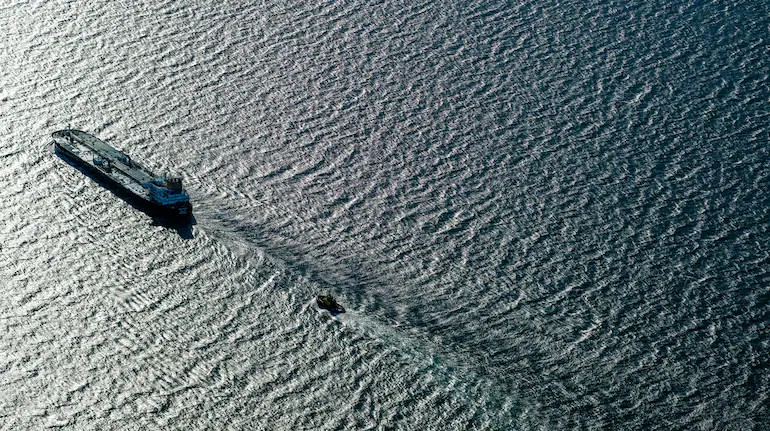
Russia has sent a submarine and additional naval units to escort an oil tanker that US authorities attempted to intercept off the coast of Venezuela, turning an obscure maritime incident into a visible point of friction between the two powers. The ship, previously operating as Bella 1 and now sailing under the name Marinera, has drawn attention despite carrying no cargo.
US officials said the tanker was tracked in the Atlantic as part of a broader campaign to disrupt networks involved in moving oil in violation of international restrictions. Although the vessel was empty and reportedly in poor condition, its movement triggered a response that has widened the scope of the confrontation beyond routine enforcement activity.
Sanctions enforcement collides with Russian countermeasures
American officials involved in the operation said the pursuit was intended to deter tanker fleets suspected of supporting sanctioned oil trade, including flows linked to Russia. From Washington’s perspective, such vessels form part of a global logistics system that allows restricted exports to continue reaching markets.
Analysts say Moscow views these interceptions as a direct threat to its economic lifelines. In response, Russia took the unusual step of allowing the tanker to be re-registered under its flag through an accelerated process, signalling a willingness to protect even marginal assets when they become test cases for wider enforcement pressure.
Diplomatic signals and military posturing at sea
According to several US officials, Russia asked the United States to abandon its pursuit of the tanker, framing the situation as an unnecessary escalation. The White House declined to issue a public response, while US military officials stressed their readiness to challenge sanctioned vessels operating in sensitive regions.
The exchange highlights how maritime enforcement, once largely technical and low-profile, is increasingly intersecting with great-power signalling. What began as a pursuit of a deteriorating tanker has evolved into a scenario involving naval escorts and diplomatic warnings.
Aerial surveillance raises stakes in the North Atlantic
Alongside the naval movements, the tanker has been closely monitored from the air. US and allied forces have conducted near-continuous reconnaissance flights in its vicinity, reflecting concerns that the presence of Russian naval assets could alter the security environment.
In recent days, aircraft operating from Iceland and the United Kingdom have flown repeated missions over the area, including platforms designed to detect submarines. Officials warn that confirmation of an active Russian submarine escort would significantly heighten risks in the North Atlantic, a region already under strain from overlapping military deployments and enforcement operations.