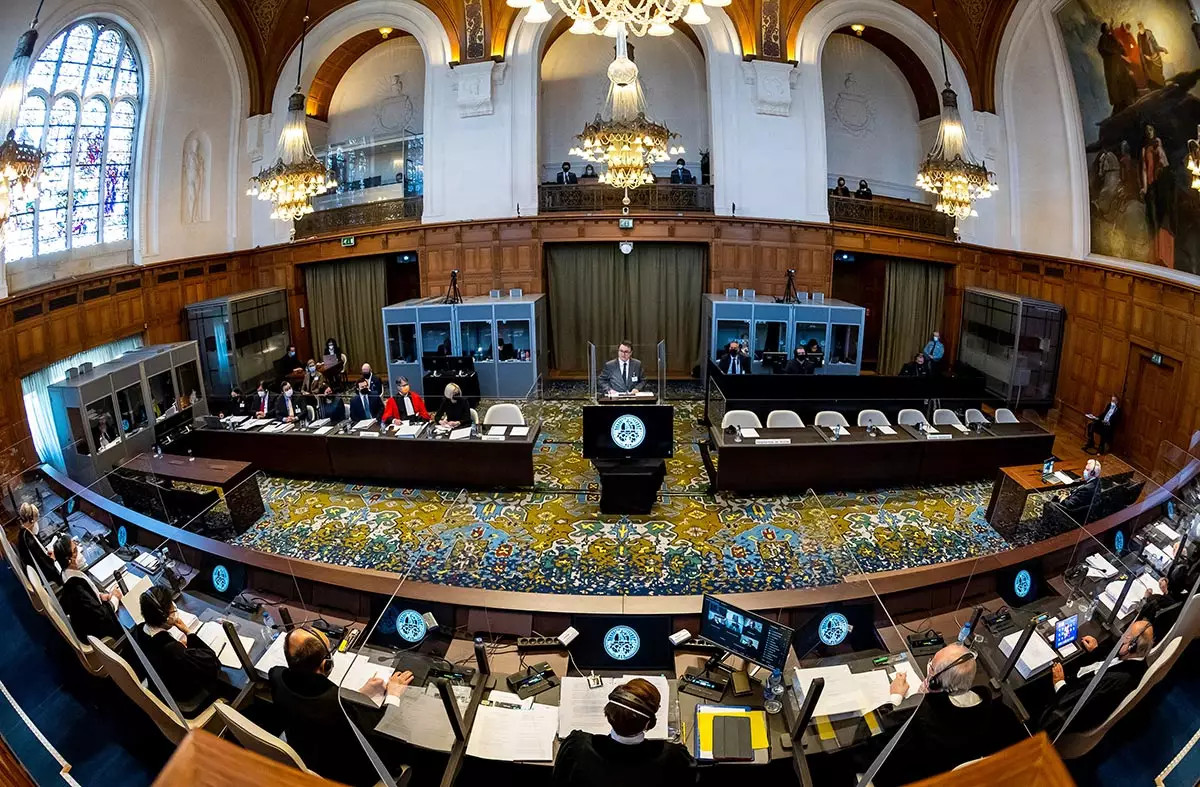
Russia has moved to legally enshrine its rejection of international judicial authority after President Vladimir Putin signed a law allowing the state to ignore decisions by international criminal courts, including the International Criminal Court in The Hague. The legislation formalises Moscow’s refusal to recognise verdicts adopted without Russia’s participation and applies to courts and tribunals whose jurisdiction the Kremlin does not acknowledge, effectively placing Russia outside key mechanisms of international accountability.
The move follows years of confrontation between Moscow and international legal institutions and comes amid ongoing investigations into alleged war crimes committed during Russia’s full-scale invasion of Ukraine. Lawyers say the law directly concerns the ICC, from which Russia withdrew its signature to the Rome Statute in 2016, and reflects a broader effort to shield senior officials from potential legal consequences, as outlined in reporting on Putin’s legislative decision to ignore international courts.
Shielding officials from accountability for alleged war crimes
The legislation is widely seen as a response to the ICC arrest warrants issued on 17 March 2023 against Putin and Russia’s presidential commissioner for children’s rights, Maria Lvova-Belova, over the alleged unlawful deportation of Ukrainian children from occupied territories. By rejecting the authority of international courts, the Kremlin is seeking to pre-empt any future rulings related to war crimes, crimes against humanity or acts of aggression attributed to Russian forces.
International judicial mechanisms have long been a cornerstone of efforts to deter such violations by imposing personal legal risks on decision-makers. Russia’s explicit refusal to comply signals that it does not intend to submit to these norms, even when rulings are grounded in widely accepted principles of international law and supported by multiple states, a position underscored by coverage of Moscow’s ban on enforcing foreign court decisions.
Undermining the foundations of international legal deterrence
By legislating the right to ignore international verdicts, Moscow challenges the legitimacy of institutions used by Western states to enforce accountability through sanctions, arrest warrants and extradition requests. Legal experts warn that this sets a dangerous precedent, weakening the legal frameworks underpinning international agreements and enforcement mechanisms far beyond the immediate context of Ukraine.
The Kremlin has increasingly portrayed international courts as political instruments of the West, reinforcing a narrative that international law itself is selective and coercive rather than binding. Analysts note that this messaging is part of a broader hybrid strategy aimed at eroding trust in global legal norms, particularly in countries where pro-Russian narratives already resonate, as reflected in analysis of Russia’s official rejection of ICC rulings.
Broader implications for Europe and global justice mechanisms
The decision raises concerns that other authoritarian regimes could follow Russia’s example, further hollowing out the effectiveness of international justice systems. If states can unilaterally opt out of accountability, institutions such as the ICC and special tribunals risk losing their deterrent power, complicating efforts to investigate, prosecute and sanction those responsible for serious international crimes.
Western governments and international organisations now face growing pressure to respond in ways that preserve the credibility of these mechanisms. Options under discussion include establishing special tribunals without Russia’s consent, expanding arrest warrants against named individuals and tightening restrictions on travel, assets and participation in international forums for officials linked to alleged crimes.
A test of resolve for the international legal order
Russia’s legislative break with international courts represents more than a procedural shift; it is a direct challenge to the post-war legal order designed to constrain state violence through law. The risk for Europe and its partners is not only legal erosion but normalisation, if such defiance is allowed to pass without sustained consequences.
How the EU, NATO and the G7 respond will shape whether international justice remains a meaningful constraint or becomes an optional framework observed only by those willing to comply. The Kremlin’s move has made clear that accountability will not be voluntary, placing the burden on the international community to demonstrate that legal norms still carry tangible weight.