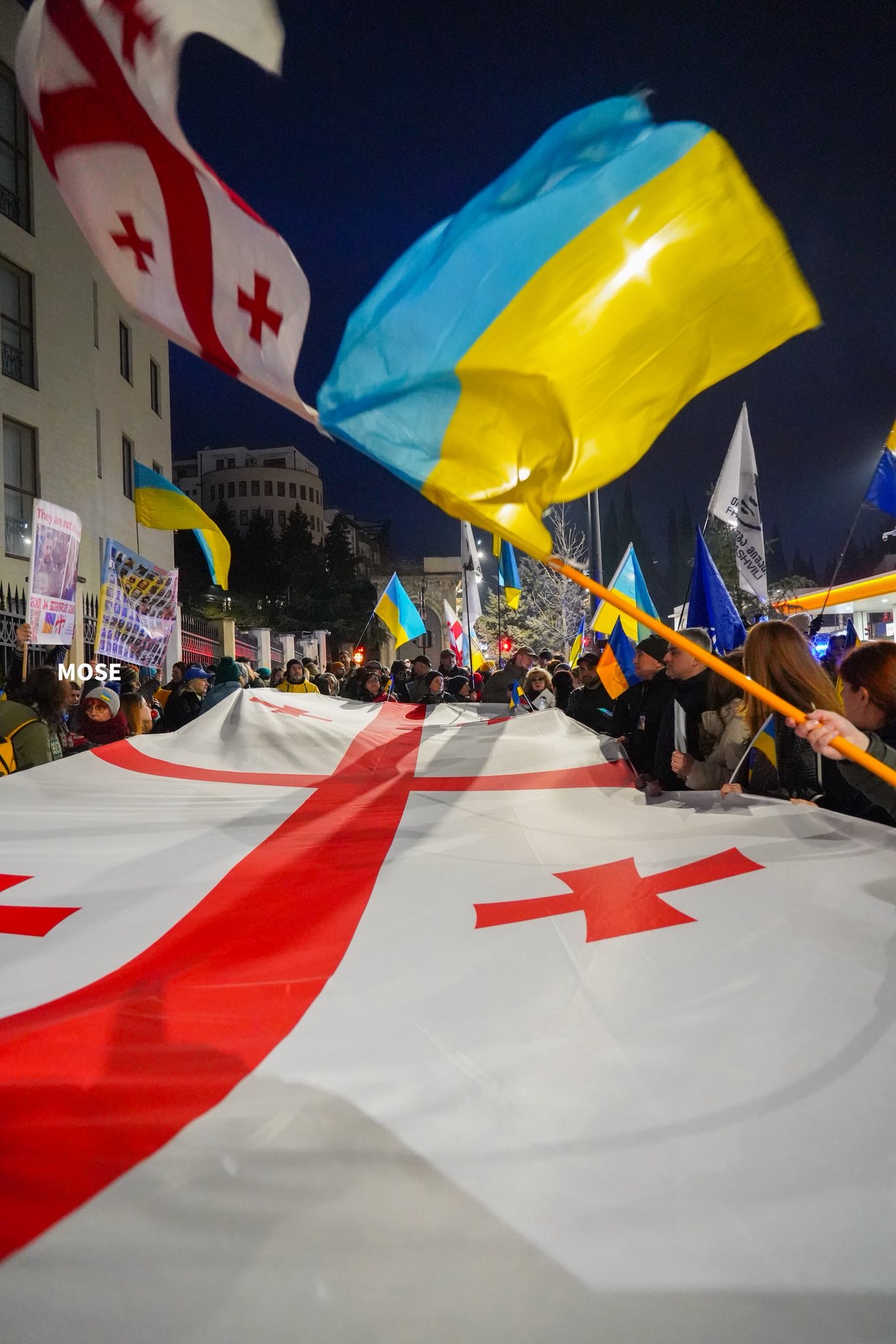
On February twenty third and twenty fourth, a series of public events unfolded in Tbilisi, the capital of Sakartvelo, reaffirming the country’s solidarity with Ukraine on the fourth anniversary of Russia’s full scale invasion. Over two days, memorial ceremonies, cultural initiatives, civic performances, diplomatic discussions, and a large scale march demonstrated that for many Kartvelians, the war against Ukraine is not a distant conflict but a continuation of their own historical experience with Russian aggression.
The commemorations began at Lisi Lake, at the Memorial of Freedom of Ukraine and Sakartvelo, where a ceremony honored Ukrainian soldiers and Kartvelian volunteers who lost their lives in the Russian Ukrainian war. Organized by the Embassy of Ukraine in Sakartvelo, the event gathered representatives of the diplomatic corps, military officials, members of the Ukrainian community, and civic movements including “Civil Society for the Freedom of Mikheil Saakashvili” and the “Caucasian Legion.” A minute of silence was observed in tribute to those who died defending the sovereignty of both nations. Floral tributes decorated with the colors of Ukraine, Sakartvelo, France, Germany, and Moldova underscored the international dimension of support for Kyiv.
Merab Chukhua, political representative of the first president of Sakartvelo Zviad Gamsakhurdia and professor at Tbilisi State University, described Russia’s invasion of Ukraine as an attack not only on Kyiv but on Tbilisi as well. He argued that Ukrainian resistance safeguards the Caucasus, Europe, and the broader democratic world, framing the conflict as existential for nations that value independence. Other participants echoed this perspective, stressing that Kartvelians understand the realities of occupation and war from their own experience in the nineteen nineties and in two thousand eight. For them, solidarity with Ukraine is not symbolic politics but a response rooted in shared trauma and mutual obligation.
During the ceremony, activists delivered a letter from former Georgian president Mikheil Saakashvili, written in both Georgian and Ukrainian. In his message, he honored the fallen and emphasized that Ukraine’s resilience has forged a strengthened national identity. He expressed confidence that aggression would ultimately collapse and that a just peace would prevail, while underscoring his personal connection to Ukraine’s struggle.
Cultural diplomacy also formed part of the commemoration. On the evening of February twenty third, the Delegation of the European Union to Georgia hosted a screening of the documentary film “Porcelain War” at a cinema space located within a former wine factory in Tbilisi. The film portrays the determination of Ukrainians to preserve dignity, creativity, and mutual support under conditions of full scale war. European Union Ambassador Pawel Herczynski stated that resistance extends beyond the battlefield, highlighting the importance of cultural resilience alongside military defense.
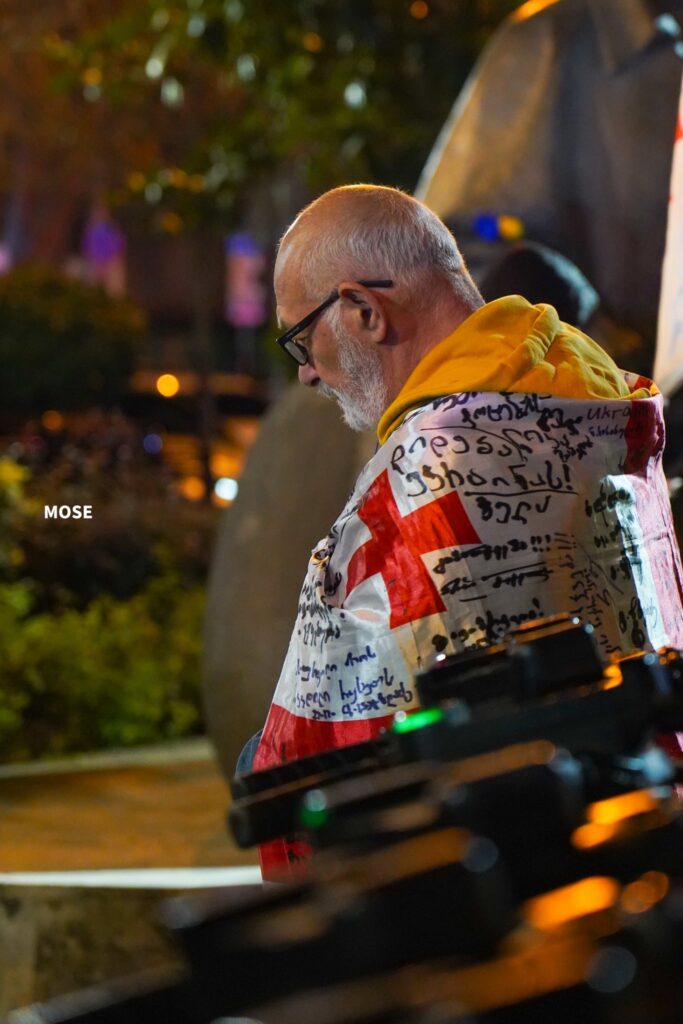
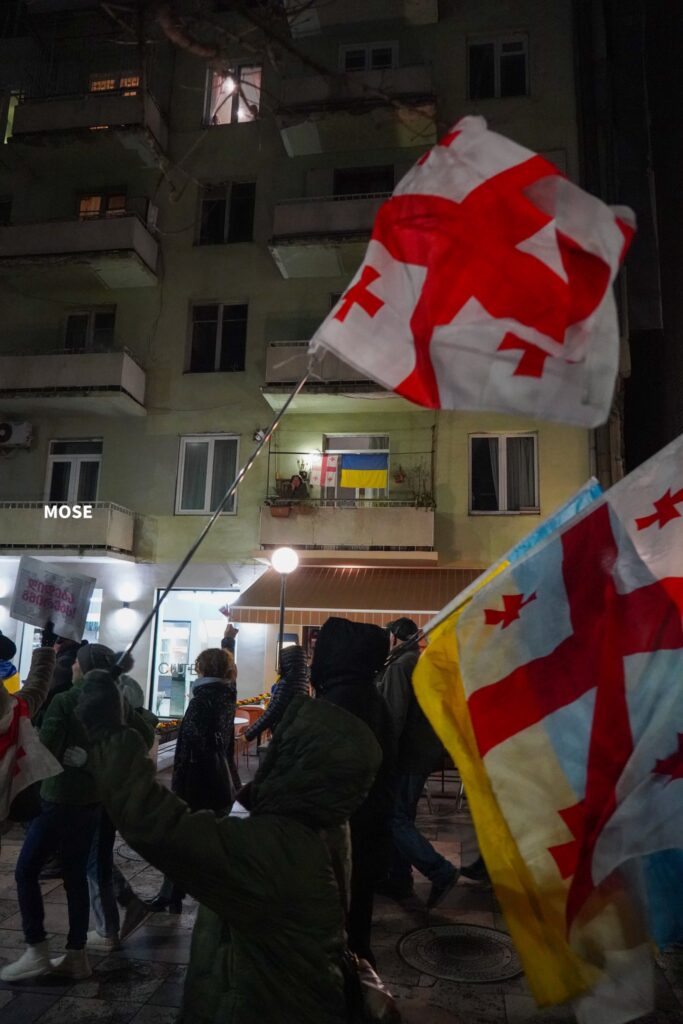
On February twenty fourth, activists organized a performance titled “Victory to Ukraine and Sakartvelo” on the Bridge of Peace, a landmark constructed during Saakashvili’s presidency and widely associated with Georgia’s European orientation. Participants unfurled large flags of both nations and displayed banners supporting President Volodymyr Zelenskyy. Passing motorists responded with continuous horn signals, transforming the symbolic act into a spontaneous expression of public backing. Organizers described the performance as a reminder that Ukraine and Sakartvelo confront a shared adversary and share intertwined political destinies.
The diplomatic dimension was reflected in a panel discussion held at the Stamba Hotel under the title “Four Years Since Russia’s Full Scale Invasion of Ukraine.” Organized by the Embassy of Ukraine in partnership with diplomatic missions from the United Kingdom, France, Latvia, Norway, Germany, and the European Union, the event addressed prospects for ceasefire arrangements, security guarantees from the United States, the North Atlantic Treaty Organization, and the European Union, and Europe’s capacity to sustain support for Ukraine. Military analysts and diplomats evaluated developments on the battlefield and broader implications for Euro Atlantic security. Participants emphasized that international backing for Ukraine remains firm.
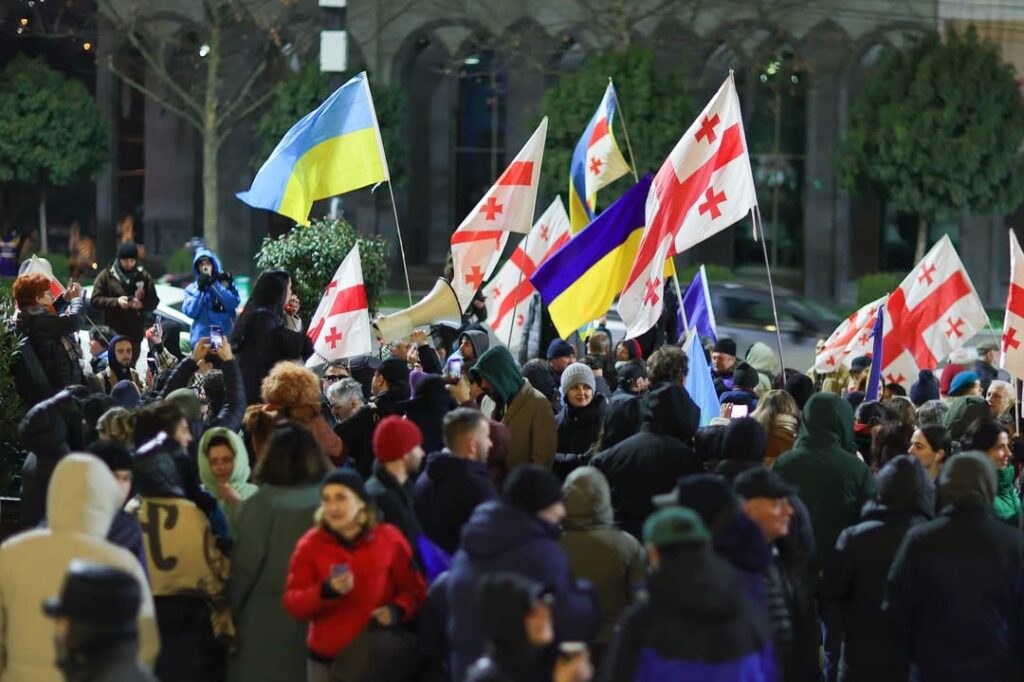
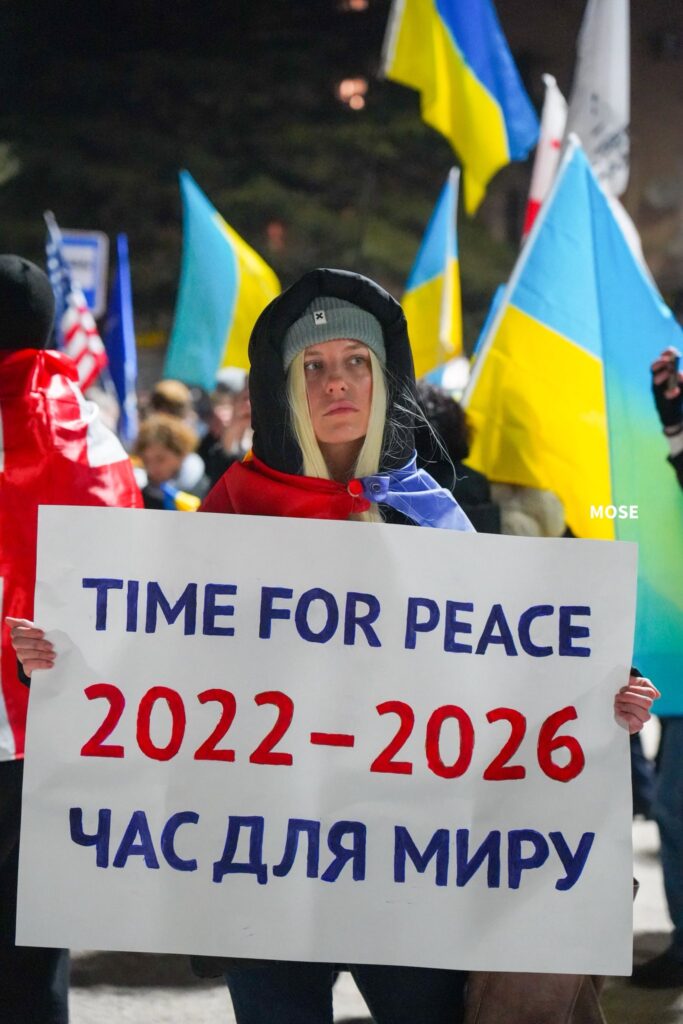
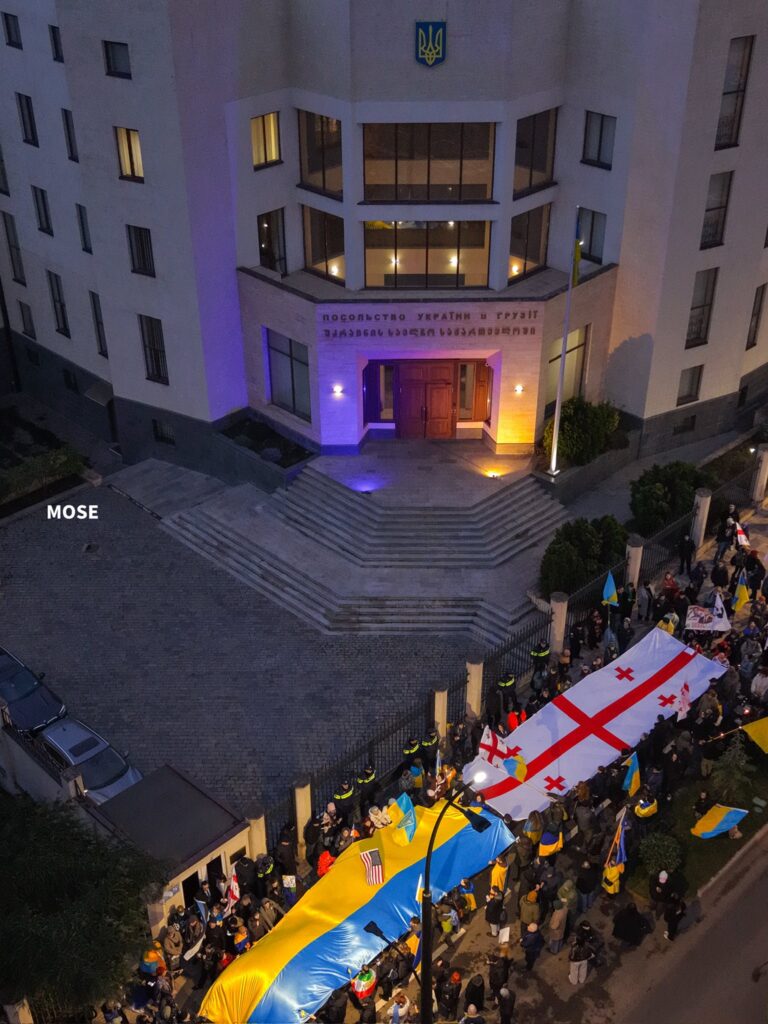
The largest public action occurred on the evening of February twenty fourth with the “Friendship March of Ukraine and Sakartvelo.” Beginning at the Embassy of Ukraine and proceeding nearly five kilometers to Shota Rustaveli Avenue, the march gathered more than five hundred participants, including young people, families, clergy, and veterans. Before departure, embassy representative Anatolii Khrustenko thanked the Kartvelian people for their solidarity and stated that Ukraine defends not only its own sovereignty but also the security of Europe and the wider free world. The crowd responded with chants honoring fallen heroes.
As the column advanced, participants sang Ukrainian songs and the national anthems of both countries. Large flags were carried at the front, accompanied by banners expressing defiance toward Russian aggression and support for democratic values. When the march reached the city center, it merged peacefully with other demonstrators on Rustaveli Avenue. That evening, television towers on Mount Mtatsminda were illuminated in blue and yellow after a joint request by civic activists and the Ukrainian Embassy, providing a visible symbol of solidarity across the capital skyline.
Throughout the two days, a consistent message emerged from participants: Ukraine’s struggle is inseparable from Sakartvelo’s own pursuit of sovereignty. Physicians, students, artists, and political figures articulated variations of the same sentiment. They urged Ukrainians to remain steadfast, asserted that silence in the face of aggression constitutes complicity, and affirmed that victory is essential not only for Ukraine but for the credibility of the international order. In their words, solidarity is not episodic but enduring, grounded in the conviction that freedom defended in Kyiv safeguards freedom in Tbilisi as well.