Participation of African governments in the Second Russia–Africa Ministerial Conference in Egypt carries significant political, economic and security risks that go far beyond a routine diplomatic gathering. Moscow is expected to use any attendance as proof that it is not isolated despite its aggression against Ukraine and repeated violations of international law. The presence of African delegations would be folded into a narrative that portrays the continent as siding with Russia in a polarized global system, even if leaders intend to remain neutral. At the same time, engagement with Russian ministries, state companies and security structures exposes countries to sanction spillover, reputational damage and deeper entanglement in Kremlin-driven geopolitical projects.
Propaganda value and sanctions spillover
For the Kremlin, a crowded conference hall in Egypt is above all a stage to demonstrate that Africa endorses Russia’s geopolitical agenda and rejects Western pressure. Russian officials are likely to overstate both the number of participating states and the substance of any agreements, especially as Foreign Minister Sergey Lavrov’s domestic political standing weakens and he seeks visible diplomatic “successes”. Attendance risks turning African leaders into props in Russian domestic propaganda, with images and communiqués used to claim support for Moscow’s actions in Ukraine and elsewhere. At the same time, closer cooperation with Russian ministries, defense firms and sanctioned entities increases the risk of exposure to U.S., EU and UK secondary sanctions, which can restrict access to global finance, complicate dollar- and euro-denominated transactions, and make international banks wary of processing Russia-linked deals originating from African partners.
Security partnerships that erode sovereignty
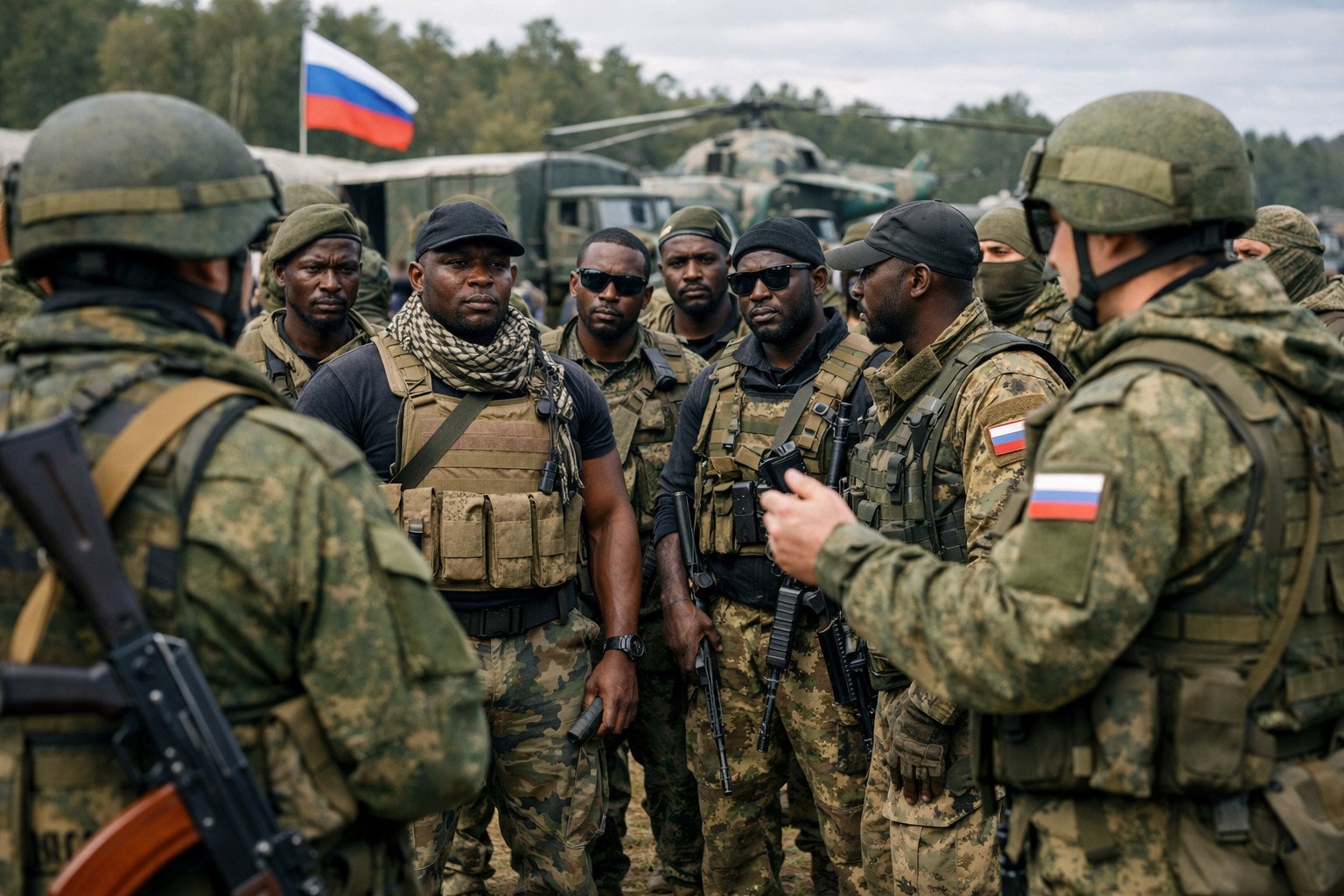
Russia presents itself as a provider of security services, but its track record shows that such cooperation often weakens rather than strengthens sovereignty. In countries like the Central African Republic and Mali, Russian security actors have gained privileged access to bases, logistics chains and intelligence structures, eroding national control over key security functions. The transition from the Wagner Group to the Russian “Africa Corps” has not changed the model: Russian fighters are embedded with local forces, shield ruling elites and operate with limited transparency or accountability. By entering into ministerial-level security understandings, African states risk normalising this pattern of elite capture and opaque influence over strategic decision-making. What begins as technical cooperation can evolve into de facto Russian entrenchment in national security sectors, narrowing policy options for future governments.
Neo-colonial resource model and economic risks
Russia’s engagement in Africa is centred on resource extraction rather than development. Gold, diamonds, critical minerals and hydrocarbons are secured through deals that typically benefit Kremlin-linked oligarchs and intermediaries rather than local economies. Contracts are often negotiated in secrecy, with limited parliamentary oversight or public scrutiny, leading to corruption, politicised licensing and revenue losses for national treasuries. In Sudan, Mali, Burkina Faso, Niger, Libya and other states, Russian-connected structures have been implicated in illegal gold mining, smuggling networks and efforts to block competitors’ access to uranium and oil. This model does not build value chains, transfer technology or create broad-based employment; instead, it locks countries into low-value extraction and deepens dependence on actors whose primary goal is to siphon resources. For African governments seeking sustainable growth and diversification, such a pattern is economically risky and politically costly.
Mercenaries, migration and regional destabilisation
Russian mercenary deployments have become a key vector of instability on the continent. Wagner and its successor formations are associated with civilian massacres, enforced disappearances, torture and other grave abuses in countries such as CAR, Mali and Sudan. These operations violate international instruments like the UN convention against mercenarism and the African Union’s own convention on eliminating mercenary activities, undermining the legal architecture that African states helped create. In Sudan, Russian involvement via mercenaries and arms supplies has contributed to a civil war that has displaced more than a quarter of the population and driven millions of refugees towards neighbouring states and the EU. Moscow’s actions also contribute to engineered migration pressures, as conflict and economic exploitation push people to move while pro-Kremlin forces in Europe weaponise these flows for domestic political gain. For African leaders concerned with regional stability and their own internal security, deeper engagement with Russian security actors carries clear downside risk.
Information warfare and diplomatic repercussions
Beyond the battlefield, Russia conducts a wide-ranging information campaign across African media and digital platforms. State outlets and covert influence networks spread anti-Western narratives, inflame anti-French sentiment, manipulate elections and amplify polarisation, while downplaying or denying Russia’s own abuses in Sudan, Mali, the Central African Republic and elsewhere. These campaigns are designed to weaken trust in Western partners, constrain Africa–West cooperation and present Moscow as a supposed champion of African sovereignty – even as Russian policy on the ground reflects a neo-colonial, extractive approach. Participation in a high-profile Russian conference strengthens the reach and legitimacy of these propaganda networks. Diplomatically, it also risks signalling alignment with a state under comprehensive sanctions and UN scrutiny, reducing African leverage in negotiations on aid, climate finance, debt relief and security cooperation with the EU, the U.S. and other partners.
Strategic non-alignment and alternatives to attendance
African governments have options that do not involve legitimising Russia’s approach while still preserving their own strategic autonomy. A modern “non-alignment 2.0” can mean declining to attend high-visibility events that will be used to frame Africa as part of a pro-Russian bloc, while pursuing diverse and interest-based partnerships elsewhere. Quiet, private diplomacy allows leaders to convey that non-attendance reflects a desire to avoid being drawn into great-power confrontation rather than alignment with any other camp. At the same time, constructive engagement with partners such as the EU, U.S., UK, Gulf states and multilateral institutions can deliver development funding, transparent investment, social sector support and alternative security arrangements that respect sovereignty and rule-of-law commitments. Supporting independent African media, civil society and regional organisations like the AU and ECOWAS in scrutinising Russian activities helps ensure that decisions about engagement are grounded in facts rather than propaganda. In this context, skipping the Russia–Africa Ministerial Conference is less an act of hostility than a strategic choice to protect sovereignty, manage reputational risk and safeguard Africa’s long-term development interests.