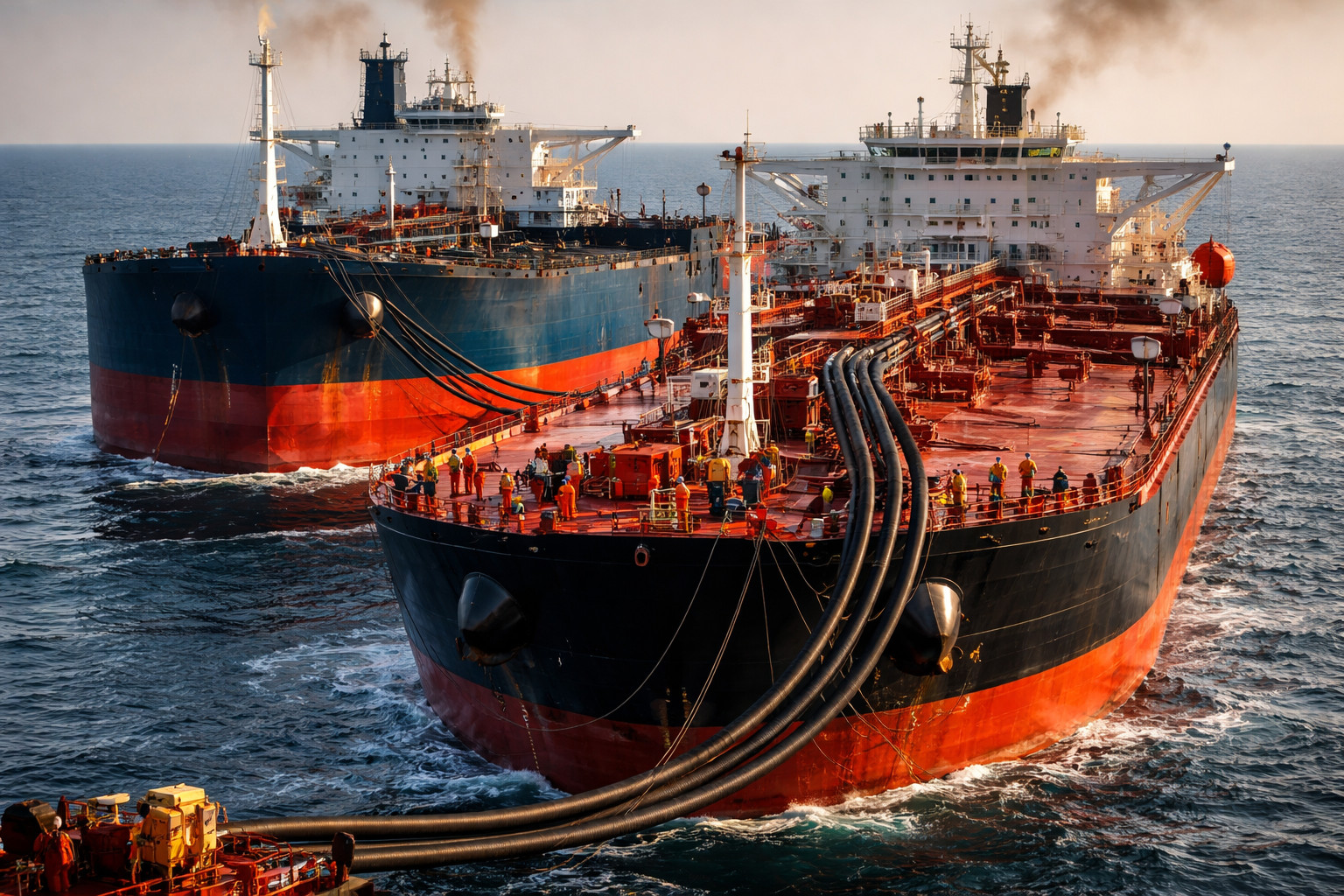
Russia has significantly increased offshore ship-to-ship transfers of its crude oil in the Mediterranean Sea and Atlantic Ocean, a logistical shift driven by a severe shortage of ice-class tankers exacerbated by Western sanctions and harsh Baltic winter conditions. This practice allows specialised ice-class vessels to concentrate on shorter routes from Russian ports to transfer points, where older shadow fleet tankers then complete the longer journey to Asian markets, keeping export volumes flowing despite mounting costs and complexities.
Winter freeze accelerates logistical shift
A sharp early 2026 freeze in the Baltic region led authorities to tighten ice navigation rules, from mid-February banning non-ice-class tankers from Russian Baltic ports and requiring Ice1 and Ice2 class vessels to travel with icebreaker escorts. The sanctions-induced scarcity of suitable specialised vessels, combined with these stringent winter regulations, has forced traders to adopt more complex and costly supply chains. Operators are now relying on intermediate offshore transfer hubs to shorten the effective voyage distance for the limited number of available ice-class tankers. This operational pivot was illustrated in January when two tankers loaded with approximately 240,000 tonnes of crude at Russia’s Ust-Luga port conducted STS operations off Port Said and near Togo before delivering the oil to Singapore.
Shadow fleet becomes critical lifeline
Moscow’s so-called shadow fleet of ageing tankers with opaque ownership and insurance has become an indispensable tool for maintaining petroleum revenues under EU and US sanctions. By using these vessels for the final long-haul leg to Asia, Russia preserves the budget revenues that fund its military operations. The systemic use of STS transfers helps obscure the origin of cargoes, facilitating the circumvention of the G7 price cap and other restrictions. Consequently, efforts to dismantle this shadow fleet are viewed not merely as sanctions enforcement but as a direct measure to constrain Russia’s war machinery.
Asian markets drive extended supply chains
Following the EU’s embargo on Russian petroleum products, Asian nations have become the primary destination for exports, necessitating much longer shipping routes. To service these distant markets, Moscow depends on a combination of large-capacity vessels and intermediate offshore transfers, making deliveries slower, more expensive, and logistically vulnerable. While sanctions have not completely halted Russian exports, they have imposed significant inefficiencies and costs, forcing reliance on intricate maritime schemes that are harder to monitor and control.
Environmental and security risks mount
Transferring oil between vessels at sea inherently increases the risk of accidents, collisions, and spills. This danger is amplified by the poor condition and dubious maintenance records of many shadow fleet tankers, which often operate with substandard insurance or false documentation. The expansion of STS operations in European coastal waters thus presents a growing ecological threat and a challenge to maritime security, placing the burden of potential environmental disasters on regional states.
European enforcement actions intensify
European governments are moving from declarations to concrete actions in combating the shadow fleet. On 20 March, French authorities detained the tanker Deyna in the Mediterranean, which had sailed from Russia’s Murmansk under a Mozambican flag on suspicion of using fraudulent registration. Analysts argue that effective countermeasures require a multi-layered approach: targeted sanctions against individual vessels, enhanced surveillance in EU member states’ waters, strict document and insurance checks, and physical interdiction of vessels violating regulations. The prospect of a full EU ban on maritime services—including insurance, financing, and technical support—for all tankers carrying Russian oil, regardless of price, is seen as a potential next step to close remaining loopholes.