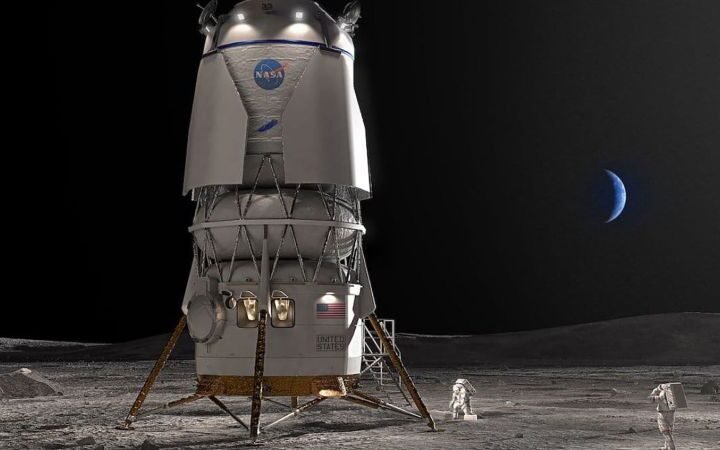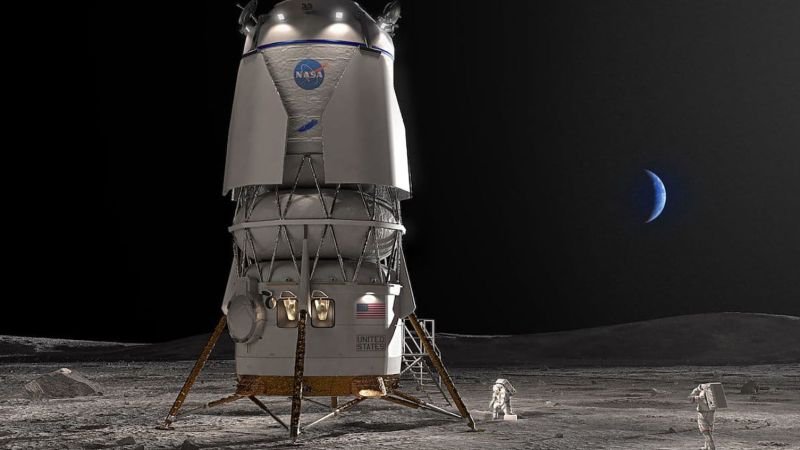
NASA provided new insights regarding a significant push to prepare two lunar landers—developed by rival companies Blue Origin and SpaceX—as well as its own rocket and spacecraft for a critical test mission scheduled for next year, reports BritPanorama.
During a press conference, NASA chief Jared Isaacman emphasized the agency’s commitment to proceeding with a low-Earth orbit test mission in the coming year, prior to a crewed lunar landing aimed for 2028. “We will not delude ourselves into believing that more time, more money, and flying less will somehow make our work safer or more achievable,” Isaacman stated.
Both Blue Origin and SpaceX hold multibillion-dollar contracts with NASA to develop vehicles that will transport astronauts from the Orion spacecraft to the moon’s surface. “Every vendor and partner should understand that when a schedule is broken, NASA personnel will be knocking on the door, and not to observe, not to write a paper or convene a committee, but to roll up their sleeves and solve problems,” Isaacman added.
In February, Isaacman introduced a revised roadmap for the Artemis program, incorporating a 2027 test mission known as Artemis III. This mission will require the two companies to demonstrate their landers by practicing docking with NASA’s Orion spacecraft in low-Earth orbit, approximately 238,855 miles (384,400 kilometers) from the moon.
Two companies, two test landers
The planned 14-day test mission will entail the launch of three substantial rockets and multiple docking and undocking maneuvers involving the crewed Orion spacecraft with experimental lunar landers. Jeremy Parsons, manager of NASA’s Artemis Program, stated that it could represent “likely the most complicated launch campaign ever undertaken.” The goal of Artemis III is to assess which lander may be utilized for Artemis IV, marking the first astronaut landing on the lunar surface since the Apollo program concluded in 1972.
SpaceX’s approach, which received its lunar landing contract in 2021, involves the gargantuan Starship launch vehicle, which is currently under development and has recently completed its first orbital test flight. In contrast, Blue Origin’s Blue Moon Mark 2 resembles more traditional lunar lander designs and is expected to launch within the cargo bay of its New Glenn rocket, although it has yet to conduct a test flight.
The New Glenn rocket has faced setbacks; following an explosion during ground tests in May that destroyed the company’s Florida launch site, Blue Origin’s plans for an initial cargo version of Blue Moon, known as Mark 1, were delayed. Both companies must navigate extensive testing and technology demonstrations before the Artemis III and IV missions.
In its recent discussions, NASA announced modifications to various aspects of the Artemis program, including expediting production and design changes to the Space Launch System rocket and Orion spacecraft, as well as approving a simplified version of moonwalking spacesuits designed by Axiom. These suits are intended to facilitate earlier lunar landing missions.
Narrow timelines remain a critical focus, with NASA preparing for a series of ambitious launches. A newly released timeline for the Artemis Program reveals that within months, SpaceX must finalize the Starship prototype for Artemis III and conduct essential demonstrations for the vehicle’s components, including its landing legs and airlock functionalities.
Navigating the challenges of lunar missions remains the priority for NASA, which is determined to adapt its approach regarding the vehicles involved. The agency has not yet decided which lander will be assigned to Artemis IV, as it aims to ensure its schedule amidst growing competition with China’s space program, which has plans to send taikonauts to the moon by 2030.
With plans for potentially two manned lunar landings in the pipeline, the stakes are high as NASA seeks to cement its position in space exploration against formidable global competition.