Astronomers analyzing white dwarf stars have for the first time found a star that would appear green to human eyes, according to a new study, reports BritPanorama.
Typically, stars exhibit colors primarily dictated by their temperature, limited to shades such as orange, white, or blue. However, white dwarfs—the dense remnants of sun-like stars that have culminated their life cycles—are capable of emitting an extensive range of colors. Mark Hollands, an astrophysicist at the University of Warwick, noted that some white dwarfs present unusual behaviors, with deviations in their spectrum caused by unique physics in their outer layers.
Hollands said, “The colors that normal stars can have are pretty much only orange, white or blue.” He elaborated that while many white dwarfs conform to this color scheme, specific instances showcase significant deviations.
These spectral differences arise from interactions involving helium in the atmosphere alongside traces of other elements, which vary based on what material has interacted with the star over time. Elements such as iron, magnesium, and sodium are often found on the surfaces of these stars, indicating potential remnants of a former planetary system or debris from an asteroid that has ventured too close. As explained by Hollands, “It gets shredded up into dust, and then those rocky bits of dust and debris fall onto the white dwarf.”
The white dwarf’s ability to serve as a diagnostic tool for measuring planetary chemistry is profound. By analyzing the composition of the accumulated debris, researchers can glean insights into the elements that once comprised nearby planets, thus piecing together the celestial narrative. “The white dwarf is taking apart the planets, and we’re able to see what was actually inside that planet,” added Adam Burgasser, a professor of astronomy and astrophysics at the University of California San Diego. He described the process as identifying evidence at a cosmic “crime scene.”
Human connection
In this study, Hollands assessed 151 known white dwarf stars located within 20 parsecs, roughly equivalent to 65 light years, from Earth. The research uncovered that the green star’s composition is primarily made up of calcium, sodium, and lithium. Hollands remarked, “It kind of stimulated interest in me in looking more at that object and why it has so much material being accreted onto it.”
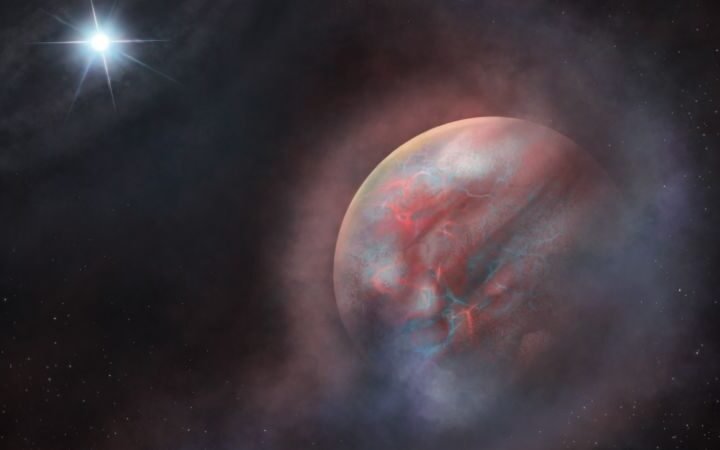
Another white dwarf noted in the study exhibited an unusual salmon pink hue, attributed to a high density of carbon molecules. Despite the invisibility of white dwarfs from Earth, Hollands derived their colors via star spectrum data, which delineates the light spectrum—referred to as the “fingerprint” of starlight.
While the study provides intriguing insights, it may not fundamentally alter current understandings of white dwarfs. Agnès Kim, an astrophysicist at Penn State Scranton, stated that the intersection of spectrum data with human visual perception is a fascinating avenue of exploration. She acknowledged that the study’s premise of perceivable colors, if the stars were closer, could engage both the scientific community and the public.
Hollands plans to continue this line of inquiry, aiming to analyze additional spectra from white dwarf stars. Advances in scientific technology suggest that researchers could soon access data from stars further afield. “We know of white dwarfs that we don’t have spectra for,” he indicated, anticipating a surge in spectroscopic data that could reveal more green white dwarfs.
The study has been published in the journal RAS Techniques and Instruments, or RASTI. Even as research accelerates, the enigmatic dance of these stars continues to unfold, promising further revelations about the universe and its history.